Locating the source of a mysterious beep with Claude
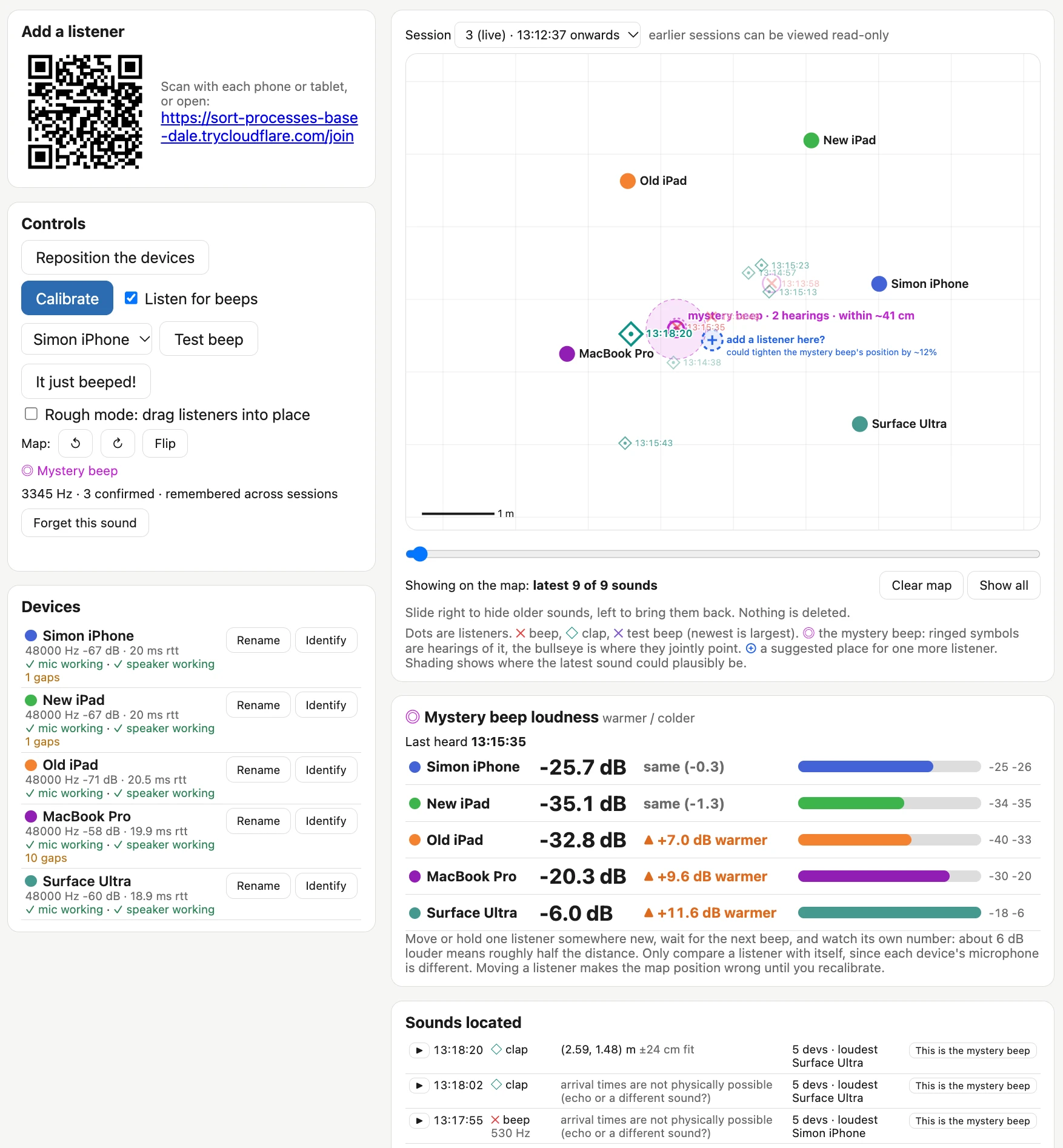
Simon Willison built a small system called Beep Locator to track down an intermittent beeping coming from a cluttered box room, and the result pinpointed the source to within roughly 40cm. It turned out to be an old carbon monoxide detector whose batteries needed replacing. The work was done with Claude Code, starting on an iPhone against an empty GitHub repository and later continued on a laptop, where the beeping was found after digging through one specific pile of boxes.
The system is not a single app but a small coordinated network. A Python web server hosts the main interface; other devices join through a URL or QR code and become listeners. Willison used two iPads, a phone, a MacBook Pro and a Surface Ultra, each granting browser microphone access and connecting back over WebSockets. Each listener keeps a rolling 60-second audio buffer and runs a simple beep detector, implemented in JavaScript in a file called detector.js, which uses a Fast Fourier Transform plus a high-pass filter to flag likely beeps. Those detection events are reported to the server.
Alignment is the interesting part. When a beep is reported, the server picks the device with the lowest round-trip time to the server and has it play a short chirp. Every listener then uploads a clip spanning roughly 0.6 seconds before the beep to 0.8 seconds after the chirp. That shared chirp gives the server a common reference point to line the recordings up, which is what makes triangulation possible across devices whose clocks and start times differ.
Willison initially hoped the listeners could locate each other purely by playing sounds to one another, but that approach did not work particularly well. The fix was a "Rough mode" where listener icons are dragged to approximate positions on a map, after which the sound-based estimates refine them. A clapping mode provided a way to validate the setup: clap in a spot, and the clap appears as a diamond on the map, distinct from the X that marks a beep. Beeps also appear in a sounds-located log with timestamps. Each entry has a play button that replays the recorded snippet from each listener in turn, with on-screen text naming which device captured which clip, temporarily muting live recording during playback. Once a recording is confirmed with a "This is the mystery beep" button, the system listens for that frequency, measures the interval between beeps and uses the accumulated triangulated positions to settle on the most likely location.
Later features were added by asking for them conversationally while the server ran: draggable rough positions, per-symbol HH:MM:SS timestamps, the replay-and-confirm workflow, a reposition step that lets an operator shift listeners around a suspected point and restart without touching each device, and a map marker suggesting a good spot to place a spare listener based on data collected so far. The prior session could be reviewed read-only through the app.
Underpinning the design is a 2007 paper, BeepBeep: A High-Accuracy Acoustic-Based System for Ranging and Localization Using COTS Devices, by Chunyi Peng, Guobin Shen, Yongguang Zhang, Yanlin Li and Kun Tan. It describes acoustic ranging that needs only a speaker, a microphone and device-to-device communication, with accuracy coming from two-way sensing, self-recording and sample counting. Claude surfaced that paper while drafting an initial problem statement. That is a sensible starting point for this kind of project: acoustic time-of-flight localization is well understood, and the hard parts in practice are clock alignment across independent consumer devices and mapping arbitrary device positions into a shared coordinate space.
The broader point Willison draws is about giving coding agents senses. Claude has no native audio input, but it can write and run code that analyzes microphone captures, and the server-to-listener WebSocket link included an installModule() method left over from the initial build that lets the admin server push fresh JavaScript to connected clients. That hot-swap matters because on some devices a page listening on the microphone re-prompts for permission on every reload; pushing code avoided touching each device by hand. So the agent could query audio logs, adjust the detector, and reconfigure its own input without human intervention per device. He compares it to a story from GitHub Universe, where Martin Woodward pointed a webcam at badge computers under test so his coding agent could judge whether updates worked.
This suggests a reusable pattern for anyone working with coding agents: build a feedback channel the model can read, and a deployment path it can write to, then let it iterate. A likely trade-off is that arbitrary remote code execution on listening clients is convenient precisely because it is dangerous; here it was safe because every device belonged to the author, but the same mechanism would need authentication and scoping in any multi-user setting. Accuracy of about 40cm in a small room is plausible for acoustic ranging at these distances, though it depends on sample rates, reverberation and how well the chirp aligns. A pile of boxes is far more forgiving than a noisy open-plan space.
Why it matters: this is a convincing demonstration that agent-assisted development can extend beyond writing code into building a bespoke measurement instrument, then using it to answer a physical question. Developers working on location-aware products or multi-device audio can read it as a template for browser-based acoustic localization built from commodity hardware. The agent-perception angle is likely the more transferable idea: teams that give coding agents live sensor feedback and a way to push code to remote clients may find the loop of propose, measure, adjust becomes the real product of the exercise.
Based on reporting from the original publisher. Visit the source for full context and later updates.
Publisher excerpt
Our house has a box room, full of boxes that we still haven't unpacked from our last move. A couple of weeks ago something in that room started intermittently beeping . The beeps were far enough apart that standing in the room and trying to determine the source of the noise was frustrating, and I really didn't want to dig through every one of those boxes. So I had Claude Code build Beep Locator , a software system for triangulating the source of a mysterious beep using multiple devices scattered around the room. He