An Opinionated Guide to Using AI Right Now
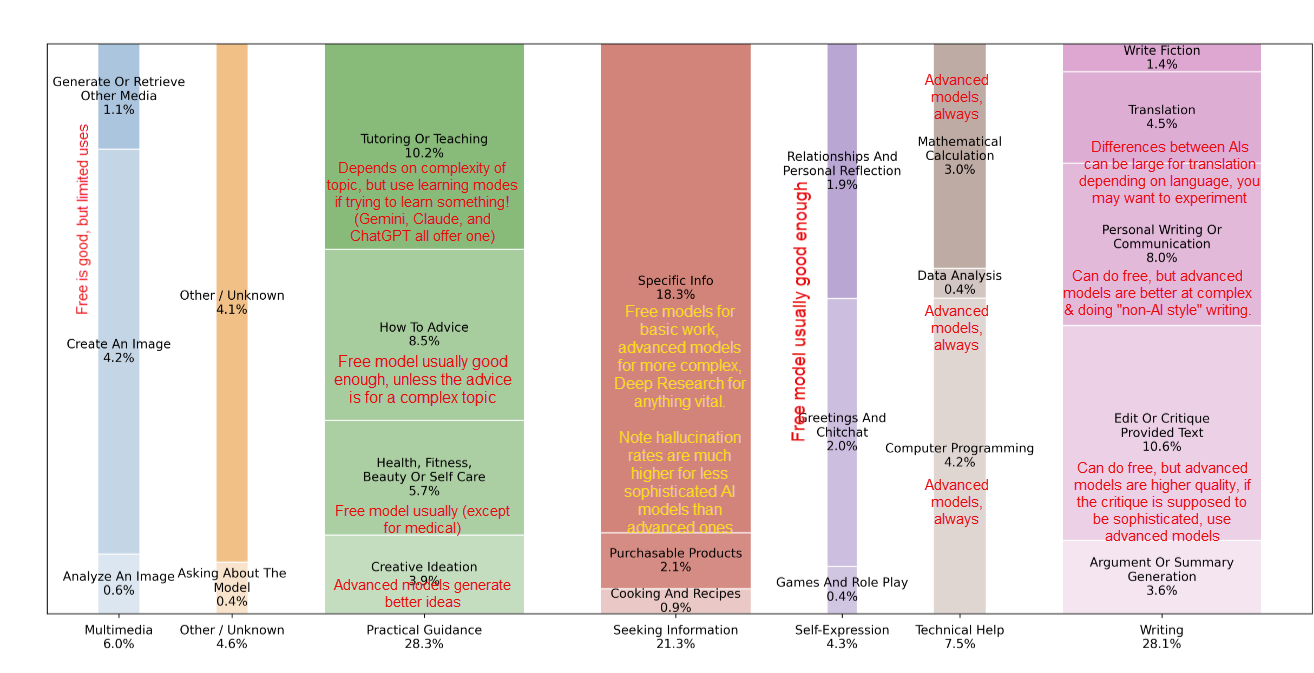
An opinionated guide to using AI, published by One Useful Thing, states that roughly 10% of humanity now uses AI on a weekly basis, and that the vast majority of that use involves free AI tools.
The guide cites a recent OpenAI breakdown of what people actually use ChatGPT for, describing it as showing less casual chat than expected and more information-seeking. The author says this data allowed advice based on real usage patterns rather than hunches, and annotated OpenAI's chart with suggestions on when to use free versus advanced models.
The guide lists four most advanced AI systems: Claude from Anthropic, Google's Gemini, OpenAI's ChatGPT, and Grok by Elon Musk's xAI. It also names open weights AI families that it says are almost but not quite as good: Deepseek, Kimi, Z and Qwen from China, and Mistral from France. According to the guide, variations on these models take up the first 35 spots in almost any AI rating system, and other services including Microsoft Copilot and Perplexity are powered by one or more of these nine AIs as a base.
The guide says some free systems, such as Gemini and Perplexity, do a good job with web search while others cannot search the web at all, and that Gemini is the best free option for image creation, with ChatGPT and Grok as runners-up. It notes that the systems differ in privacy policies, levels of access, capabilities, approaches to ethical issues and personality, and that these fluctuate over time.
For paid use, the guide describes tiers of $20 or around $200 per month, saying the $20 tier works for most people while the $200 tier is for complex technical and coding needs. It says users choosing the $20 tier should pick among Claude, Gemini and ChatGPT, which offer advanced, agentic and fast models, voice mode, image and document viewing, code execution, mobile apps, image and video creation (Claude lacking in this area) and Deep Research.
It adds that Grok has some of the most powerful models and is rapidly adding features but has not been as transparent about product safety as some other companies, and that Microsoft Copilot can make it hard to control which models are used and when. The guide distinguishes chat models, generally free and best for conversation; agent models, slower but able to autonomously carry out multiple steps; and wizard models, which take very long and handle complex academic tasks. For real work, it suggests agent models are more capable and consistent and less likely to make errors, while noting all AI models still have a lot of randomness and may answer differently to the same question.
Based on reporting from the original publisher. Visit the source for full context and later updates.
Publisher excerpt
What AI to use in late 2025