Keep inference running through regional capacity shortfalls with cross-Region inference routing in Amazon SageMaker AI
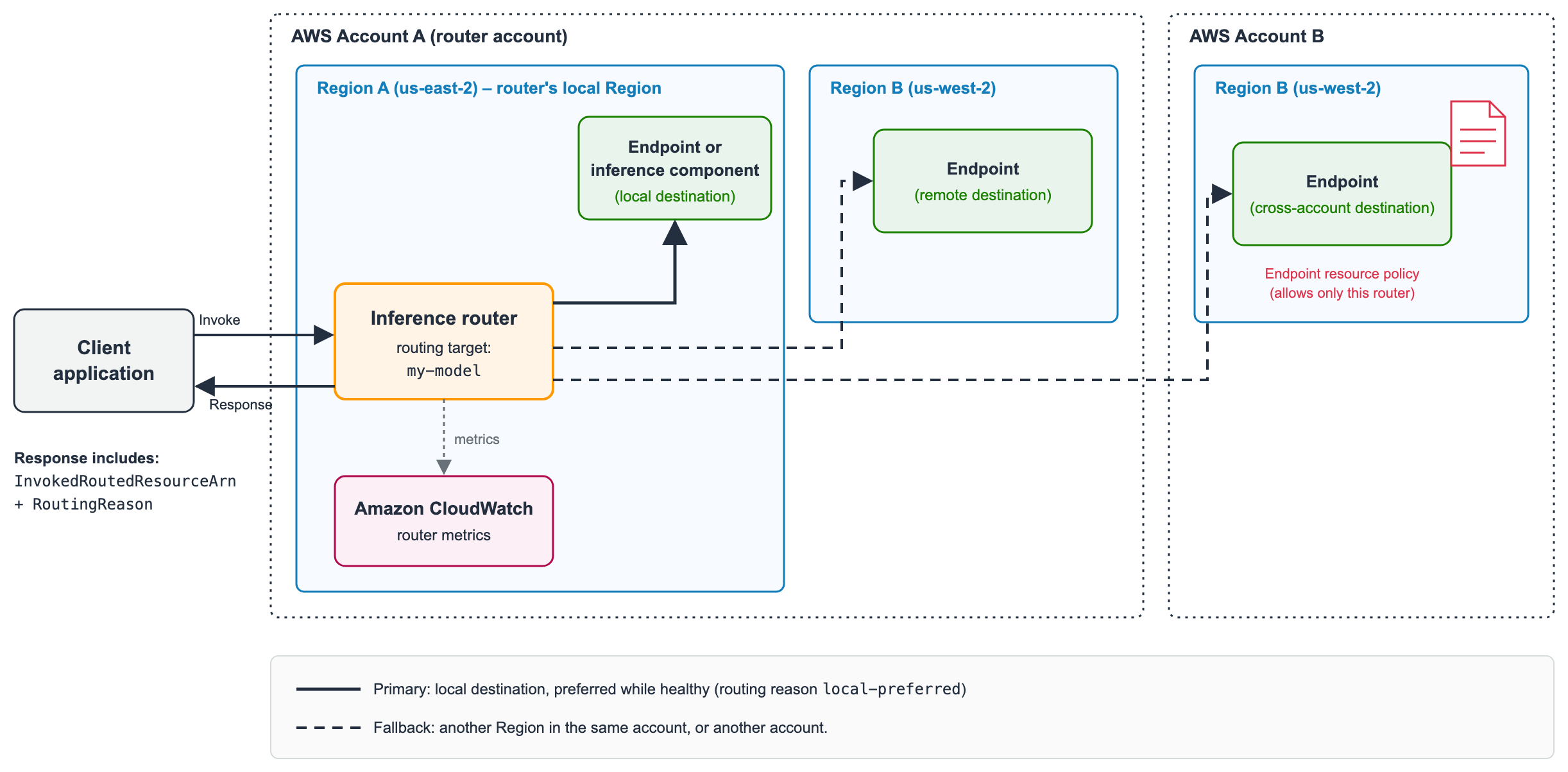
AWS has added cross-Region inference routing to Amazon SageMaker AI, a managed capability that moves inference traffic between AWS Regions and accounts when a local endpoint cannot keep serving reliably. Until now, teams running models on SageMaker AI managed endpoints had to build that routing themselves. The new feature centers on a resource called an inference router, a regional object in the customer's account that applications invoke in place of a specific endpoint.
Setup works through registration. For each model, the operator lists the endpoints and inference components the router may use, and the application calls the router. The router keeps requests in its own Region while the local destination is healthy, shifts new requests elsewhere when it is not, and brings traffic back gradually once the failure clears. Endpoints themselves are deployed as before, with the same models, configurations, instance pools and autoscaling, and direct InvokeEndpoint calls keep working.
The vocabulary is worth fixing in mind. A routing target is a name for one logical model on a router, such as fraud-model; a router can hold several targets, and each fails over independently. A destination is a real-time endpoint, inference component or asynchronous endpoint registered under a target, identified by its full Amazon Resource Name, which carries its Region and account. The region where the router is created is its local region, and a target holds either real-time destinations, mixing endpoints and inference components across regions and accounts, or asynchronous endpoints only. Importantly, the router creates no capacity, scales nothing, deploys no models and copies no artifacts; every destination must already be running.
Routing decisions rest on a health score per destination, computed from recent requests measured in that destination's own Region. Server errors, throttles and timeouts depress the score, with SageMaker AI platform errors such as a failed health check weighing most heavily. Request-level faults like invalid input do not count, since they would fail anywhere. Latency is not an input, so an endpoint that keeps answering successfully keeps its traffic. Signals such as failed instance launches or an endpoint running below its autoscaling target speed up the reaction, but only after failures begin. Health is published to Amazon CloudWatch in three states: healthy, overloaded (serves normally but loses part of its traffic) and degraded (loses most traffic, keeps a small share to detect recovery). AWS manages the thresholds and timing, so there is nothing to tune, and if health data for remote destinations goes stale the router stays local rather than moving traffic on a gap in monitoring.
Traffic begins to move within roughly a minute of sustained errors, longer for low-volume destinations, and is spread across healthy remotes in proportion to their health. Weights and fallback order are not configurable. Return after recovery takes several minutes and is deliberately slower than the exit, and in-flight requests are not interrupted. The retry rule is narrow: if a destination fails a real-time request without running the model — a throttle, a 503, a model not yet ready, a cross-Region cap rejection or an access denial — the router retries once elsewhere. It never retries timeouts, 500 errors or model errors. Asynchronous calls try each eligible destination once, local first, until one accepts.
Common patterns include absorbing G-series capacity shortfalls in one region with spare capacity in another, an example AWS gives with US East (Ohio) and US West (Oregon), and routing across endpoints owned by separate accounts. In the cross-account case, the endpoint owner attaches a resource-based policy allowing the router account to invoke the endpoint, constrained by the sagemaker:SourceInferenceRouterArn condition key to one named router; a second statement without that condition lets the router account read status, without which the destination reports as unknown. In the router account, callers need sagemaker:InvokeInferenceRouter on the router and sagemaker:InvokeEndpoint on every destination, because the router invokes each destination on the caller's behalf; the router never grants access a caller would not otherwise have. Applications elsewhere reach it by assuming a role in the router account.
A notable operational lever is the cross-Region traffic cap, configured on real-time endpoints through CreateEndpointConfig with CrossRegionTrafficConfig. It takes MaxInvocationsPerSecondPerInstance, measured by load-testing the model, instance type and typical payload, and MaxCrossRegionPercentPerEndpoint. SageMaker AI multiplies the per-instance rate by instances in service and applies the percentage, so the cap tracks autoscaling: 50 invocations per second per instance at 20 percent over 4 instances yields 40 requests per second from other regions, rising to 60 with 2 more instances. Local callers are never counted or throttled by it. When the cap is exceeded the endpoint rejects excess requests before the model runs and the router retries elsewhere, otherwise the application sees a throttling error. Inference components on an endpoint share the cap. If the configuration is omitted, any amount of cross-region traffic is accepted.
In AWS's worked example, Qwen3-4B served by the vLLM container runs as an inference component in Ohio and Oregon, with a router in Ohio and one target listing both. Response streaming is not supported, and each request must finish in about a minute, matching the InvokeEndpoint limit. Applications read InvokedRoutedResourceArn and RoutingReason from each real-time response; the reason is one of local-preferred, capacity-available, failover or only-healthy. Asynchronous responses omit the serving destination. CloudWatch metrics published via OpenTelemetry cover invocations per destination with an error.type label (invocation_4xx, invocation_5xx, invocation_model_error), destination duration, router overhead including cross-region network time, and destination status.
In practice the most consequential gap for product teams is model latency being excluded from health scoring. An endpoint that is slow but successful retains its share, so latency-sensitive products may want their own timeout budgets alongside the router. The inability to set weights or fallback order, and the minute-scale reaction time, also mean the router suits capacity shortfalls rather than strict latency-tiering. The cross-region traffic cap looks like the key safeguard: without it, overflow can push a healthy receiving region into the throttling that started the problem.
Why it matters: teams running SageMaker endpoints across regions can drop bespoke failover, retry and IAM plumbing that sits on every request path and adopt a managed router with observable routing reasons and CloudWatch metrics. Platform owners gain a way to admit other regions' overflow only up to a measured share. The constraints — no streaming, no latency-based routing, fixed thresholds — mean architects should treat this as availability infrastructure, not a performance optimizer, and re-load-test when inference component mixes or payloads change.
Based on reporting from the original publisher. Visit the source for full context and later updates.
Publisher excerpt
Cross-Region inference routing in Amazon SageMaker AI gives your application one invocation path across the endpoints and inference components you already run, in one or more AWS Regions and AWS accounts. The router prefers its own Region and shifts new requests to another destination only when the local one can't serve reliably.