Managing Amazon Bedrock costs end to end: A playbook for FinOps and platform teams
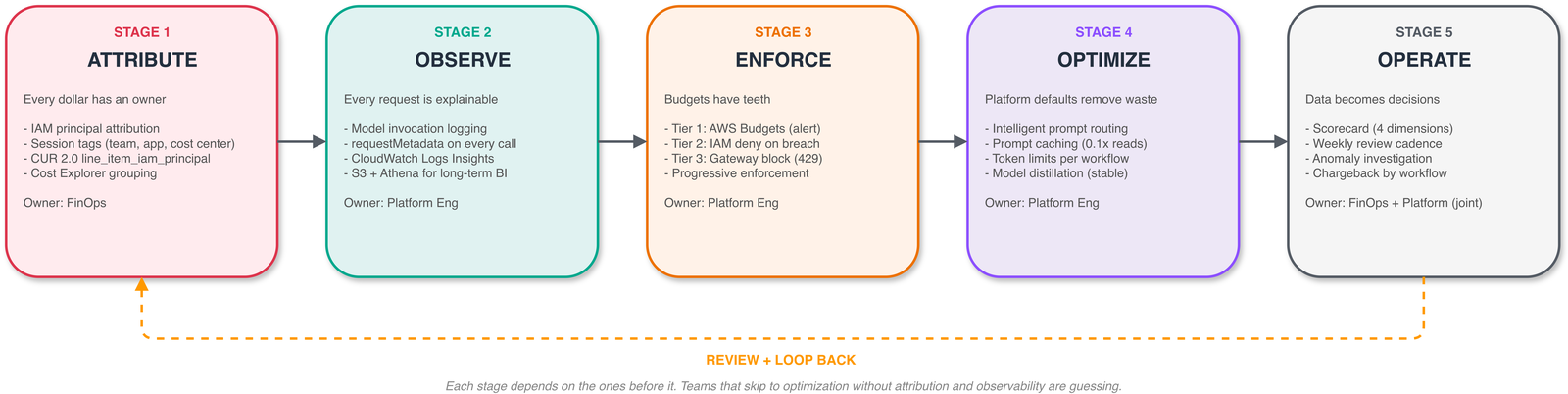
AWS published a playbook for managing Amazon Bedrock costs, aimed jointly at FinOps practitioners and platform engineering teams. Its core argument is that cost control for generative AI is an architectural discipline rather than a matter of picking cheaper models or trimming prompts. The playbook describes five stages run as a continuous loop: attribute, observe, enforce, optimize and operate. FinOps leads the first and last; platform engineering owns the middle three.
The framing rests on how agentic workloads consume tokens. A conversational assistant typically issues one invocation per user turn, while an agent that plans, reads files, calls tools and iterates issues many invocations per task and carries a larger context each time. Consumption therefore tracks the autonomy granted and context size, not the number of user interactions.
Stage 1 is attribution. Bedrock automatically attributes inference costs to the IAM principal that made the call, across all models, with no resources to manage. The caller's ARN lands in the line_item_iam_principal column of the AWS Cost and Usage Report 2.0, covering IAM users, roles, federated identities and API keys. Setup involves enabling IAM principal data in the CUR export, tagging principals with business dimensions such as team, application and cost center, passing session names and tags through OIDC or SAML claims for federated access, and activating those tags as cost allocation tags in AWS Billing, via the console or the UpdateCostAllocationTagsStatus API. Tags appear in CUR 2.0 with an iamPrincipal/ prefix and surface in Cost Explorer under the IAM category within 24 to 48 hours.
The playbook singles out the shared-role problem: a gateway calling Bedrock through a single IAM role attributes every dollar to that role, erasing per-user visibility. The fix is a per-user session pattern where the gateway assumes the invocation role once per user, passing the user's identity as the session name and their attributes as session tags, then caching credentials for up to an hour. That takes one AWS STS call per user per hour rather than per request, and requires two roles: a gateway execution role holding sts:AssumeRole and sts:TagSession, and the invocation role it assumes. The resulting billing entries look like assumed-role/BedrockRuntimeRole/gw-alex with the user's tags attached.
Two alternative attribution mechanisms cover narrower cases. Application inference profiles are per-application, per-model, per-Region resources on the bedrock-runtime endpoint carrying cost allocation tags, suited to small, stable portfolios. Projects and workspaces serve the bedrock-mantle endpoint for the Responses and Chat Completions APIs; a project spans many models, so a single project ID fits fast-changing model usage and is the attribution path for OpenAI-compatible workloads. For bedrock-runtime, IAM principal attribution through session tags is the stated recommendation.
Stage 2 is observability. Model invocation logging can send request data, response data and metadata to CloudWatch Logs, S3 or both, with CloudWatch for operational queries and S3 plus Athena for long-term BI. The playbook treats logging as provisioned infrastructure with retention and encryption policies rather than a manual toggle. Because CUR attribution lags roughly 24 hours, CloudWatch plus OpenTelemetry can drive near-real-time per-developer dashboards within minutes.
Workload-level questions need request metadata stamped on each call, which Bedrock captures in invocation logs. Bedrock does not enforce metadata, so the recommendation is to inject a mandatory, normalized key set centrally in a shared SDK wrapper or gateway and track metadata coverage as a platform health signal. CloudWatch Logs Insights queries can then rank consumers by total tokens grouped by caller and model, or by application and workflow for a workload leaderboard.
Stage 3 offers three enforcement tiers. Tier 1 layers AWS Budgets alerts on the native billing pipeline, with OpenTelemetry dashboards filling the CUR gap; nothing to deploy, no added latency, but nothing can hard-stop spend. Tier 2 uses a Lambda aggregator tallying per-user token and dollar counters in DynamoDB from invocation logs, adding breaching identities to a shared IAM deny policy until a monthly reset or admin override. A deployable variant in the AWS Solutions Library checks usage against per-user and per-team limits when issuing credentials and withholds them once a limit is exceeded; because it relies on client-emitted telemetry, its figures can differ from CUR. Both forms are asynchronous, with blocks landing seconds to minutes after the breaching call or at the next credential refresh. Tier 3 places a gateway in the data path, returning HTTP 429 the moment a limit is crossed, with sub-second blocking and per-user model allowlists, at the cost of a component to deploy, scale and security-review plus client reconfiguration. For Claude Code and Claude Desktop fleets, the Claude apps gateway for AWS is the official recommendation; for mixed-provider workloads, LiteLLM on ECS Fargate is cited.
Choosing a tier turns on connectivity and spend velocity: direct callers can only use Tiers 1 and 2, and organizations already spending millions monthly should build enforcement now. Most should phase in from Tier 1.
Stage 4 targets platform defaults. Model routing can downshift routine completions to cheaper models within a family via intelligent prompt routing or gateway rules; the playbook suggests evaluating quality on the top workloads from the leaderboard, and notes that more than half of agentic coding calls landing on cheaper models is an achievable target. Prompt caching, as of October 2026 published pricing for Anthropic Claude in US East (N. Virginia), bills writes at 1.25x the base input rate with the 5-minute TTL and 2x with the 1-hour TTL; reads cost 0.1x on Claude Sonnet 4.6 and Claude Haiku 4.5 and 0.05x on Claude Sonnet 5.5 and Claude Opus 5.5. With the 5-minute TTL a single reuse pays for the write, and ten calls against a stable prefix cost roughly a fifth of the uncached price. The only losing case is writes never re-read. Tracking cache-read against cache-write volume per workflow reveals unstable prefixes, often a timestamp or session ID placed before the cache point.
Application-level savings, such as just-in-time retrieval, conversation compaction and distilling high-volume workflows onto smaller models, belong to application teams; the platform's role is to publish the per-workflow token leaderboard and set token limits so those teams can see where they stand.
Stage 5 turns the data into decisions through a standing health dashboard whose first signal is model mix: which models are called and how often, as a direct measure of routing discipline.
Why it matters: teams running agents on Bedrock face token bills that scale with autonomy and context rather than user turns, so cost surprises compound quickly. Developers and platform teams get a concrete recipe for per-identity attribution, mandatory request metadata and graded enforcement, though each step adds operational work or, at Tier 3, a latency-path dependency. This suggests the biggest practical win for most organizations is fixing shared-role gateways and setting routing defaults centrally before building hard blocks.
Based on reporting from the original publisher. Visit the source for full context and later updates.
Publisher excerpt
This post presents a five-stage operating model for managing Amazon Bedrock cost: attribute every dollar to an owner, make every request observable, enforce budgets, optimize platform defaults, and operate a review cadence. Written for FinOps and platform engineering teams.