Childhood and Education #22: Voice Without Exit
Nikole Hannah-Jones, the New York Times journalist behind the 1619 Project, has published a self-critical essay in the Times about the school she chose for her daughter Najya. By her own account she sent the girl to PS 307, a majority-Black, low-income New York City elementary school, out of a sense of obligation to the common good, even though she had the money and connections to choose otherwise. The piece describes a school where children went unsupervised at lunch, teachers often failed to show, the principal was largely absent, reading assessments were never administered, and math homework came back ungraded. Najya eventually confronted her mother about the choice, and Hannah-Jones writes that she feels she failed both her values and her child. The essay drew wide commentary, including from the writer Zvi Mowshowitz, whose newsletter post is summarized here.
The most concrete allegations concern assessment and grading. In December of one school year, Najya came home reporting she had jumped three grade levels in reading in a single month. Hannah-Jones contacted the school's literacy coach and learned that once the family began asking for a reading assessment, the teacher had the coach do the evaluation, which found Najya was reading fine. Hannah-Jones concluded the teacher had most likely never run the school's mandatory reading assessments for Najya or her classmates, assuming poor competence for these mostly low-income Black children. Separately, math assignments were found mostly wrong and entirely ungraded.
Earlier, toward the end of first grade, Hannah-Jones visited during lunch and found two classes seated with no food and no adult supervision while children chased, hit and pushed one another and aides and cafeteria workers looked on. An aide said the lunch period was short-staffed. Najya told her mother it was always like that. Hannah-Jones sent her back for second grade anyway, which is the point at which Mowshowitz says he stops following her reasoning: a different neighborhood public school was available.
The middle school chapter, Unison, is described through clubs, trips, a production of Hamilton and Black History Month observances, but also students who never got homework and teachers who could not control classrooms. Unison eliminated homework on the argument that studies show little academic impact and that it sets up students who cannot work independently to fail. It also ran an 'Algebra for all' policy that, in Hannah-Jones's telling, passed students through without teaching them algebra; Najya had failed the Algebra test the year before, which her mother initially attributed to poor test-taking.
When Najya was finally allowed to research and pick schools herself, with the constraint that she choose a public one, her top picks were heavily white and screened students, the kind of school her mother had spent her career arguing against. She got into a strong academic high school and was overwhelmed at first, having never been assigned homework. With intense help she caught up, reaching As and Bs within about a year. That recovery is what prompts the newsletter's central question: if eight years of schooling taught neither academics nor discipline, what were those years for? Mowshowitz extends it to grades and tests generally, asking how much of the apparatus is effectively fake.
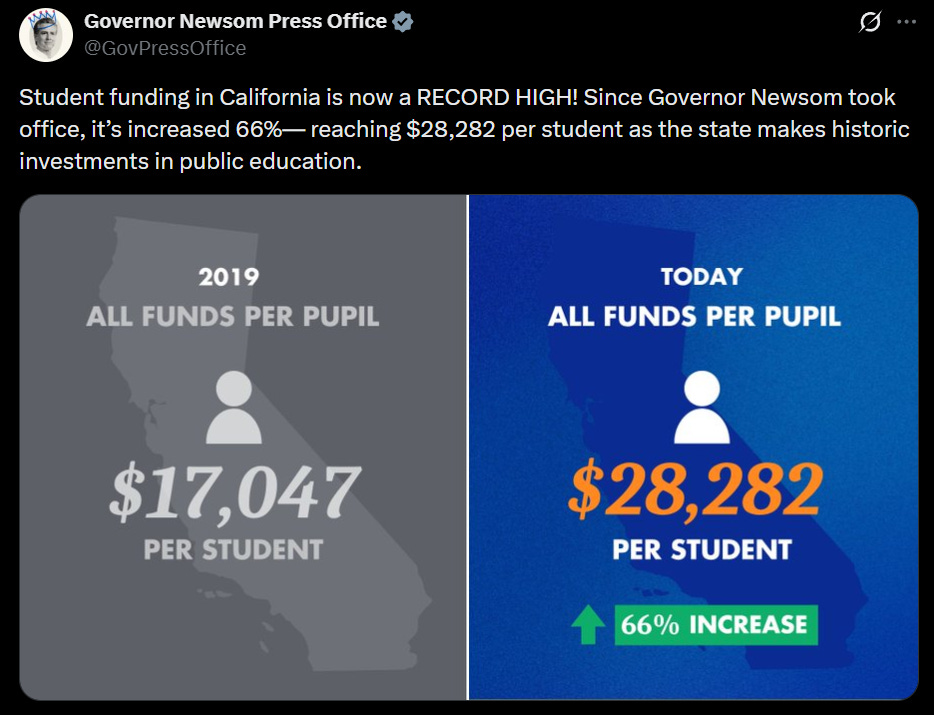
Commentators quoted in the post push on the element of choice. One notes Hannah-Jones could have used her neighborhood school but hand-picked one with the demographics she wanted and supplemented it with private tutoring that began in fourth grade. Jack Despain Zhou frames two versions of the story: a well-meaning reformer defeated by entrenched inequality, or a wealthy, influential woman who used New York City's generous school choice to place her child at an out-of-neighborhood school receiving $52,349 per student in 2024-2025, a 1:10 faculty-student ratio, more funding than over 90% of city schools, while publicly praising the decision as late as 2024. Alex Tabarrok of Marginal Revolution notes the irony of invoking the history of Black school integration to justify keeping one's own child in a segregated school.
The Manhattan Institute's visit to PS 307 supplies numbers the post leans on: teachers averaging over $100,000 a year, $52,000 per student annually, a 9-to-1 student-teacher ratio, and a school down the street spending less than half as much with significantly better academic outcomes. Per-pupil figures are inflated by special-needs spending, but not without limit. The post argues this falsifies the pure funding theory of school failure, while noting that spending can still be locally rational: parents pay premiums for peer groups and reputations. It cites research by Patrick Bayer, Peter Blair and Kenneth Whaley finding that tax-funded increases in school spending raise local house prices, which the authors read as evidence that U.S. teacher spending is inefficiently low. Mowshowitz's own reading is that willingness to pay does not establish that the money produces better outcomes.
Why it matters: this is a case study in voice versus exit for anyone building or choosing products in a system with weak feedback loops. Grades, assessments and homework are the telemetry of a school; when they are skipped or rubber-stamped, parents and administrators lose the signal they would need to intervene, and the article's account suggests years can pass before anyone notices. For product teams, the parallel is concrete: a metric nobody actually measures is worse than no metric, because it manufactures false confidence, and a system that ignores its most connected, motivated users will ignore everyone else too. The recovery within roughly a year, if it holds generally, also implies that remediation capacity, not time served, is the binding constraint, an inference from the facts as reported rather than a demonstrated finding.
Based on reporting from the original publisher. Visit the source for full context and later updates.
Publisher excerpt
Nikole Hannah-Jones wrote a brave self-critical piece in The New York Times, centrally about how she intentionally sent her daughter to a well-funded but failing school, PS 307, in the hopes of using voice to improve it, and how that utterly failed her daughter and failed to impact the school.