NVIDIA Expands Advanced Technology Access for Europe’s Scientific Community Through Open Learning Resources, Collaborations and Compute
At the AI in Science Summit in Dublin, the European Commission launched the AI in Science Enablers Initiative, a shared framework connected to RAISE, the Resource for AI Science in Europe, intended to bring private-sector support closer to the continent's research community. Nvidia announced it is joining the campaign, pledging access to accelerated tools, models and platforms; compute, cloud, data and scientific resources; skills, training and technical support; collaborative projects and pilots; and support for startups and ecosystem development. Ekaterina Zaharieva, the European Commissioner for Startups, Research and Innovation, framed the effort as turning Europe's AI-in-science ambition into concrete commitments giving researchers tools, expertise and resources.
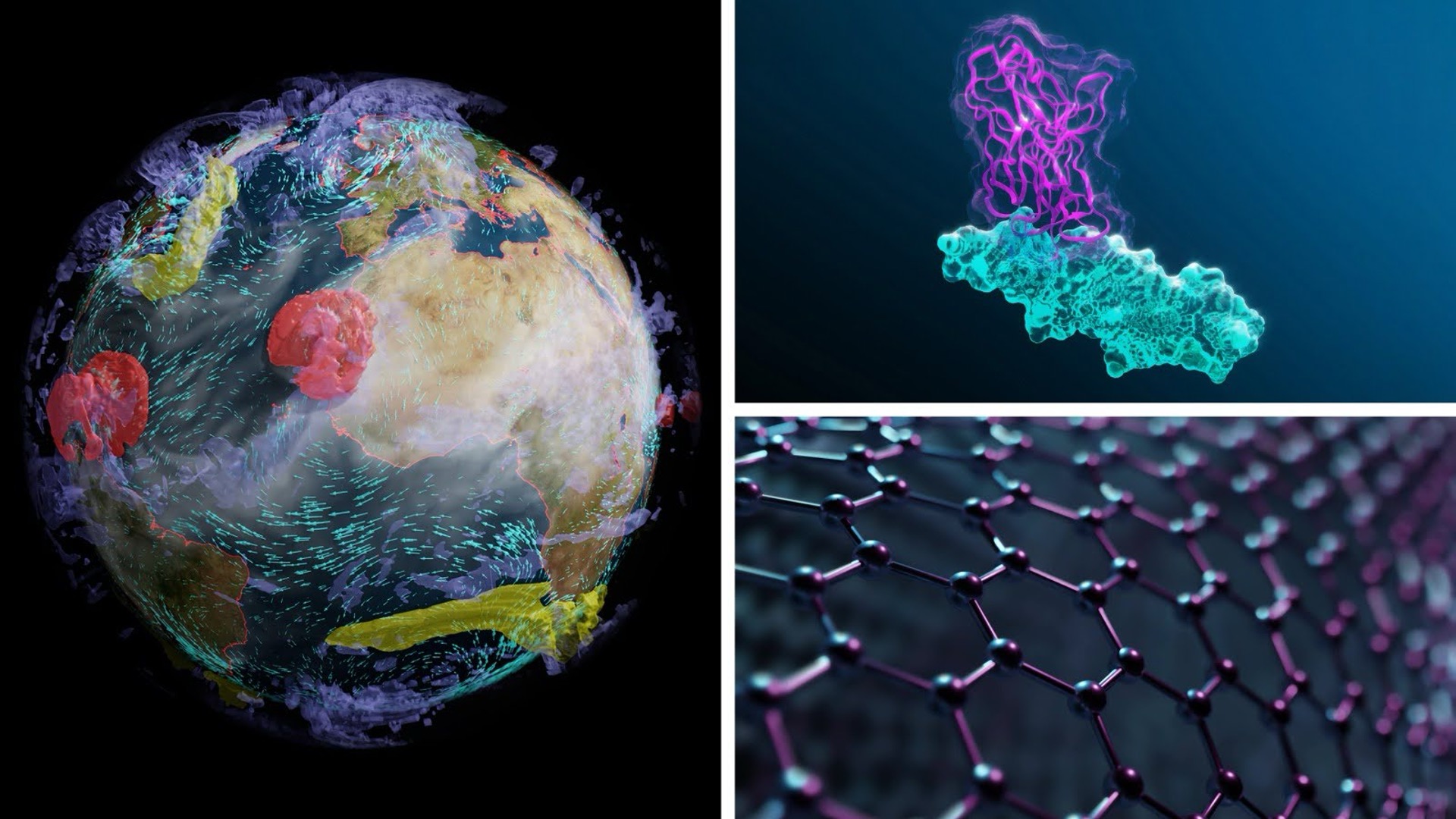
The open source component is the most concrete. Nvidia says it has released more than 250 open models, 250 open datasets and over 1,400 open source software projects, spanning large language models, healthcare, robotics, climate science, physical AI, autonomous vehicles and scientific research. The models and datasets sit on Hugging Face and GitHub. Researchers are pointed toward the Nemotron family for agentic reasoning — architectures, open weights, open source models, training data and recipes — and toward scientific software including the BioNeMo Agent Toolkit, PhysicsNeMo libraries, Earth-2 models and ALCHEMI NIM microservices, aimed at biology, chemistry, molecular design, weather and climate, energy, engineering, physics and materials science.
For developers, the practical value of that stack depends on licensing and packaging details that a headline count does not settle. NIM microservices are typically distributed as containerized inference endpoints, which lowers deployment friction but ties a pipeline to Nvidia's serving layer; open weights let a lab fine-tune or self-host instead. PhysicsNeMo and Earth-2 target physics-informed and weather/climate modeling, domains where teams often already have bespoke simulation code, so the question is how cleanly these libraries wrap existing solvers.
On skills, the Nvidia Deep Learning Institute launched an open source courseware hub with hands-on materials on accelerated computing and deep learning. The company says the material is freely downloadable and openly licensed, with no enrollment, fees or deadline, and modular enough to adapt for university curricula, supercomputing center bootcamps or developer community events. It is positioned as a bridge into Nvidia's broader training and certification programs. For a university or national lab, openly licensed modular courseware removes the procurement step that often slows curriculum changes; the trade-off is that the material, however open, points learners at Nvidia's toolchain and its paid certification path.
Compute access runs through partnerships with cloud infrastructure providers and European national AI factories, including in France, Spain and Sweden, aimed at opening routes for startups and small and medium-sized enterprises to sovereign European compute and services. The Nvidia Inception program for startups supplies compute resources and technical support. Nvidia says AI2F in France is the first AI factory to have collaborated with Inception for four months, with strong results, and that the BSC AI Factory ran a pilot and is now rolling out its first full accelerator program, with other European national AI factories interested in replicating the model in 2027. The stated strategic objective is building self-sustaining AI ventures in Spain and Europe. Sweden AI Factory, one of Europe's 19 EuroHPC-funded AI factories, announced a collaboration with Nvidia to open its infrastructure and expertise to Inception startups and SMEs in sectors including life and material sciences, autonomous systems and gaming.
EuroHPC supercomputing centers such as CINECA and JSC provide academia and startups with free access to Nvidia GPU infrastructure and services for open research, complemented by office hours, bootcamps and hackathons that help researchers fine-tune models on their own datasets. This month Nvidia is co-organizing a European AI hackathon with Austrian Scientific Computing, the Leibniz Supercomputing Centre, the High-Performance Computing Center Stuttgart and The Cyprus Institute, for Pharos-CY.
On infrastructure, Nvidia says it is powering Europe's most ambitious expansion of AI infrastructure to date, with 35 supercomputers currently in development across the continent, described as the largest single-year buildout of supercomputing capacity Europe has ever seen. Together, those systems are expected to equip over 3 million researchers with next-generation infrastructure, accelerating discovery in climate science, drug development, materials research and beyond.
Read together, the announcement blends programmatic access — courses, hackathons, office hours, Inception membership — with the hardware pipeline that ultimately determines whether that access is usable. The two halves are not equivalent: compute and startup slots are finite and allocated through partner factories and programs, while the open models and courseware can be downloaded without an application. For product teams, the open weights and recipes are the part that can be evaluated today without a partnership agreement. A likely trade-off for European labs is that sovereign compute offers data residency and regional funding alignment but may lag the largest commercial clusters in capacity and the newest silicon, so workload placement becomes a real planning decision rather than a default.
Why it matters: research groups, science-focused startups and platform teams in Europe get a wider menu of no-cost entry points, chiefly downloadable open models, datasets and courseware plus Inception and AI factory routes to GPU time. The practical near-term decisions are which Nvidia scientific libraries and NIM services to adopt into existing pipelines and which workloads to run on national AI factory capacity versus commercial cloud. The larger effect, if the 35 systems and their user targets materialize on schedule, is that compute scarcity may stop being the default constraint for smaller European labs — inference, since the buildout is stated as in development rather than complete.
Based on reporting from the original publisher. Visit the source for full context and later updates.
Publisher excerpt
Much of today’s scientific progress begins with computation. But turning accelerated computing’s potential into scientific progress — modeling climate systems, designing molecules, simulating materials and more — depends on more than breakthrough technology. Especially for smaller labs, early-career scientists or science-based startups, the hardest part of research can be everything that comes before the science: […]