How CrossnoKaye grounds physical AI with Amazon Bedrock AgentCore
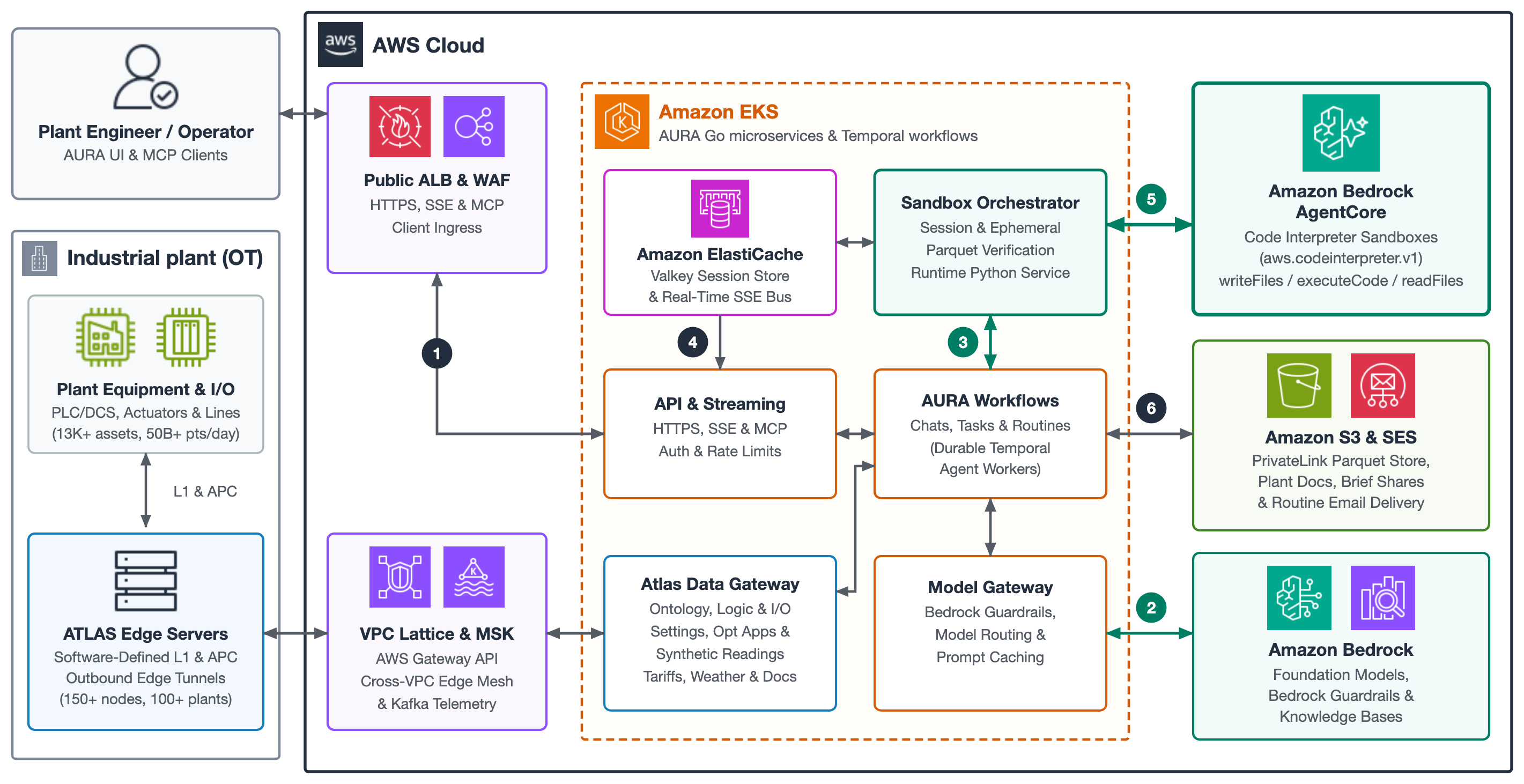
CrossnoKaye, an industrial automation vendor, has described how its agentic intelligence system, AURA, is built on AWS alongside its ATLAS software-defined automation platform, with Amazon Bedrock AgentCore's code interpreter doing the numerical work. The account, published on the AWS Machine Learning Blog, explains why the company rejected bolting a general-purpose agent onto existing plant systems and instead runs the agent inside the same platform that already controls equipment. ATLAS is deployed at food and beverage plants, industrial refrigeration facilities, aggregates quarries and manufacturing sites.
The scale figures are the headline context. Across more than 100 industrial facilities and 13,000 controlled assets, CrossnoKaye says it stores over 22 trillion machine data points and ingests more than 50 billion new readings a day. It runs over 1,000 live advanced process control applications, which it reports improve production throughput by 11–17 percent while cutting total facility energy costs by an average of 21 percent. The platform is also credited with more than 9,000 control software deployments per year, over 1 million run hours and zero safety incidents, and roughly 650,000 closed-loop control actions per day.
The argument against external agents is specific to operational technology. In a typical plant, PLCs and DCS run equipment logic, historians log time-series tags under site-specific names, SCADA drives operator screens, and alarm or optimization tools sit separately. Control sequences, state machines and safety interlocks live in proprietary controller code an outside tool cannot inspect, and granting an add-on agent access across those systems means spreading credentials across the plant network.
CrossnoKaye's architecture has three layers. First, each facility gets an on-premises ATLAS control panel with redundant computers, power supplies and network switches running a local Kubernetes cluster of contract-first microservices. The cloud authors, validates and versions base control narratives — state machines, sequences, operating bounds, interlocks and alarm rules — which are downloaded and executed locally against existing controllers. The appliance doubles as an outbound-only IT/OT gateway with no inbound firewall ports, streaming telemetry to AWS via VPC Lattice and Amazon MSK. If cloud connectivity drops, the plant keeps running on the local edge cluster. That design keeps the safety-critical loop deterministic and on site, which is the standard pattern in industrial control; the cloud layer can advise and optimize but not execute directly.
Second, derived signals and closed-loop optimization run in the cloud on that shared plant model. Pipelines built from versioned Python packages in Amazon S3 compute synthetic readings such as heat-flow distributions, asset health indices, energy intensity and mass-balance deviations, writing them back to the historian beside physical I/O. Optimization applications combine those signals with physics models, model predictive control, reinforcement learning, utility tariffs and weather forecasts to produce setpoint schedules, ordered per facility through SQS FIFO queues before dispatch to the edge.
Third, AURA runs inside the platform boundary on Amazon EKS as microservices and Temporal workflows. Under the caller's enterprise permissions, its agents query an internal Atlas Data gateway that exposes equipment topology, deployed control narratives and interlocks, physical and synthetic readings, setting and alarm histories, active schedules and documentation indexed in Amazon Bedrock Knowledge Bases. Because layout, control logic and sensor data share one model, AURA can reason about interlocks rather than timestamps alone. In a quarry example, operators kept clearing a secondary crusher fault that actually originated from a slipping recirculating belt under the tertiary crusher tripping its overload interlock, which in turn triggered the upstream safety interlock — a slip confirmed and fixed in minutes once the right equipment was inspected.
The code interpreter is the other half of the design. LLMs read engineering context well but cannot reliably do statistics or physical balances across millions of readings in a prompt, so AURA writes Python and runs it at runtime in isolated, AWS-managed microVM sandboxes under AgentCore, with Bedrock Guardrails and local edge safety controls alongside. AURA operates in three modes: interactive Chats spanning up to 200 facilities in a single turn, repeatable parameterized Tasks pinned to immutable version snapshots, and Routines triggered by schedules, sensor thresholds, rate-of-change windows, alarms or equipment mode changes.
State handling differs by mode. Chats bind a warm AgentCore session recorded in ElastiCache for Valkey with a 15-minute sliding TTL, so in-memory tables survive follow-up questions and a replacement session is provisioned transparently after idle expiry. Tasks and Routines get a fresh single-use microVM per run, stopped with StopCodeInterpreterSession when the calculation finishes, which prevents cross-run contamination and idle charges. A fleet triage example shows the payoff: alarm summaries across 94 facilities are grouped by rule and inter-arrival time, so a site with 103 activations from two repeating dump-tank level rules ranks below one where 58 activations span ammonia detection, evaporator faults and hot-gas valves within a second.
AURA also enforces data contracts because early free-form scripts that printed JSON to standard output proved brittle — occasional misnamed columns, dropped time windows or output that broke chart rendering. Before a sandbox is allocated, the Sandbox Orchestrator validates the input contract and stages up to 50 datasets. A deterministic verification harness appended to the model's script checks that each declared output table exists as a pandas DataFrame with required columns and types, then serializes it to Apache Parquet rather than text. If the script raises an exception or omits a column, the Temporal workflow turns the traceback and schema mismatch into a structured retry prompt and the agent reruns in a clean sandbox. This 'no numbers without verified artifacts' pattern is a reusable idea for any agent producing figures a human will act on.
Routines demonstrate the end-to-end path. At 2:00 AM a Routine spotted low-stage suction-pressure drift and launched a pinned Task read-only; by 02:03 the sandbox analysis ruled out sensor drift and low refrigerant charge and isolated condenser-side fouling. At 02:04, inline citations were checked against saved telemetry windows, setting change records and S3 artifacts. A formatted HTML Brief went out through Amazon SES within four minutes, with an Investigate in AURA button that verifies live facility permissions and opens a Chat preloaded with the evidence. No control change is made automatically.
The safety model has four layers. Bedrock Guardrails evaluate every prompt and completion at the Model Gateway, retrieval is isolated per organization, and Briefs require verified citations noting analyzed windows and gaps. Sandbox microVMs have no network routes, credentials or API paths to equipment; Routines are read-only, and proposed setting changes need explicit human approval under the operator's identity with post-change telemetry verification. Cloud optimization only dispatches setpoints inside engineering-approved envelopes, while the edge cluster enforces state-machine guards, rate-of-change clamps, bounds and interlocks no cloud service or agent can bypass. Beneath that sit hardwired safety relays, local programmable trips and mechanical relief devices. In practice, the architecture concedes that AI is unsuitable for real-time control and confines it to observation, analysis and proposals.
Why it matters: Teams building agents over industrial or other high-stakes data get a concrete reference pattern — keep execution in isolated sandboxes, verify output schemas before trusting numbers, and gate any change behind human approval with independent hardwired safety. The operational effect, by inference, is that the agent's value depends more on owning the plant context than on model choice. CrossnoKaye supplies vendor-reported figures, so buyers should treat the throughput and energy savings as claims to validate.
Based on reporting from the original publisher. Visit the source for full context and later updates.
Publisher excerpt
CrossnoKaye brought physical AI to heavy industry with Amazon Bedrock AgentCore. Its ATLAS platform and AURA agentic system ground AI reasoning in live plant data and run verifiable Python in isolated AgentCore sandboxes, giving plant engineers checkable, math-backed answers instead of model guesses.