This featherweight, flying robot carries its own sensors and computers
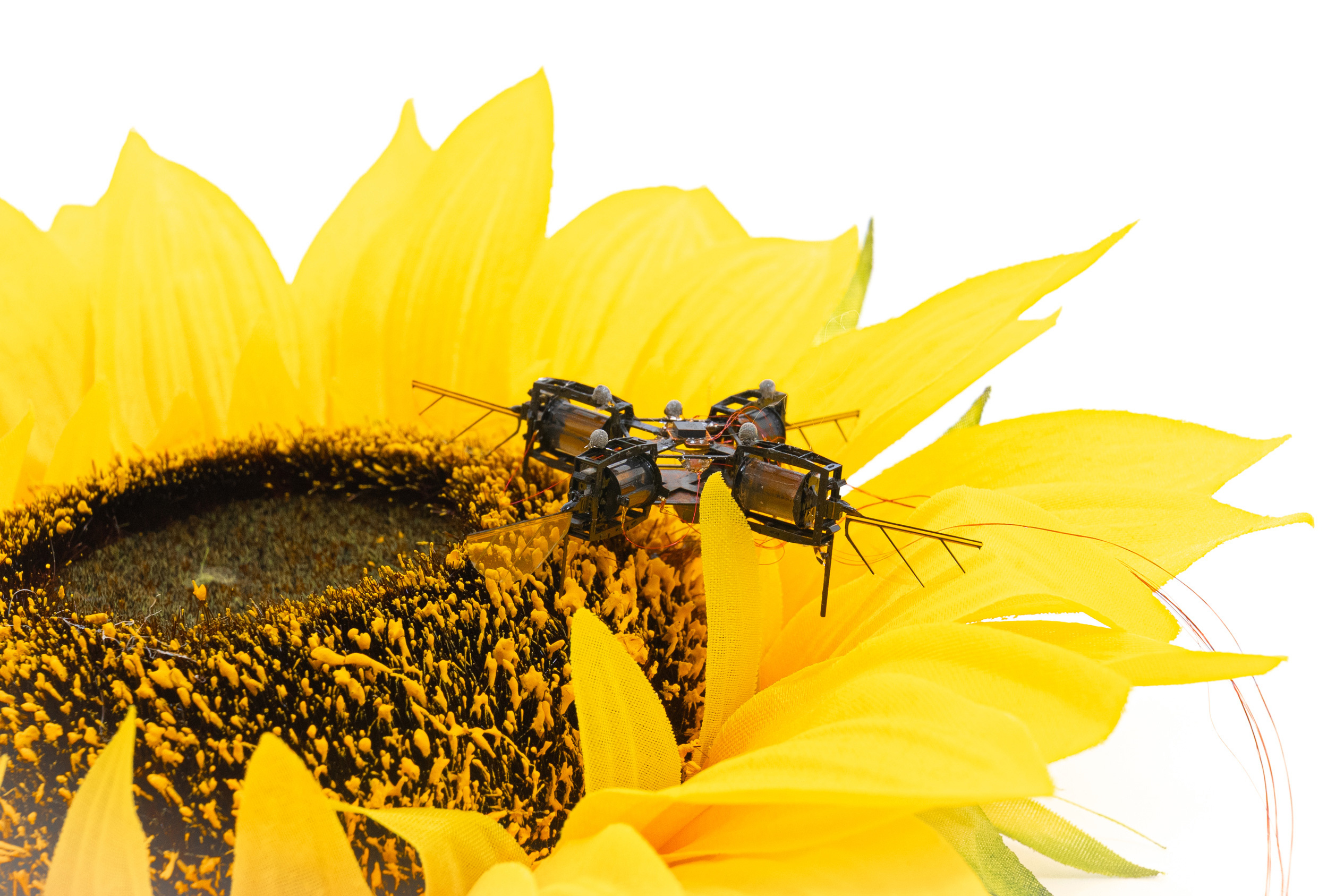
MIT researchers have demonstrated a flapping-wing aerial microrobot that carries its own sensors and computation, allowing it to fly a complex trajectory and land precisely on a sunflower without the lab motion-capture setup that earlier versions depended on. The work, described in a paper appearing in Science Robotics, comes from the lab of Kevin Chen, an associate professor in EECS and head of the Soft and Micro Robotics Laboratory within the Research Laboratory of Electronics. Chen is a co-corresponding author alongside Jonathan P. How, a Ford Professor of Aeronautics and Astronautics at MIT, and Elizabeth Farrell Helbling, an assistant professor at Cornell. Yi-Hsuan (Nemo) Hsiao, Quang Phuc Kieu and Zhongtao Guan, all MIT graduate students, are co-lead authors.
The robot still draws power from an offboard source, so it is not yet untethered. What has changed is that the sensing and control loop now runs onboard. Chen described it as the first demonstration of an aerial microrobot that is both sensory and compute autonomous.
The platform inherits the design the group has refined over roughly a decade: four wings, each driven by soft actuators that act as artificial muscles and flap fast enough for detailed maneuvering. It is about the size and shape of a microcassette and weighs less than a paperclip. The central engineering problem was payload. Navigation electronics add mass that a vehicle this small cannot easily spare, which is why earlier versions stayed inside a motion-capture volume where cameras could track them from outside.
To free up capacity, the team reworked the artificial muscles rather than simply enlarging them. They tuned the radius and length of the soft actuators so that scaling up the actuators by 50 percent produced a 46 percent gain in net lift, arriving at a lift-to-weight ratio of 1.9. Chen noted that increasing actuator size usually drags output power down and erodes lift, so the geometry had to be matched closely for lift to keep pace with the added actuator weight. That margin is what lets the robot carry an electronics package weighing just 244 milligrams.
The package combines three sensing modalities: an inertial measurement unit for attitude, an optical flow sensor for lateral speed and position, and a time-of-flight sensor for height. Together they approximate the information a motion-capture rig would supply, but without absolute position references the vehicle tends to drift. The team's answer was an estimation algorithm that computes orientation, angular velocity and position very quickly by simplifying the math to cut computational cost. Their finding was that running a faster, less exact estimate beat a slower, more accurate one. Hsiao said the group spent substantial effort on sensor selection and position estimators to keep drift low, and that the robot now flies with positional accuracy comparable to flying under offboard cameras.
Mechanically, the electronics sit on a fiberglass substrate, chosen so the flapping vibrations do not disturb the components. How framed the constraint in terms of the tight budget on a computer that small: it has to handle both perception and control, fit on the vehicle, and run fast enough to keep it stable in flight.
In flight tests the robot hovered at various heights and followed point-to-point trajectories with positional errors of only a few centimeters. For the pollination-flavored demonstration, a joystick sent high-level position setpoints that steered the robot around several plants before it settled onto a sunflower, a maneuver Hsiao called quite difficult even with motion capture.
Power analysis showed the electronics draw only about 6 percent of total consumption, with the artificial muscles and wings taking the rest. The team has identified ways to trim electronics power further, which would leave headroom for more components such as a camera for object recognition.
Two goals guide the next phase: adding an onboard camera for autonomous object recognition and obstacle avoidance, and integrating power electronics and batteries so the robot can fly untethered outdoors. Funding came from the U.S. National Science Foundation, the Office of Naval Research, the Air Force Office of Scientific Research, MathWorks, and a Zakhartchenko Fellowship.
My reading is that the headline result here is less about flight dynamics, which this group had already shown, and more about closing a control loop on a few hundred milligrams of electronics. The trade-off the researchers report, favoring frequent rough estimates over infrequent precise ones, is a familiar pattern in embedded robotics: latency hurts stability more than small errors do when the plant is twitchy. The 6 percent power figure also matters, because it suggests the electronics are not the binding constraint; the actuators are. Until power storage shrinks enough to ride along, untethered outdoor flight remains the hard part, and battery mass would likely eat into the 1.9 lift-to-weight margin that makes the current payload possible.
Why it matters: Teams working on small robots, embedded perception and agricultural automation should note that onboard autonomy at insect scale is moving from lab-only demonstrations toward field-capable designs, though offboard power keeps outdoor deployment out of reach for now. For developers, the techniques, fast approximate state estimation and vibration-isolated packaging for tiny compute, transfer well beyond flapping robots. Whether this becomes practical for pollination is still an open question that depends on the camera and battery work the group has queued up, which is my inference rather than a stated outcome.
Based on reporting from the original publisher. Visit the source for full context and later updates.
Publisher excerpt
The speedy microrobot flies without an attached motion-capture system, moving it closer to applications like agriculture or industrial surveillance.