How Natera designed an agentic AI system for lab ops with Amazon Bedrock AgentCore
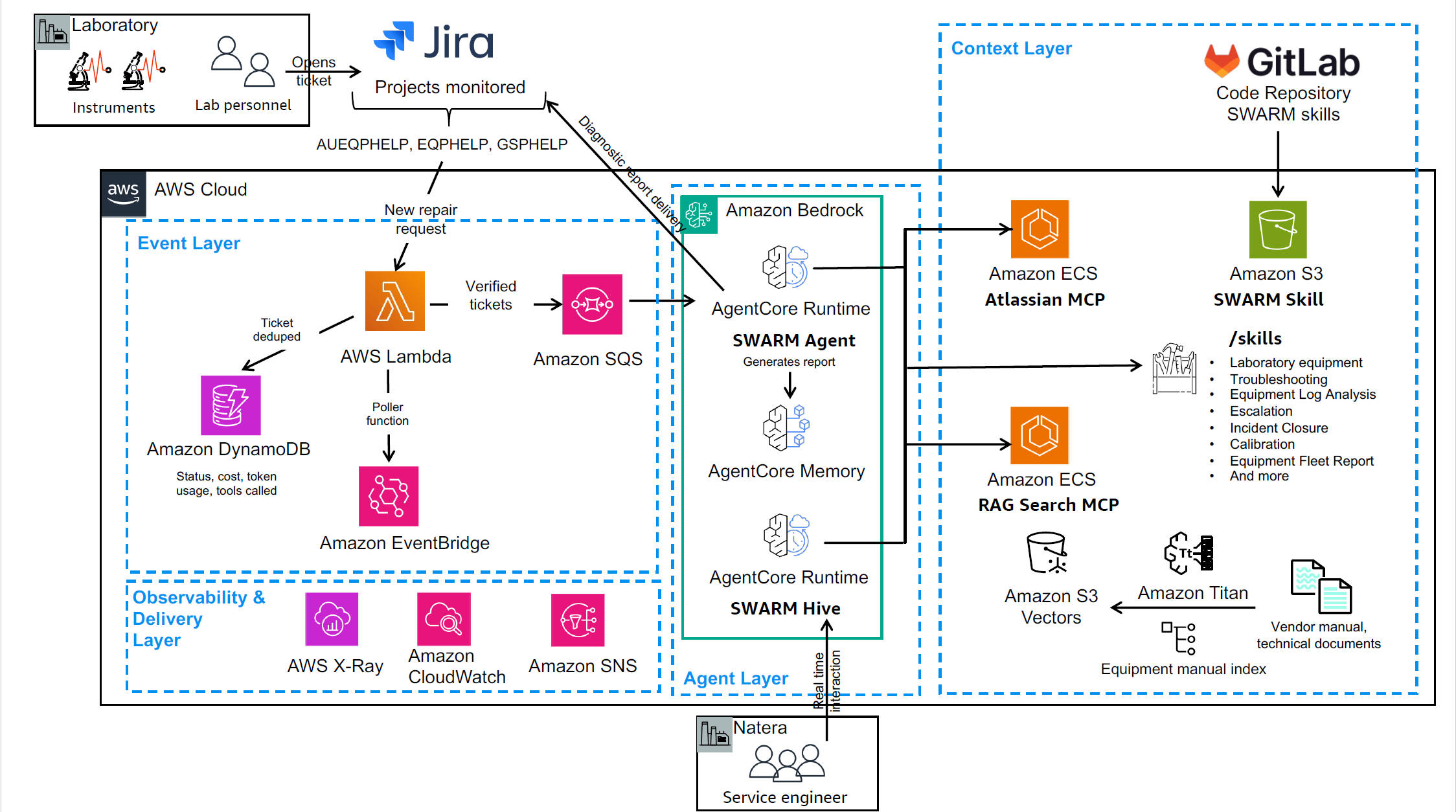
Natera, a cell-free DNA testing company, worked with AWS to build SWARM (Systematic Workflow Analytics and Resolutions Manager), an agentic AI system for its lab operations, with the lab engineering team led by Ariel Jirau. AWS's Machine Learning Blog published the architecture walkthrough; the system runs on Amazon Bedrock AgentCore, a managed service for building, deploying and operating AI agents. In a 90-day production evaluation measured from Jira ticket metadata, average first response time fell from 17.4 hours to roughly 8 minutes, about 130x faster, and 96.2 percent of incoming tickets received a SWARM-generated diagnostic report before an engineer reviewed them.
The problem SWARM addresses is knowledge continuity. Natera's labs run many families of precision instruments, each with its own failure modes, vendor documentation and resolution patterns, and the service engineering team was organized around deep individual expertise rather than standardized playbooks. When a senior technician who had spent years diagnosing one instrument family left, that knowledge was effectively lost, and no system existed to capture or deploy it at scale. The team fielded more than 65 tickets per day across three Jira queues at an average first response of 17.4 hours, so instrument downtime delayed sample processing and patient reporting, and hiring more engineers could not keep pace.
Natera's stated requirements were autonomous handling of high-volume tickets, integration with existing tools such as Jira and Confluence, and built-in security and observability (encryption, IAM integration, distributed tracing) without custom infrastructure. Jirau said the team needed a managed runtime that let engineering effort go into diagnostic accuracy rather than infrastructure plumbing, with identity management and the flexibility to swap models without rewriting agent logic.
The system uses two runtimes that share one skill library. The swarm-agent works in the background, selecting skills based on equipment type and symptoms, querying the knowledge base, and producing a structured HTML report with a lead cause hypothesis, ranked troubleshooting steps and a confidence label, stored in Amazon S3 and linked to the Jira ticket within minutes. The swarm-hive runtime is the interactive side, where engineers follow up, upload images and explore alternative troubleshooting paths; AgentCore memory keeps per-engineer conversational context across sessions, and free-form input passes through Amazon Bedrock Guardrails for content filtering. Jirau framed the design as augmenting rather than replacing engineers by making institutional knowledge available the moment a ticket arrives.
The architecture has four layers: an event layer routing Jira tickets through Amazon EventBridge and Amazon SQS; an agent layer hosting the two runtimes and skill library; a context layer drawing on vendor manuals, historical tickets and operational data; and an observability and delivery layer for traces, logs and metrics. Notably, Jira integration uses EventBridge Scheduler plus a polling AWS Lambda function rather than webhooks, so verified tickets enter an SQS queue for reliable delivery. DynamoDB deduplicates by ticket ID with time-to-live expiry and stores per-run metadata such as status, cost and token usage to feed the evaluation loop. This decouples agent processing from the ticketing system's availability, a pattern worth copying for any queue-driven agent.
Security is a keyless deployment model, chosen because SWARM runs in a clinical environment where credential exposure is unacceptable. GitLab CI runners present an OIDC token to an IAM identity provider, and AWS STS exchanges it for short-lived credentials scoped to the deployment role, with no long-lived access keys in the pipeline. IAM enforces least privilege per component, private subnets and VPC endpoints keep traffic off the public internet, and Secrets Manager rotates the few remaining credentials on a 30-day cycle. SWARM runs on HIPAA-eligible AWS services under a Business Associate Agreement, every agent invocation is audit-logged, and no patient-identifiable information reaches the vector index or the model; tickets carry only equipment and workflow metadata.
On retrieval, early prototypes with general-purpose retrieval and no equipment-specific metadata gave inconsistent results, so Natera built a custom document pipeline. Amazon Titan Text Embeddings produces vectors, Amazon Bedrock Knowledge Bases provides managed Retrieval Augmented Generation (RAG), and documents are embedded in batches of 100 to balance indexing throughput against API rate limits. Chunking uses the tiktoken cl100k_base tokenizer with a chunk size of 1,000 tokens and 150 tokens of overlap. Jirau said adding missing vendor manuals for the lowest-scoring instrument family lifted accuracy from 71 to 75 percent with no model changes, which is why the team checks data coverage before model tuning when accuracy plateaus. In practice, that is the most transferable lesson here: for documentation-heavy support agents, corpus gaps often dominate prompt or model tweaks.
The skill library holds 33 skills, 24 tied to specific instrument families and 9 cross-cutting workflow skills. Each has a defined interface, is independently testable and is evaluated like production software. Deterministic work such as parsing Jira fields or formatting HTML reports is written in Python, while LLM skills handle reasoning like interpreting symptoms, matching documentation and writing diagnostic narratives. A versioned library means a bad diagnosis can be traced to a specific skill rather than debugged across the whole system.
Observability was built before the first production deployment. CloudWatch captures searchable logs per run, AWS X-Ray traces each run from ticket intake to report and records time and cost per tool call, Amazon SNS emails failure alerts, and a Slack tracker gives the team live visibility. Natera treats per-invocation tracing as a regulatory and operational requirement rather than optional tooling, a reasonable position where downtime affects patient reporting.
Evaluation is continuous rather than a one-time gate. Every processed ticket gets a hypothesis, ranked steps and a self-rated confidence label; engineers record the actual fix, an evaluator grades the response as Accurate, Partial or Wrong by instrument family, and the typical remedy is a knowledge base update followed by a re-run of the evaluation set. On 524 evaluation tickets, 269 carried a confidence label and had an engineer-verified resolution for comparison. High-confidence tickets reached 74 percent accuracy across 154 cases, while Moderate and Low both sat at 65 percent across 78 and 37 cases. Natera notes the Low sample is too small to be meaningful and expects the tiers to separate as the dataset grows. The High-versus-rest gap is currently the useful signal for how much weight an engineer should give a diagnosis.
Why it matters: teams running high-volume operational support across heterogeneous equipment or systems can use this blueprint for autonomous first-pass triage with a human in the loop, and the reported 130x response-time gain and 96.2 percent coverage show what a mature deployment looks like. The transferable design choices are a versioned, testable skill library, separate runtimes for batch and interactive work, keyless CI credentials, tracing built in before launch, and treating documentation coverage as the first lever on accuracy. Inferring from the published figures, the confidence calibration still needs work before teams could safely act on low-confidence diagnoses without review.
Based on reporting from the original publisher. Visit the source for full context and later updates.
Publisher excerpt
Natera built SWARM, an agentic AI system on Amazon Bedrock AgentCore that captures institutional lab-operations knowledge and deploys it at scale. This post walks through the full architecture, from knowledge base construction to deployment and evaluation, delivering about 130x faster first response and 96.2% automated coverage across support tickets.