With a feel for physics, AI models simulate a wider range of real-world scenarios
Researchers at MIT's Computer Science and Artificial Intelligence Laboratory (CSAIL) and Tsinghua University have developed a pre-training approach called GeoPT that gives simulation models a way to learn physics, according to MIT News. The work was presented at the International Conference on Machine Learning in July.
GeoPT draws on "synthetic dynamics," interactions between small particles and complex 3D shapes. The system studied 1.3 million samples in which tiny spheres moved at various speeds and angles until stopping at a point on an object, sticking on contact rather than passing through or bouncing off. The researchers say this gives models a feel for physics before they train on labeled data.
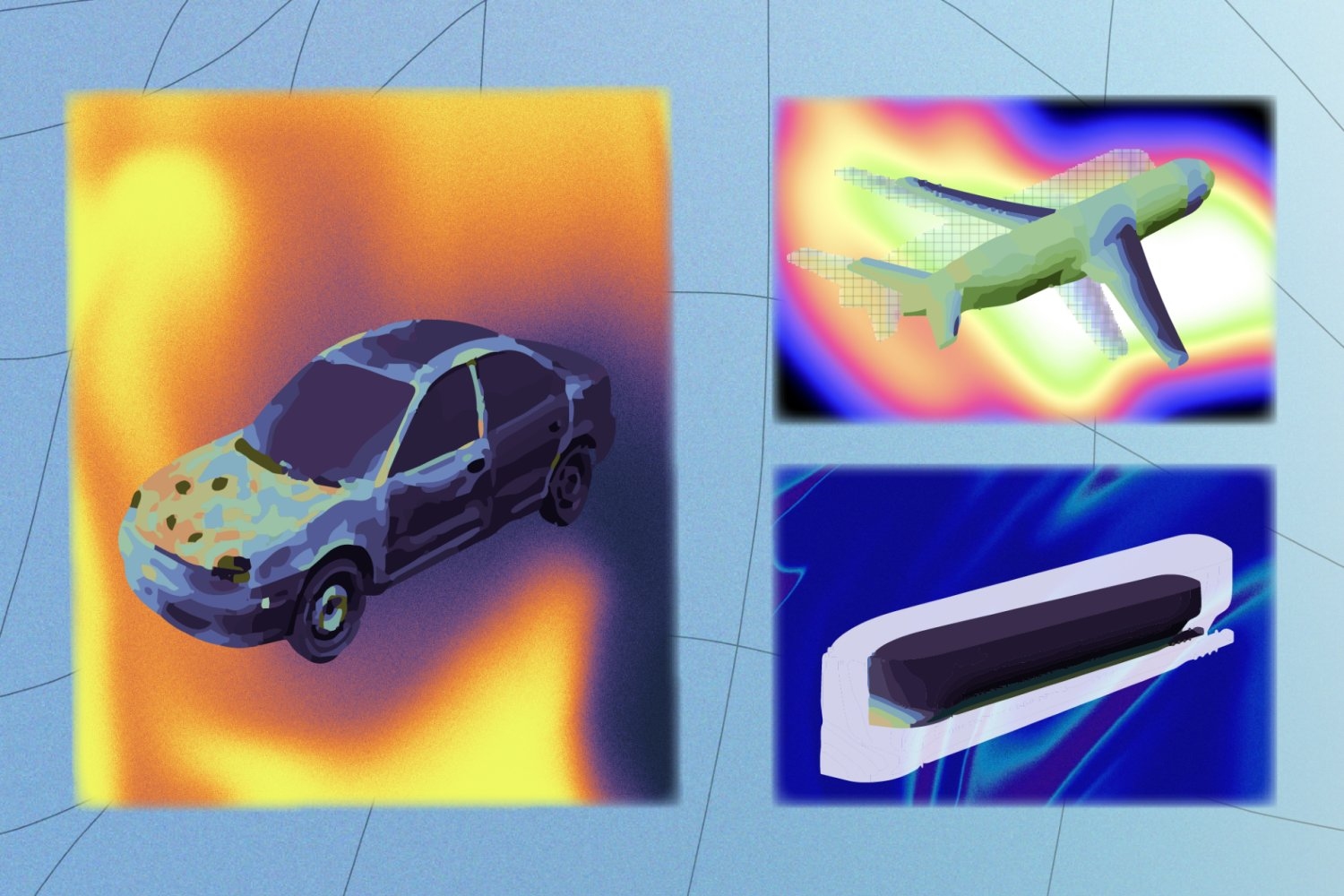
Users upload 3D models of objects such as battleships, passenger airplanes and trucks, and specify the direction and speed of the force to simulate. The output is a heat map showing how the object will be affected in different places.
According to the researchers, GeoPT outperformed state-of-the-art simulation models across benchmarks, reaching peak performance twice as fast and training on up to 60 percent less data. On a dataset of complex 3D shapes and their responses to wind currents and surface pressure, it surpassed those models in speed, accuracy and efficiency. It showed similar results for fighter jets responding to wind. Testing how a boat hull handled air and waves, it required 60 percent fewer labeled data points and reached peak accuracy four times faster than top baselines. It also predicted how 3D vehicles would deform in collisions and simulated light passing through a toy rabbit without prior training on that model or light physics.
"We believe physics is the third modality for AI models, after text and pixels," said Minghao Guo, an MIT PhD student and CSAIL researcher who is a co-lead author. Co-lead author Haixu Wu, an MIT postdoc and CSAIL researcher, said GeoPT made high-fidelity simulations with over 100 million mesh points in seconds.
Fei Sha, an AI research scientist at Meta who was not involved in the research, commented on the approach and the prospect of physics foundation models.
The researchers describe the system as a preview of a physics world model they have been working toward and say they hope to scale it up to more shapes and more complex phenomena, such as weather patterns, materials testing and realistic video generation. The work was supported in part by Neural Modular Physics Twin for Robotics.
Based on reporting from the original publisher. Visit the source for full context and later updates.
Publisher excerpt
“GeoPT” helps AI models understand the basics of physics so they can simulate how objects respond to things like wind and water more efficiently and accurately.