Managed NVIDIA Dynamo on Amazon SageMaker HyperPod Inference
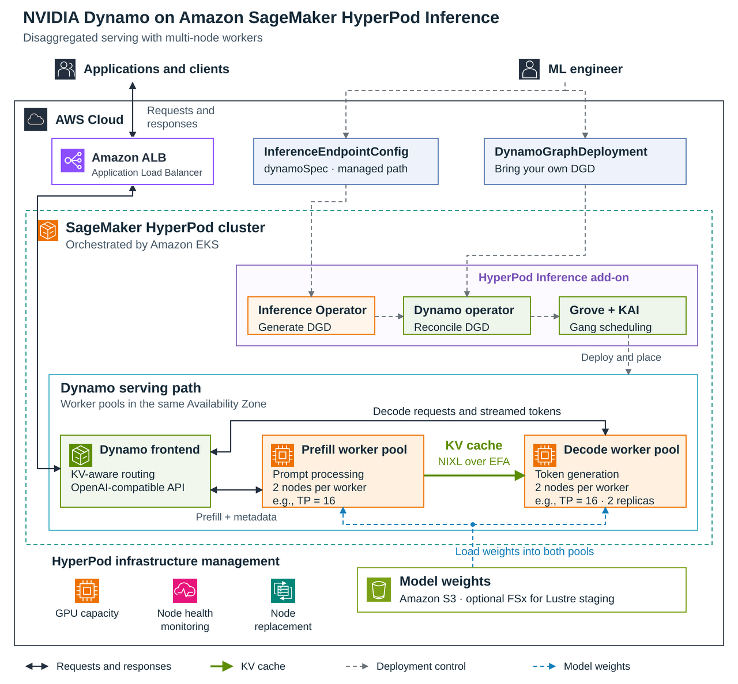
Amazon Web Services has added support for NVIDIA Dynamo to Amazon SageMaker HyperPod Inference, giving teams a managed way to run distributed large language model serving on the platform. Dynamo is an open source distributed inference framework from NVIDIA that handles multi-node deployment, disaggregated prefill and decode, and KV-aware routing; it works with engines including vLLM, SGLang and TensorRT-LLM. HyperPod supplies the surrounding infrastructure: Elastic Fabric Adapter networking, coordinated GPU scheduling, and node health monitoring with automatic replacement.
The problem the integration targets is memory and contention. The post cites GLM-5.3, whose FP8 weights on their own exceed the 640 GB of GPU memory available on a single ml.p5.48xlarge instance, before KV cache and runtime overhead are counted. Long prompts are a second pressure point: when prompt processing and token generation share the same GPUs, generation slows down.
Operationally, the HyperPod Inference add-on installs Dynamo's custom resource definitions along with several components. The HyperPod Inference Operator manages endpoint deployment through an InferenceEndpointConfig (IEC) custom resource, and its dynamoSpec section carries the Dynamo configuration. The Dynamo operator manages a DynamoGraphDeployment (DGD), covering the frontend, model workers, replica counts and resource requirements. Grove coordinates groups of related pods, including multi-node workers, and their scaling relationships. The Kubernetes AI (KAI) Scheduler places pods on GPUs, using gang scheduling to bring up all the pods a multi-node worker needs at once. The Dynamo runtime itself comes from AWS Deep Learning Containers, and the add-on manages the component versions in lockstep, so picking up a new supported Dynamo release means updating the add-on.
In the disaggregated topology, the Dynamo frontend routes requests to separate prefill workers that process prompts and decode workers that generate tokens. Each pool loads the full model weights, and KV cache moves between them over EFA. Because the pools are separate, they can be scaled and tuned independently. Dynamo also offers aggregated serving, where both phases run in the same worker. Either way, workers can sit on one instance or span several using tensor and pipeline parallelism. The KV-aware router weighs reusable prefix KV cache alongside current worker load; the first helps cut prompt recomputation and improves time to first token, the second helps avoid piling requests onto busy workers. HyperPod monitors node, GPU and EFA health and handles node replacement, after which the orchestration components recreate the affected workers.
The add-on offers two configuration paths. Teams that already run Dynamo can bring their own DGD, keep using upstream documentation, recipes and manifests, and let the Dynamo operator manage the deployment, provided they use a supported container image and configure storage, networking and pod placement for the cluster. Teams already on HyperPod Inference can instead use the IEC with dynamoSpec, keeping the configuration format and OpenAI-compatible interface they know. On that path the operator stages model weights from Amazon S3 or Amazon FSx, manages the endpoint, TLS and registration, and handles autoscaling through autoScalingSpec with Kubernetes Event-driven Autoscaling (KEDA) for both aggregated and disaggregated deployments. vLLM is the default engine, and the operator supplies defaults for KV-aware routing and replica counts.
The post walks through GLM-5.3 on ml.p5.48xlarge instances over the IEC path. An aggregated example runs one model-worker replica across two instances, 16 GPUs, with two frontend replicas, setting routingMode to kv-aware. The disaggregated variant swaps in a block with one prefill replica and two decode replicas, each spanning two instances for 16-way tensor parallelism, so six instances in total. Deployment is a kubectl apply; the operator stages the weights and generates the DGD, and Grove and KAI Scheduler place the pods together. Once the endpoint is ready for chat completions, clients call it with an OpenAI-compatible payload through the SageMaker Runtime API.
Two benchmarks are reported. For Qwen3-235B-A22B-FP8 on Dynamo with TensorRT-LLM across two p5en.48xlarge instances, 16 H200 GPUs, with requests of 4,000 input and 200 output tokens, AWS used AIPerf to compare topologies and kept points meeting two targets: P90 time to first token under one second and median generation of at least 50 tokens per second per user. Disaggregated serving reached 2.05 times the best aggregated throughput, 207 versus 101 output tokens per second per GPU, at concurrency 80 and 32 respectively.
The second benchmark tests a worker spanning nodes for Qwen3.5-397B-A17B-FP8 with Dynamo and vLLM at TP4 x PP2 on eight H200 GPUs. The model fits on a single instance, so the split serves only as a controlled baseline. Same model, parallelism and workload configuration; eight GPUs on one p5en.48xlarge versus four GPUs on each of two instances; an agentic workload with high prefix reuse at concurrency 32. The two-node setup delivered 126.4 output tokens per second per GPU, or 99.1 percent of single-node throughput, which the authors read as evidence the node boundary is not a significant throughput penalty.
My reading is that the disaggregated number deserves scrutiny before anyone budgets for it. It was not a like-for-like comparison of the same concurrency: the winning points sit at 80 and 32 respectively, so the 2.05x figure reflects each topology's best SLA-compliant operating point rather than a fixed-load comparison. The separation makes sense mechanically, since prefill is compute-bound and decode memory-bandwidth-bound, and mixing them wastes both, but the practical gain depends on prompt-to-output ratios, prefix reuse and whether the two pools can be sized economically. The cross-node result is the more quietly useful one: near-parity at 99.1 percent suggests EFA and gang scheduling do their job, though it says little about far larger models or heavier KV-cache transfer volumes.
Best practices from the post: start from a Dynamo recipe matched to model, engine and GPU type, and size workers around weights, KV cache and runtime memory. AISimulate can compare aggregated and disaggregated options and help size prefill and decode pools before spending GPU time. On multi-instance deployments, confirm traffic uses the intended EFA transport, including KV-cache transfers between pools. Benchmark with representative traffic via AIPerf or a generated agentic trace, sweep concurrency, filter to points meeting SLAs, and choose on cost and latency priorities. Tune topology and worker allocation before engine settings, changing one variable at a time, and validate every candidate on the actual HyperPod deployment.
Why it matters: teams serving models too large for one instance, or with long prompts that starve token generation, get a managed route to Dynamo's multi-node and disaggregated modes without hand-assembling the Kubernetes orchestration. HyperPod Inference users can adopt it through their existing IEC format and OpenAI-compatible interface, while existing Dynamo users can bring their own manifests. The likely shift, and this is inference, is that arguing about disaggregated versus aggregated becomes a benchmarking exercise on real traffic rather than an infrastructure project.
Based on reporting from the original publisher. Visit the source for full context and later updates.
Publisher excerpt
Amazon SageMaker HyperPod Inference now supports NVIDIA Dynamo for distributed inference, with multi-node and disaggregated serving, KV-aware routing, and automatic fault recovery. Serve large models across many nodes without building the orchestration layer yourself.