Introducing Kimi K3.1 Pro on Amazon Bedrock
Moonshot AI's Kimi K3.1 Pro Highspeed is now available on Amazon Bedrock, alongside the launch of the vendor's new K3.1 series. The model is a post-trained variant of Kimi K3 that keeps the same 3T-class open-weight architecture and a 1-million-token context window, but was trained with substantially more post-training compute. According to Moonshot AI, the added training targets long-horizon agentic work and fewer factual errors, and improves professional tasks such as financial modeling and office documents, plus coding for game engines, 3D scenes and computer-aided design scripts.
The Highspeed name refers to throughput: Moonshot AI reports that it generates output tokens 2–3 times faster than Kimi K3.1 Pro. For agentic coding that difference compounds, because a coding agent makes many sequential model calls per task — reading files, planning a change, editing code, running tests and fixing failures — and each call must finish before the next begins. A higher output-token rate shortens every step of that edit-test-fix loop. This reasoning about compounding latency comes from AWS's framing rather than an independent benchmark.
Migration is deliberately cheap. Kimi K3.1 Pro Highspeed uses the same endpoint, APIs and features as Kimi K3 on Bedrock, so teams already building on Kimi K3 can try it by changing the model ID in existing code. Supported capabilities include tool calling, structured output, configurable reasoning, image input and streaming. The data-handling story is unchanged: processing stays inside the AWS data boundary, data is not shared with Moonshot AI and is not used to train the model. Zero data retention is always on for inference, and zero operator access means AWS operators cannot view prompts or completions during inference.
Access runs through the bedrock-runtime endpoint via the OpenAI-compatible Chat Completions and Responses APIs, or through Bedrock's Converse and Invoke APIs; AWS recommends Chat Completions. Requests are routed through cross-Region inference profiles. The global.moonshotai.kimi-k3.1 profile can dispatch to any supported commercial AWS Region and costs less per token than the geographic variants, making it the default choice for most workloads. Teams with residency constraints can pin to us.moonshotai.kimi-k3.1 (US Regions) or in.moonshotai.kimi-k3.1 (India Regions). A console playground path lets people try the model without code.
Getting started requires Python 3.11 or later with the OpenAI SDK, aws-bedrock-token-generator and boto3, plus an IAM identity permitted to call bedrock:InvokeModel and bedrock:InvokeModelWithResponseStream on the relevant profiles, with bedrock:CallWithBearerToken added for bearer-token auth. The model always reasons before answering, and reasoning effort is tunable to low, high or max. Unset, it defaults to max, so lowering the setting is the most direct lever on latency and output tokens for simpler requests. In the Responses API the same control appears as reasoning.effort; in the Converse API only the model ID needs to change, though responses may include a reasoning block before the answer text.
Two cost levers are documented. The Flex service tier serves the model at half the Standard price in exchange for potentially longer response times, suited to model evaluations, summarization and background agentic tasks. Tier is chosen per request, so one application can mix Priority for latency-critical calls, Standard for everyday traffic and Flex for cost-sensitive work; on-demand quota is shared across all three. CloudWatch's ServiceTier and ResolvedServiceTier dimensions show how traffic split by tier, and AWS advises ramping a small share of traffic first.
Explicit prompt caching addresses the fact that agents resend large stable prefixes — system instructions, tool definitions, repository conventions, reference documents — every turn. Marking where a stable prefix ends with a prompt_cache_breakpoint can raise hit rates, cutting latency and input cost on repeated context. The rules: explicit caching works on Chat Completions, Responses and Invoke but not Converse; a breakpoint must follow at least 256 tokens of stable content; cached content persists for at least 30 minutes; cache writes bill above standard input, while reads are discounted and exempt from the input tokens-per-minute quota. In practice, caching only pays off when prefixes are genuinely reused — write costs make one-shot prompts worse.
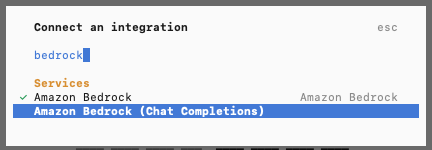
A worked integration shows OpenCode, an open-source terminal coding agent, pointed at Bedrock's Chat Completions endpoint via its OpenAI-compatible provider and a Bedrock API key. Short-term keys last up to 12 hours, work only in the Region of issue and are recommended for production; long-term keys are for exploration. Declaring the model's reasoning capabilities in OpenCode's config exposes low, high and max as selectable variants.
Availability is via the three inference profiles, with the model card and regional availability pages listing supported Regions and Bedrock pricing for rates.
Why it matters: Teams already on Kimi K3 in Bedrock can evaluate a faster, more heavily post-trained variant with a model-ID change, and the 1-million-token window plus caching suits long agentic contexts. The Flex tier and explicit caching give product teams real cost controls, at the price of added configuration complexity. Inference: the speed claim is vendor-reported, so benchmark against your own agent loops before shifting production traffic.
Based on reporting from the original publisher. Visit the source for full context and later updates.
Publisher excerpt
Kimi K3.1 Pro from Moonshot AI is now available on Amazon Bedrock. Learn how to get started through the OpenAI-compatible Chat Completions, Responses, and Converse APIs, optimize inference with explicit prompt caching, and use the model as a coding assistant in OpenCode.