GLM-5.3: How Chinese labs keep stride with the frontier
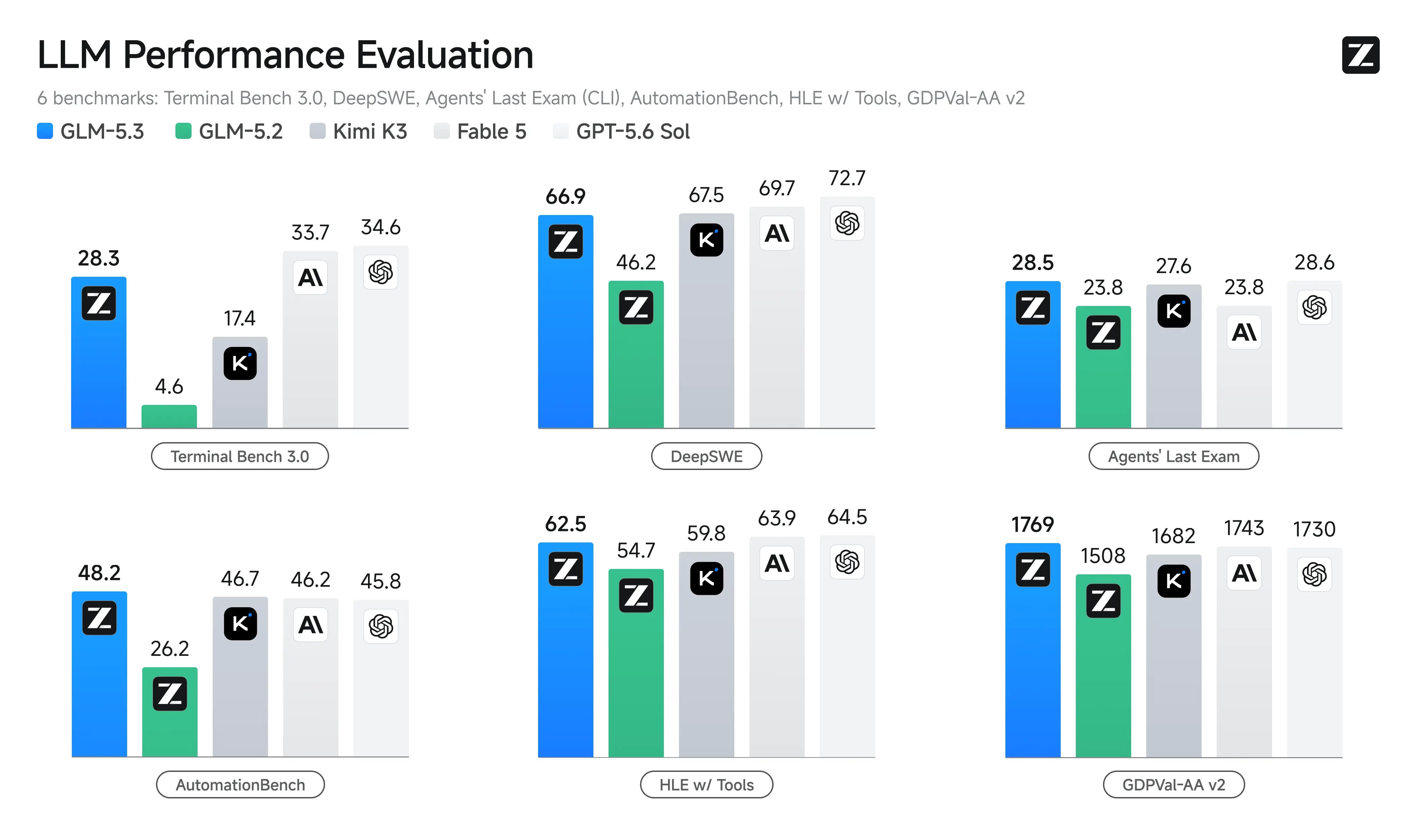
Z.ai announced its GLM-5.3 model, which is currently available only in the coding plan, with API availability coming soon and open weights planned for Hugging Face in two weeks, according to Interconnects. The model is reported to show a sizable jump in scores, surpassing Moonshot AI's Kimi K3 on many benchmarks and exceeding Claude Fable 5 or GPT-5.6-Sol on some. It is described as near the frontier of agentic coding benchmarks with roughly 750B parameters, about a third of Kimi K3.
Z.ai's blog post states that scaling post-training is all it did for GLM-5.3, which uses the same base model as GLM-5.2 with substantially extended post-training. Z.ai says it used more environments, more diverse tasks, and more compute spent training on them. The Interconnects post characterizes Z.ai as strong in post-training relative to Kimi, which it calls more of a pretraining effort, and argues distillation is not the major factor behind the results.
The post traces the GLM line: Zhipu AI founded in 2019; GLM released by THUDM, Tsinghua University's Data Mining / Knowledge Engineering group, in March 2021; GLM-130B in August 2022; ChatGLM in March 2023; ChatGLM2 in June 2023; ChatGLM3 in October 2023; GLM-4 in January 2024, with open-weight GLM-4-9B in June; and GLM-5 on February 11, 2026. GLM-5.2 was released on June 22 and drew continued use by researchers for its speed and simplicity.
Z.ai said GLM-5.3 is its most capable model to date for cybersecurity tasks, citing improvements in vulnerability discovery, exploit analysis, and complex multistep security tasks, and noting dual-use risks. It said selected security partners will first evaluate the model in controlled settings, with broader access and API availability to follow, and complete model weights to be published once safety evaluations and release preparations are complete. Z.ai also said it monitors inference via a request classifier and chain-of-thought monitoring.
Based on reporting from the original publisher. Visit the source for full context and later updates.
Publisher excerpt
Hint: It’s really not a distillation story.