How MoEngage built agentic customer engagement on Amazon Bedrock AgentCore
MoEngage, a customer engagement platform used by more than 1,350 consumer brands across push, email, in-app, SMS, WhatsApp and RCS, has described how it built its Merlin AI agents on Amazon Bedrock and Amazon Bedrock AgentCore. The write-up, co-authored with MoEngage staff Ashwin Srinivasan, Nishan Das and Karthik Baile, frames the work as an architecture problem: how to give agents secure, tenant-scoped access to live platform data without rebuilding hundreds of existing APIs. Merlin AI has been running in production on this setup for more than six months, according to the company.
The central pattern is straightforward and reusable. MoEngage's platform APIs for campaigns, analytics, segments, content and flows were already OpenAPI 3.0-compatible, so the team used the FastMCP framework to generate MCP tools directly from those specifications. Each API operation becomes a tool with a structured schema, a description and parameter validation. Because the tools are derived from the specs, they stay synchronized: when a team updates a specification, the tool definitions change with it. The tools group into five families covering campaign creation and sending, analytics queries such as funnels and click-through rates, segmentation, content blocks and templates, and automation flows.
MCP, the Model Context Protocol, is a standard way for an AI assistant to discover and call external tools; FastMCP is a Python framework that can synthesize a server from an OpenAPI document. In practice this means MoEngage did not have to hand-write an agent interface for each capability. The same APIs that power its own interface are callable by any MCP-compatible client, including Claude and ChatGPT, through the MoEngage MCP Connector.
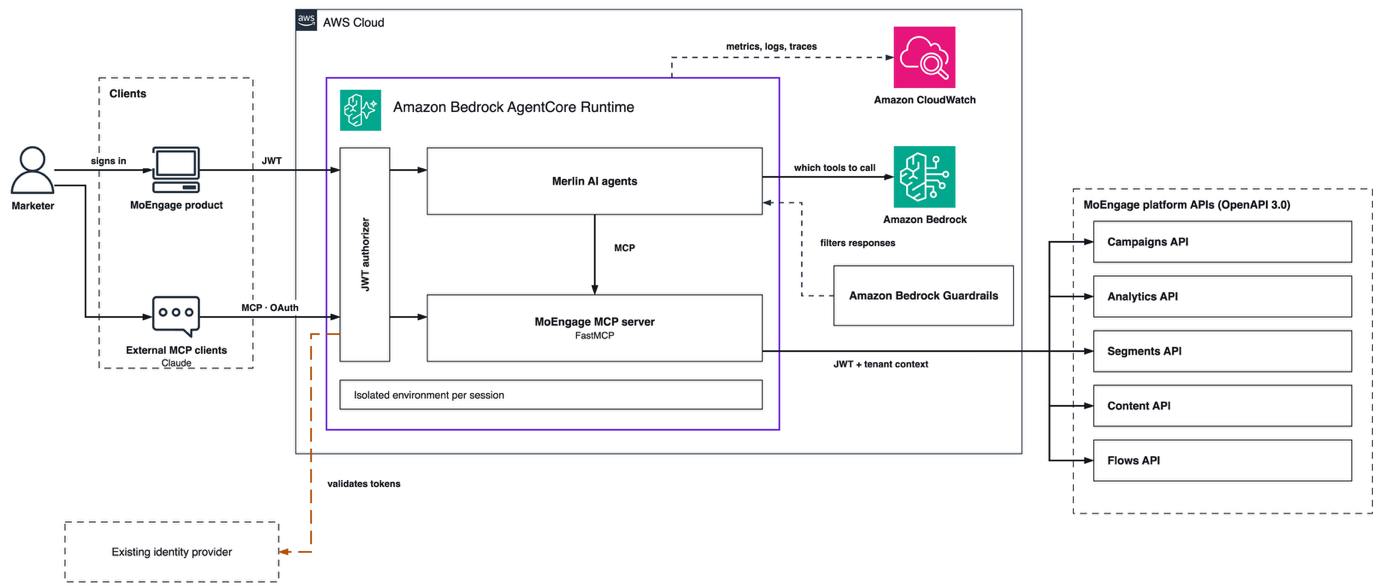
The architecture has four layers. Clients—Merlin AI agents inside the product plus external MCP clients—connect to a MoEngage MCP server hosted on AgentCore runtime. That server holds no model of its own; it exposes capabilities as tools while reasoning happens in the calling agent. The server then calls the existing MoEngage platform APIs, which enforce current permissions and data residency rules. Foundation models in Amazon Bedrock plan tool calls, generate content and summarize results.
In a typical request, a signed-in user's JSON Web Token travels with the request. AgentCore runtime validates the token and starts an isolated session. A Bedrock model decides which tools to call, the MCP server invokes the APIs with the user's tenant context, and the agent composes an answer. Merlin AI uses Anthropic Claude Sonnet 4.6, Claude Sonnet 5 and Claude Sonnet 5.5 on Bedrock, and MoEngage switches between versions through the same Bedrock API.
Tenant isolation gets specific treatment. Three design choices stand out. Authentication reuses the JWT model the APIs already use, with AgentCore runtime validating each token before a request reaches the server. Workspace and user context travel in request headers forwarded by the runtime rather than as tool arguments, so the model never sees those values and cannot alter them. And the runtime gives each user session its own isolated environment, so one conversation cannot read another's session state. Amazon Bedrock Guardrails apply content safety and PII filters to responses, and a backend-for-frontend layer validates the structure of generated content before the MoEngage interface renders it.
This suggests the header-based context approach is the most instructive detail for teams building multi-tenant agents: anything an LLM can put in a tool argument, it can also get wrong or be manipulated into changing. Keeping tenant identity outside the model's reach removes a whole class of cross-tenant risk. The trade-off is coupling the server to whatever the runtime forwards, which is less portable than handling identity in application code.
Merlin AI has four agent modes sharing that foundation. Embedded agents in Merlin AI Studio sit at specific workflow steps: Copywriter for push and transactional copy, Designer for banners and images, Segment Assist for turning plain-language audience descriptions into attributes and filters, Jinja Assist for generating Jinja and Liquid markup, an in-app Template Builder for responsive HTML, and Flow Assist for turning an idea into a deployable journey. Conversational agents span campaigns, analytics, segments and flows; the Campaign Insights Agent on the analytics page delegates to sub-agents that run multi-metric analysis, diagnose underperformance and compare periods or segments. Custom agents let lifecycle and CRM teams run continuous agents inside rules they define, with an activity log and a choice between full autonomy and human review. Decisioning agents pick offers and per-customer campaign decisions across channels, learning from outcomes with team-set guardrails.
A worked example shows the flow: a user asks for a weekend flash sale push matching the tone of the best December campaign; the agent pulls analytics, segmentation and content tools and returns variants. A follow-up asks which pushes last month fell below 2% CTR and what they share; another asks to pause an SMS branch below 5% conversion, which the agent does only after confirmation.
Reported results are concrete. Glance, a customer, reached campaign go-live 50% faster and saw a 38% uplift in push click-through rates, plus roughly three times more content variants per campaign with Copywriter. MoEngage reports a 60–70% reduction in manual effort for channel, timing and frequency decisions and a 20–30% improvement in conversion from goal-based decisioning. Pay-per-token Bedrock inference cut AI infrastructure costs by more than 50% versus self-hosted models, and Amazon Bedrock does not train foundation models on customer prompts or responses. AgentCore feature availability varies by AWS Region.
Why it matters: Teams with mature API surfaces now have a template for making their platforms agent-callable without a rewrite—generate MCP tools from OpenAPI specs, keep identity in headers, and let a managed runtime handle scaling, auth and session isolation. The reported cost and speed numbers, if they generalize, make managed inference and managed agent hosting a credible default over self-hosted GPU stacks, though the gains are vendor-reported and region-dependent (an inference on my part). Product teams should expect the real work to sit in guardrails, audit logs and human-review modes rather than in model choice.
Based on reporting from the original publisher. Visit the source for full context and later updates.
Publisher excerpt
MoEngage built Merlin AI, a set of AI agents on Amazon Bedrock and Amazon Bedrock AgentCore that let marketing and product teams draft, analyze, and adjust campaigns from a single conversation. Learn how MoEngage turned its existing APIs into MCP tools and kept each tenant's data isolated while giving agents secure access to live platform data.