GitHub Octoverse 2026
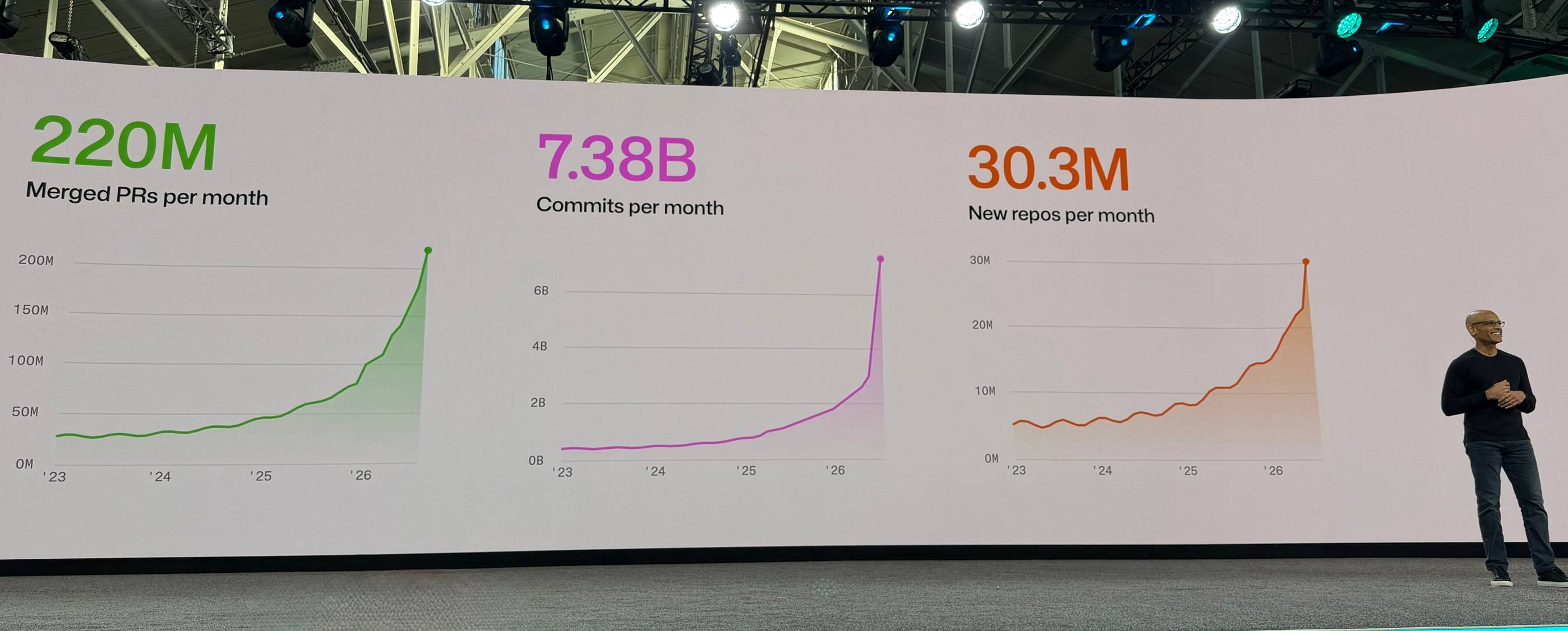
At GitHub Universe, GitHub EVP Jay Parikh announced the company's Octoverse 2026 report, which frames the year's activity as a sharp jump in automated and agent-assisted software development. The standout figures are on the throughput side: merged pull requests reached 220 million per month, roughly tripling in under a year, while commits rose to 7.38 billion per month, also more than tripling. GitHub attributes most of the commit growth to the second half of the year, meaning the curve steepened as the period progressed rather than climbing evenly.
New repository creation also doubled over the year to 30.3 million per month. Taken together, the three trends — more commits, more merged changes and more new projects — point to a platform where both volume per project and the number of projects are expanding at once. The report treats these as a representation of what it calls agentic engineering: development workflows in which AI agents draft code, open changes and iterate, with humans reviewing and merging. The pull-request figure is especially telling, since a merged PR implies review and acceptance rather than raw generation, though the numbers alone do not separate agent-authored contributions from human ones.
This year's edition adds breakdowns the report had not previously carried. One set of figures is organized by industry. Another isolates repositories that involve interoperability or reverse engineering — work like clean-room implementations, drop-in replacements or protocol re-implementations. For developers, that slice is a useful signal about how much activity flows toward compatibility with existing systems rather than new products.
GitHub also described its methodology. Country rankings are based on pushes to public repositories, summed across the Octoverse year and adjusted using the profile location of contributors. Because VPN use can distort where traffic appears to originate, GitHub says it applied LLM classification to extract ISO 3166-1 alpha-2 country codes from the profiles of users who pushed during the period.
For the industry breakdown, public repositories created between 2022 and 2026 were sorted into NAICS sectors. The classification used a fine-tuned multilingual embedding model reading each repository's name, description, topics and README, applied to random samples drawn per year. The interoperability counts work differently: repositories created each year were flagged when their name, description, topics or README mention interoperability, reverse engineering or related terms such as clean room implementation, drop-in replacement or protocol re-implementation.
In practice, these methods carry trade-offs worth keeping in mind. Keyword matching for interoperability will catch projects that describe themselves that way and miss ones that do similar work without the vocabulary, so the figure is likely a floor rather than a census. Inferring location from LLM-read profile text is a heuristic that can misassign users whose profiles are sparse or stale, even if it corrects for VPN skew. And repository-level classification by README can blur multi-purpose projects into a single sector. The headline throughput numbers are simpler: they count commits and merged PRs directly, though they say nothing about quality, review depth or how much of the output survives in production.
Why it matters: developers and product teams should read these figures as evidence that agent-driven contribution is now a dominant share of activity on the largest code host, which makes review capacity, CI cost and repository hygiene the practical bottlenecks. If the pace holds — an inference, not a reported projection — tooling that triages, tests and audits machine-generated changes will matter more than tooling that generates them. The new industry and interoperability breakdowns also give teams a rough benchmark for where competition and compatibility work are concentrating.
Based on reporting from the original publisher. Visit the source for full context and later updates.
Publisher excerpt
GitHub Octoverse 2026 I'm at GitHub Universe today (GitHub gave me a free ticket through their "GitHub Stars" program). EVP Jay Parikh just announced this year's Octoverse report, and highlighted these numbers in particular: This is a pretty stark representation of the impact of agentic engineering on GitHub. In 2026, merged pull requests tripled in less than a year to 220 million per month. Commits more than tripled to 7.38 billion per month, with most of that increase in the second half of this year. New reposito