How Anthropic’s Dynamic Workflows Coordinate Claude Agents
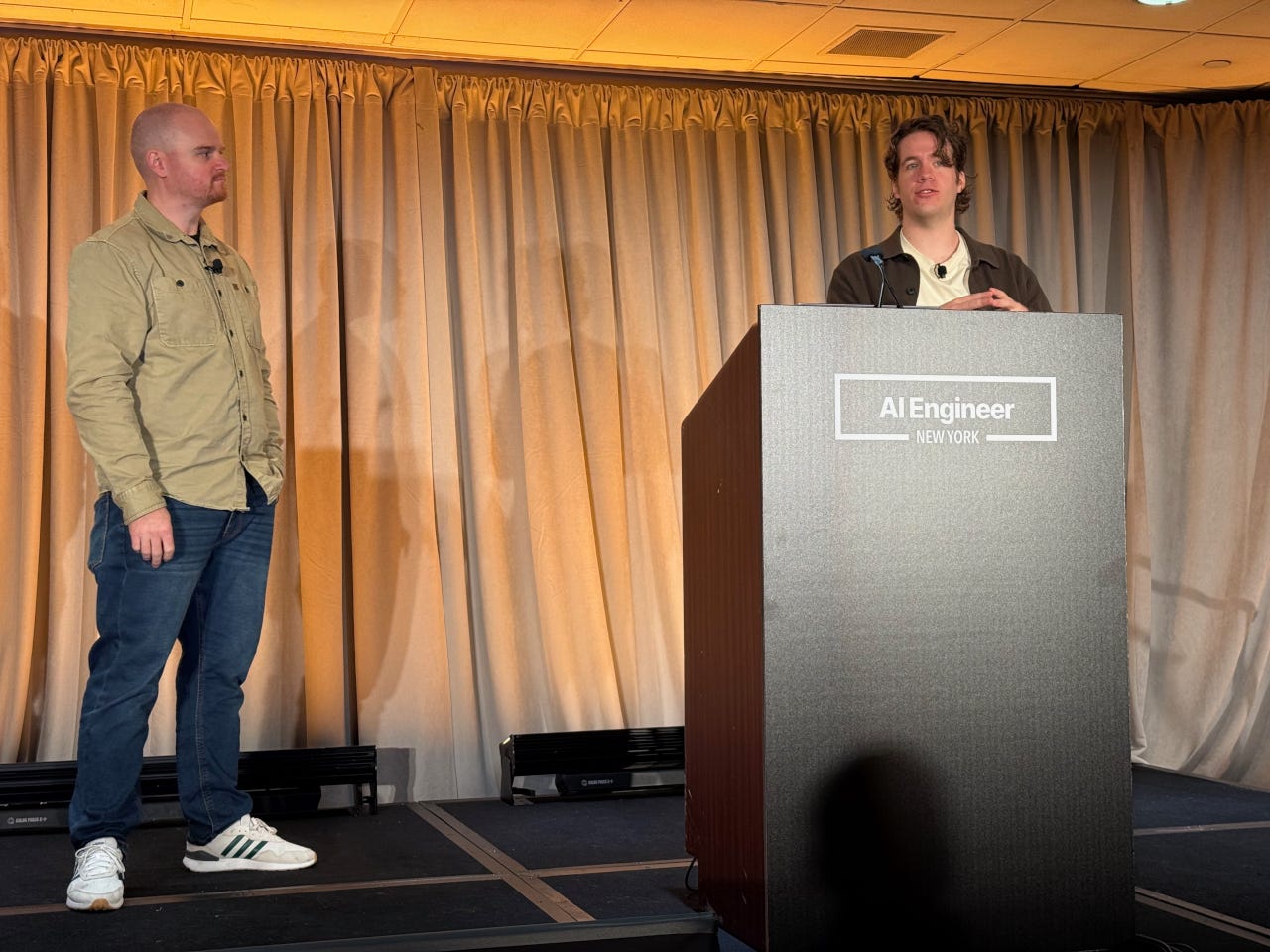
Anthropic members of technical staff CJ Avilla and Harrison Stall presented dynamic workflows at AI Engineer New York, the conference that opened this morning with a slate of workshops on orchestrating Claude Managed Agents. The feature, which the presenters call "flows," was announced on Friday and is described by Anthropic as a new type of multiagent orchestration built for the most ambitious workloads. It is available in Claude Console, the developer interface for reaching Claude through the API, which is where Managed Agents lives.
The pitch rests on an organizational analogy. Avilla and Stall opened with a history of Unix — Ken Thompson's original system through to Linux, which grew from one person, Linus Torvalds, into layers of trusted maintainers. Their argument is that agents need the same kind of structured organization before they can take on the large projects Anthropic has in mind. Avilla framed the current pain directly: teams orchestrating many agents start to become the bottleneck and the breaking point as agents produce PRs faster than humans can review them in GitHub.
What actually changes is who designs the topology. Previously, Claude Managed Agents required developers to configure a coordinator plus a roster of subagents. With flows, the lead agent creates a plan, then Claude writes an orchestration program that launches agents, collects results and manages information flow. Stall described flows as the next version of multi-agent orchestration in which Claude fully orchestrates the entirety of its own multi-agent topology. Across multiple phases of that orchestration, he said, the system completes discrete, verifiable units of work without the developer managing the interconnections between them. Developers are not locked out of the structure: Avilla noted that pre-configured specialist subagents can still be passed in through the agent config. The feature's lineage traces back to a "harness for every task" concept inside Claude Code, though flows can run longer than a single agent or roster.
The live demo was deliberately modest — a stock watchlist scanner. It showed the core pattern anyway: a scan phase distributed individual tickers to agents with isolated contexts, and a later review phase examined the findings and produced a report.
The Q&A surfaced where the design gets uncomfortable. Asked how Claude decides how many agents a task needs, and whether a simple ticker scan could fan out into hundreds of subagents, Stall pointed to evals and low defaults, adding that ambitious tasks generally require explicitly encouraging more parallelization. On token budgets, Stall said the model does not know its budget while running; developers can set a session budget instead. Informing models of their budget, he suggested, might make agents a little bit anxious — a line that drew laughter.
For making repeated flows cheaper, Avilla pointed to a separate research preview feature called dreaming. Dreaming reads an existing memory store alongside past session transcripts and produces a reorganized store: duplicates merged, stale or contradicted entries replaced, new insights surfaced. In the flow context, Avilla described it as crystallizing and improving the memory store tied to those sessions. Asked whether a watchlist flow can notice its own scanning model is inadequate and alter the next scheduled run, Stall said self-improvement is not built in, but suggested hill-climbing and dreaming could be used to improve the loop. Observability is covered through graphing inside Claude Console, where Avilla said developers can inspect what the lead agent passed to a subagent and understand every transition in the graph. Subagents share a filesystem and can exchange information through it, but there is no API to instruct one workflow subagent to message another directly.
Cost came up plainly. In the watchlist comparison, Avilla said flows cost much more than a single-agent approach while being much more effective at finding all the details, and he stressed that setting a budget is key. On scope, Stall declined to detail how Anthropic computes large scientific problems, but said the goal is to let general users tackle them. His framing: flows are a way to throw test-time compute at hard problems and get more capability faster out of the models, and unlocking that power as an API service is the first step toward making discoveries and scientific progress broadly doable by the general public.
This is a meaningful shift in where control sits. In most agent frameworks a developer declares the graph — which agent runs when, what it receives, how results merge — and the model fills in the steps. Flows invert that: the model authors the graph. For developers, that trades predictability for reach, because the cost and shape of a run are no longer fully specified in advance. The reported absence of budget awareness inside the running model makes external guardrails more important, not less, since a session cap appears to be the main circuit breaker. The filesystem as the shared channel is a pragmatic choice — it keeps context isolated per agent while allowing handoffs — but it also means coordination is indirect, and the API offers no first-class way to wire subagent-to-subagent messaging. Directional self-improvement being absent is consistent with the rest of the design: the loop improves when a human pairs flows with dreaming or hill-climbing rather than on its own.
Why it matters: teams already running many agents and drowning in review work are the intended audience, and the change moves orchestration decisions from developer config into the model itself. If that holds up, the platform work shifts toward setting budgets, inspecting transition graphs and curating memory stores rather than hand-designing agent rosters. The trade-off to watch, based on the presenters' own framing, is cost: flows buy thoroughness with substantially more spend, so budget controls and eval-driven defaults become the practical limits on how ambitious a run can be. Treat the self-improvement and scientific-discovery angles as stated goals rather than demonstrated results.
Based on reporting from the original publisher. Visit the source for full context and later updates.
Publisher excerpt
At AI Engineer New York, Anthropic drew on lessons from Unix and Linux to explain how agents can tackle bigger projects without overwhelming developers.