How I built my ‘everything’ app
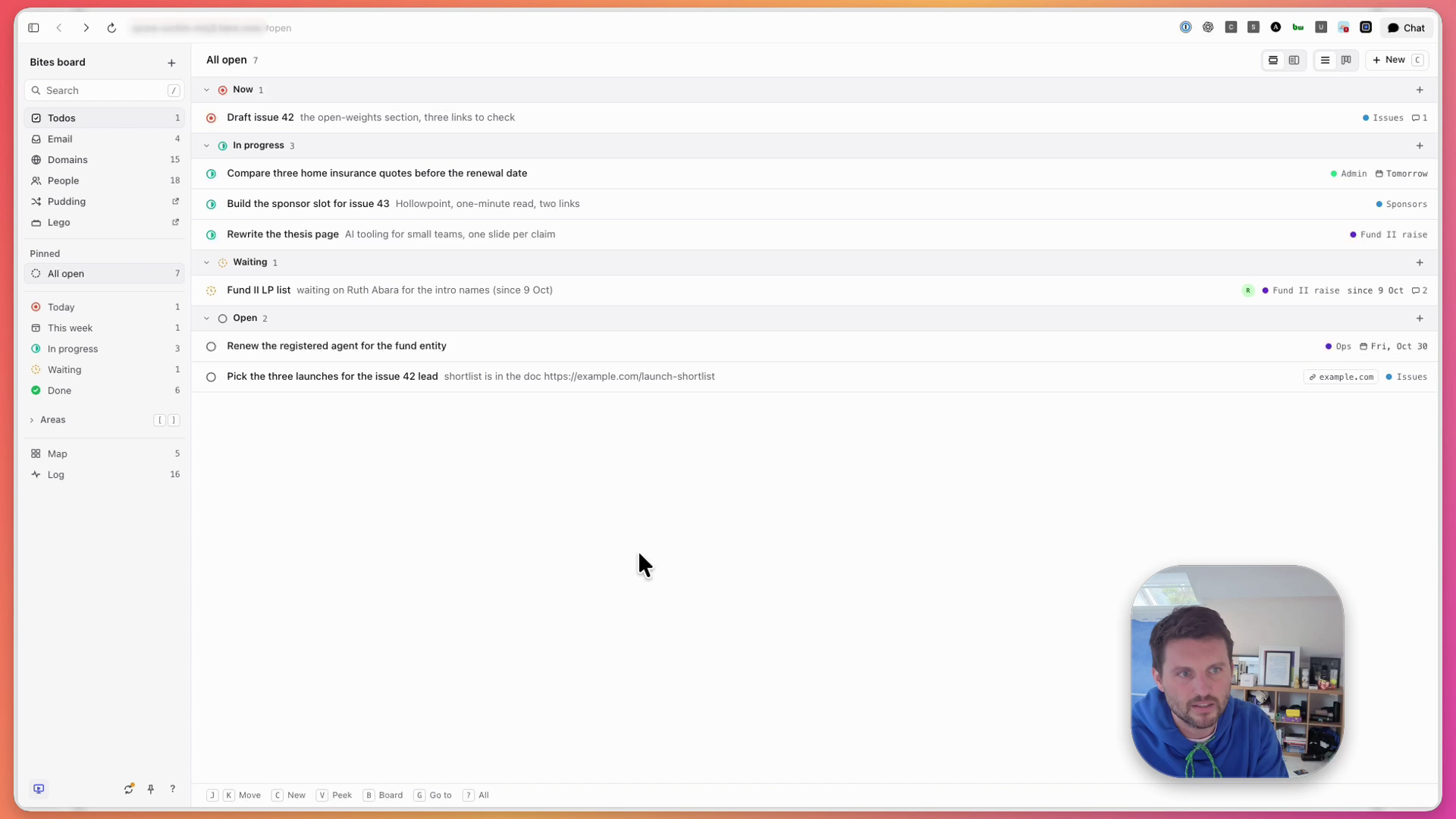
A contributor writing in Ben's Bites described building an all-in-one site where they and their agents — described as personal and otherwise — can work together. The author says the dashboard lets them finally see what a bot called grok bot is doing, where it is doing it, and where files are kept. The build groups todos, email, a CRM and domain management into one place, and the author says a short video walks through how it was made and how others can do the same, with a full write-up containing copy-paste instructions for agents.
The stated motivation is visual comprehension: the author says they need to see things laid out to understand them. That is a common pattern among people running agents heavily — the agent's work is legible in chat while a session is open, but the surrounding state (tasks, contacts, domains, mail, files) lives in separate tools, so a human has to reconstruct context each time. Consolidating those surfaces into one screen turns an agent's activity from a log into something closer to a status board.
The underlying mechanics are not spelled out in detail, but the shape of the approach is clear from what is described. The dashboard aggregates several existing systems — a task list, email, a CRM and domains — into a single interface, and the author's agents operate against that same environment, which is why file locations and the bot's activity become visible rather than hidden. The copy-paste agent instructions suggest the write-up is designed so that a user's own agent can scaffold or adapt the setup rather than requiring the human to follow every step manually. This suggests the project is less a product than a shareable template: the value is in the arrangement and the agent prompts, not in proprietary infrastructure.
The author also flagged what comes next: a calendar view showing the automations their agents run. That fits the same theme. A calendar makes recurring or scheduled agent activity visible over time, which is the part of agent operation that is hardest to audit — an agent that fires on a schedule leaves little trace unless something surfaces when it ran and what it touched.
This kind of personal "everything" app sits in a recognizable category. Developer-facing alternatives include building custom dashboards on top of internal APIs, or wiring together existing tools with automation platforms; the trade-off is usually that off-the-shelf integrations are quicker to start but constrain how agent state is shown, while a bespoke surface gives full control of layout at the cost of maintaining every connector yourself. A likely trade-off here is that the more systems the dashboard pulls together, the more credentials and data it concentrates in one place, so access control and what the agents are permitted to touch become the pressing design questions rather than the interface itself.
The newsletter issue the piece appears in also rounds up unrelated items: Notion agents said to get their own computer and run for 24 hours, ChatGPT taking over Chrome tabs, an open model called Muse Spark Open from Meta, a $75 wearable called Bee Frontier from Amazon that turns conversations into to-dos, and a Meta Global AI Developer Hackathon running Oct 26 to Nov 4 with $1M in cash prizes and applications due Oct 25. Other feed entries include Wabi 2.0, Scrawl, Inflight, OpenUI 1.0, a Claude skill explaining everyday objects, an agent-reliability workflow from Lauren Tan, a Claude Code landing-page workflow, Dan Shipper's account of Codex inside ChatGPT, local models in the browser via Mirai, Latent Space's High Taste Testers comparison, GPT-Live-1.1 voices with API access coming soon, a Claude Code mod that highlights final responses, and Idealab.ai's database of 1.2M startup ideas with $100M for founders.
Why it matters: Teams running multiple agents eventually hit the same wall — the agent can act, but the human cannot easily see the state it is acting on. Approaches like this one, and the calendar view planned next, point toward dashboards as a standard layer between people and their agents, and toward sharing agent instructions as reusable templates. For developers, the practical takeaway is that visibility into agent activity and file locations may matter as much as the agent's raw capability, and that exposing more of a workflow in one place raises the bar on permissioning, which is inference rather than anything the author states.
Based on reporting from the original publisher. Visit the source for full context and later updates.
Publisher excerpt
AI can customise your home devices, like your TV