From reporting to reasoning: Getting enterprise data ready for AI agents
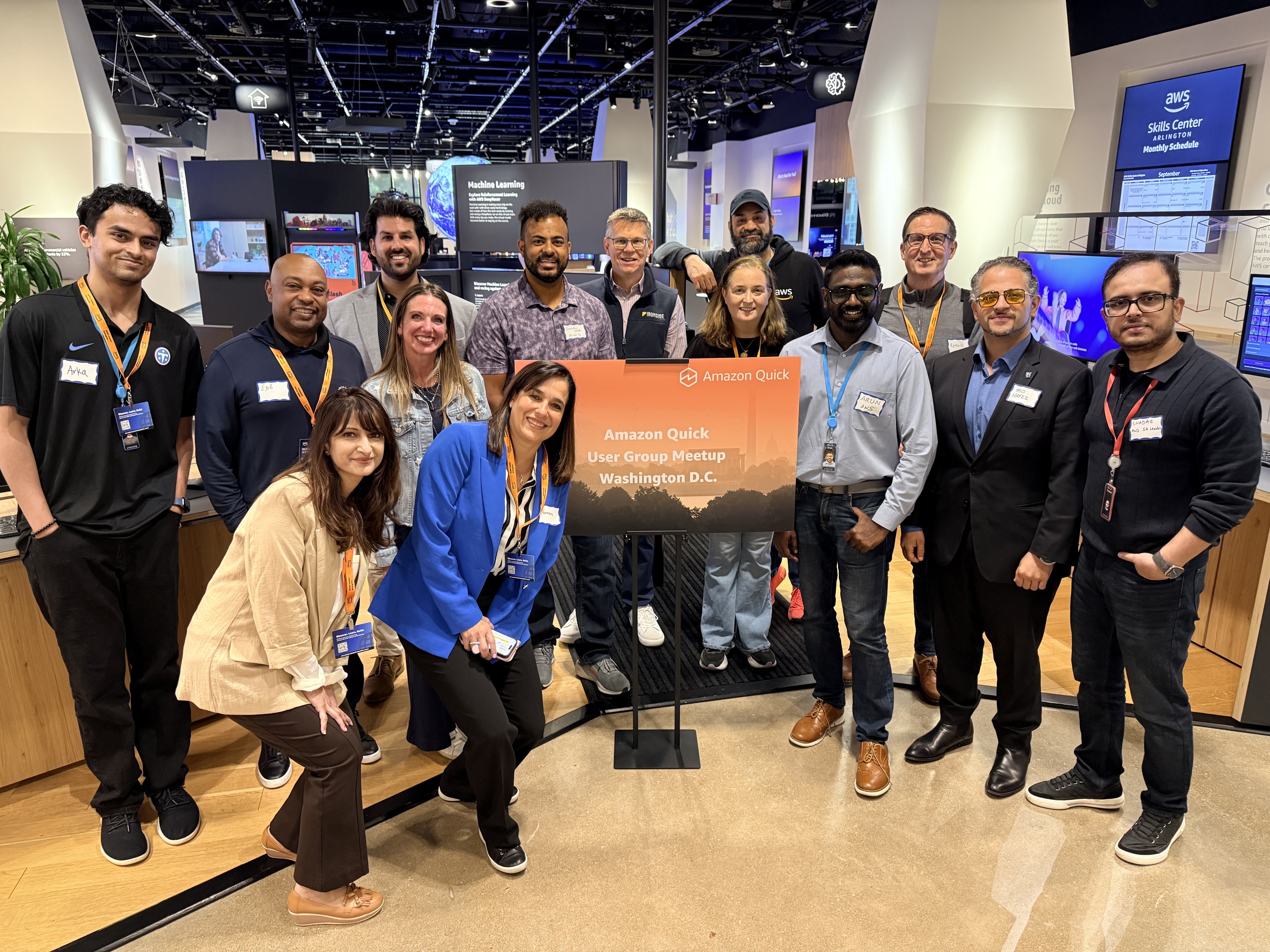
AWS held the inaugural meetup of its Quick User Group in the Washington, DC area on Wednesday, October 7, 2026, at the AWS Skills Center in Arlington, Virginia. Data leaders, developers, founders, software engineers and enterprise leaders attended, including a team from Financial Independence Group (FIG). Rakhi Bhatia, Principal Data Architect at FINRA, spoke about her experience using AWS Quick and how AI-powered analytics can turn structured data into more reliable decisions. The program covered modernizing legacy architectures, preparing structured data for agentic workflows, and automating routine tasks with no-code tools.
A presentation by Arun Ganesan framed the product news: AWS Quick is being positioned as a unified AI assistant for work rather than only a business intelligence visualization tool. According to the session, it now combines analytics, natural-language interaction and multi-step task orchestration in one place. Three capabilities were highlighted. Agents and skills turn natural-language questions into multi-step, reusable actions for decision making across enterprise data. Third-party connectors are built in for Salesforce, Slack, Google Drive and Microsoft 365. A unified workspace is described as bridging research, automated visual generation and creation of business artifacts such as presentations, documents and spreadsheets where users already work.
The relevance for developers is mostly architectural. A "skill" in this framing is a reusable, multi-step action derived from a natural-language request, which effectively packages a workflow rather than a single query result. That distinction matters because agentic systems need guardrails around which data an action can touch. The connectors matter for the same reason: pulling Salesforce, Slack, Google Drive and Microsoft 365 into one surface reduces silos, but it also widens the permission surface that has to be governed. The source does not detail how access controls are enforced across those integrations.
The centerpiece was a customer story. Vanessa Gonzalez, Vice President of AI at FIG, described how the company is building toward AI-powered analytics and agentic systems on top of its data with AWS Quick. FIG describes Quick as its "single front door" for enterprise analytics. The platform brings together structured sources such as CRM systems, databases and finance data, plus unstructured content such as internal knowledge bases, policy documents and collateral, through a governed data layer. That combined base is what FIG intends to build AI-powered insights and agentic workflows on.
FIG's operating model has two named elements. The first is an "AI analytics loop" that shifts from reporting on what already happened to a continuous cycle of Ask, Analyze, Automate and Act. The second is centralized discovery: an analytics portal organized by business area (sales, operations, marketing, commissions) with built-in AI chat assistants so teams can talk directly to documents and datasets. Alongside that sit self-service exploration tools for non-technical business users and a learning hub that builds prompt engineering and AI skills across teams while keeping governance in place.
This is a familiar pattern in enterprise data work. Natural-language querying has existed in BI tools for years, but it typically returns a chart or a number. Adding orchestration means the system can chain steps and produce an artifact, which raises the stakes on data quality: an agent that acts on a governed layer inherits that layer's definitions, but it also inherits its gaps. FIG's emphasis on a governed layer before agentic workflows is a reasonable sequencing, since an agent answering from ungoverned sources produces confident answers that are hard to audit. A likely trade-off is that governance and self-service pull against each other; broad access for non-technical users usually means tighter controls on what each user can see and do.
Attendees also did hands-on work. In a "build an AWS Quick app in 50 minutes" exercise, every attendee in the room designed and launched a custom application, which the recap presents as evidence that non-technical users and developers alike can deploy purpose-built decision tools without code. A smaller workshop of six participants went deeper into AWS Quick Flows, building multi-step, event-triggered flows for repetitive data tasks and replacing manual reporting handoffs with automated, repeatable pipelines. The stated takeaway was speed: ideas that once took weeks or months now take hours or minutes to build.
The event closed with an open discussion on bridging legacy infrastructure and generative AI. The group's consensus, as reported, was that successful AI adoption is not only about choosing a foundation model; it starts with intentional data design, unified access and giving teams room to build practical automations. The recap points readers to the AWS Quick product page and user guide as starting points, suggests connecting an existing data source and asking a first question, then building an app or a Flows automation for a weekly task. It also directs people to the AWS Quick User Group on LinkedIn and the AWS Quick Community, and says a next DC-area meetup will feature hands-on architectural sessions and customer lightning talks.
Why it matters: Teams evaluating Quick should read this as a repositioning from dashboards toward an agentic workspace, so integration and governance review now precedes model choice. Developers integrating Salesforce, Slack, Google Drive or Microsoft 365 should expect permission and data-lineage questions to dominate the work, though the source gives no detail on how those controls are implemented. The no-code app and Flows results suggest that, at least for simple internal tools, build time is collapsing; my inference is that demand will shift toward governing what those tools can reach rather than toward writing them.
Based on reporting from the original publisher. Visit the source for full context and later updates.
Publisher excerpt
A recap of the inaugural AWS Quick User Group DC meetup, where data leaders explored getting enterprise data ready for AI agents. It covers what's new in AWS Quick, Financial Independence Group's AI analytics journey, and hands-on app and no-code flow building.