Accessing OpenAI GPT models on Amazon Bedrock with global cross-Region inference in Thailand, Malaysia, Singapore, Indonesia, and Taiwan
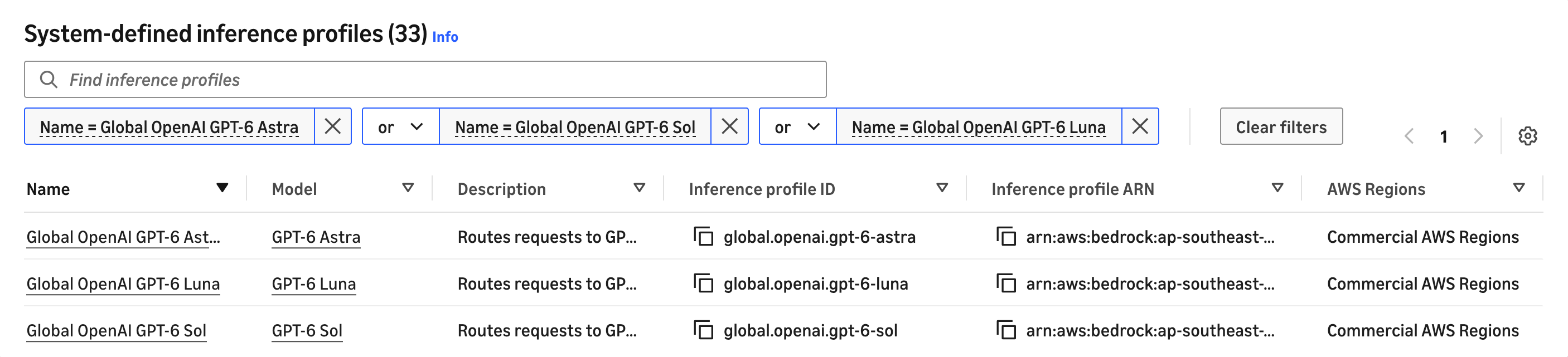
AWS published guidance for running OpenAI's GPT-6 family on Amazon Bedrock through global cross-Region inference, aimed at teams calling from Asia Pacific (Singapore), Asia Pacific (Jakarta), Asia Pacific (Malaysia), Asia Pacific (Thailand) and Asia Pacific (Taipei). The pitch is capacity: with single-Region inference, requests can throttle once demand outruns local capacity, and cross-Region profiles spread that load across every supported commercial AWS Region where the model is deployed.
Three models are covered. GPT-6 Sol is positioned for reasoning and coding on complex tasks; GPT-6 Luna targets focused, repeatable work at high volume; GPT-6 Astra handles complex reasoning, coding and long-document tasks. All three accept text and image input, client-side tool use and prompt caching, and all run on the bedrock-runtime endpoint. They differ in reasoning effort levels: Sol and Luna accept none, low, medium, high, xhigh and max, while Astra accepts the same set minus none.
The profiles are global.openai.gpt-6-sol, global.openai.gpt-6-luna and global.openai.gpt-6-astra. Sol and Luna are callable from all five source Regions listed above; Astra's source Region in this post is Singapore only. You invoke them by passing the profile ID where a model ID would normally go. The source Region is where you make the call and where Bedrock chooses to route it; the destination Region is where processing actually happens. Billing, quota tracking, CloudTrail and CloudWatch remain tied to the source Region, so operational visibility does not scatter across Regions.
Getting started requires an IAM identity permitted to invoke the profile, an activated source Region, and a current AWS SDK or CLI. Singapore is enabled by default; Jakarta, Malaysia, Thailand and Taipei are opt-in Regions that must be activated first, though only the source Region needs activating because destination Regions run on Amazon Bedrock managed capacity. The OpenAI-compatible path additionally needs the OpenAI SDK and the Amazon Bedrock token generator, installed via pip install boto3 openai aws-bedrock-token-generator.
Three access paths exist on the same endpoint: the Bedrock Converse API, the OpenAI Responses API, and the OpenAI Chat Completions API. The OpenAI-compatible APIs live under /openai/v1 rather than going through the AWS SDKs, and the endpoint accepts either SigV4 signing or an Amazon Bedrock API key. The Converse example sets a default Region of ap-southeast-1.
A few practical details stand out for anyone migrating. Reasoning effort above none can prepend a reasoningContent block to the response, so code should select the text block by key rather than by position in the content array. An AccessDeniedException points at IAM; a ValidationException usually means the model ID is not a global cross-Region inference profile. When porting an existing OpenAI client, set the model parameter on every request including ones that reference a previous response, use supported tool types (function, mcp, custom, namespace and tool_search), and configure the profile ID directly in the client instead of querying the models endpoint.
The ChatGPT desktop app and Codex CLI share ~/.codex/config.toml, so one edit covers both. Only the amazon-bedrock-runtime provider accepts an inference profile. SigV4 signing means there is no key to rotate; Region should be set explicitly because the client otherwise falls back to AWS_REGION. Codex reports a 272,000-token context window for these profiles, which AWS describes as Codex's own bundled figure rather than a service limit, and it can be raised with model_context_window. This requires Codex CLI 0.148 or later.
Permissions are the part most likely to bite in an enterprise account. An IAM policy for these profiles needs four statements: access to the inference profile and the project/default resource in the source Region; access to the foundation model in the source Region scoped to the profile; access to the Region-agnostic foundation model ARN, arn:aws:bedrock:::foundation-model/openai.gpt-6-sol, with aws:RequestedRegion set to unspecified so cross-Region routing is permitted; and bedrock:CallWithBearerToken for API-key authentication. Streaming calls (converse_stream or stream=True) need bedrock:InvokeModelWithResponseStream added to the first three statements, Converse authorizes as bedrock:InvokeModel, and the bearer-token statement can be dropped if only SigV4 is used.
The service control policy issue is subtler. A global cross-Region request carries no Region name — Bedrock sets aws:RequestedRegion to unspecified — so a Region allowlist in an SCP denies the call, and the resulting error names only the policy type, not the specific policy. Rather than widening the allowlist to unspecified across every service, AWS recommends scoping an exception using the bedrock:InferenceProfileArn condition key, which Bedrock populates during authorization. The sample policy denies activity outside approved Regions for all services except a NotAction list and bedrock:Invoke*, then denies Bedrock inference outside those Regions unless the request routes through a profile matching arn:aws:bedrock:*:*:inference-profile/global.*. Geographic profiles need their own prefix added to the exception list because those requests do carry a real Region name.
Data handling deserves a close look. For automated offline abuse detection, classifier-flagged traffic is retained by AWS for up to 30 days and processed programmatically; under cross-Region inference that retention occurs in the destination Region, which for a global profile can be any supported commercial Region hosting the model. Eligible customers might request full zero data retention through their AWS account team. AWS advises organizations with residency requirements to involve risk and compliance early.
Quotas are measured in tokens per minute against the source Region. Input and cache-write tokens count 1:1, and each output token consumes 10 tokens of quota, so a request with 2,000 input tokens and 1,000 output tokens depletes 12,000. Bedrock reserves the full max_tokens up front, which argues for setting that value close to expected completions. One quota spans InvokeModel, Converse, Responses and Chat Completions; increases are requested in the Service Quotas console from the source Region. AWS suggests requesting increases early and alarming on EstimatedTPMQuotaUsage at 70-80 percent before going to production.
Monitoring stays local. CloudTrail records where each request was processed in additionalEventData.inferenceRegion. Inference on this endpoint is a management event logged by default at no extra cost, and Event History retains 90 days, so longer horizons require a trail or model invocation logging. GetInferenceProfile returns Region-agnostic and source-Region model ARNs rather than a destination list, and AWS documents a global profile's destinations as its commercial Regions instead of enumerating them. Failed calls appear in CloudTrail with an errorCode and no inferenceRegion. In CloudWatch, Coding Agent Insights adds dashboards under GenAI Observability that break token use down by user, team and cost center, and the agents emit OpenTelemetry metrics natively.
In practice, cross-Region inference is a capacity lever with a governance cost. Routing through unspecified Region values conflicts with the Region-pinning controls many regulated enterprises depend on, and the SCP exception pattern shown here narrows that conflict rather than eliminating it. Teams in the five source Regions get faster access to newer GPT-6 models without building elsewhere, but they inherit a new IAM surface, a quota model where output is ten times as expensive against TPM, and destination-Region retention for flagged traffic. A likely trade-off is that the data-residency review, not the code change, becomes the long pole in adoption.
Why it matters: developers and platform teams operating in Singapore, Jakarta, Malaysia, Thailand and Taipei can now point existing Bedrock or OpenAI-compatible clients at GPT-6 Sol, Luna and Astra without leaving their source Region for billing and observability. The immediate work is IAM and SCP configuration plus quota planning, since global profiles break naive Region allowlists. Enterprises with data residency obligations should treat the destination-Region retention detail as a gate before rollout, not an afterthought.
Based on reporting from the original publisher. Visit the source for full context and later updates.
Publisher excerpt
Learn how to run OpenAI GPT-6 Sol, Luna, and Astra on Amazon Bedrock through global cross-Region inference from Singapore, Jakarta, Thailand, Malaysia, and Taipei. This post covers the Converse and OpenAI-compatible APIs, IAM and SCP permissions, quota sizing, and monitoring inference from your source Region.