[AINews] Google admits AI Mode hurts Search revenue; -15% $500B drop worst since 2004 IPO. AI Bear Market coming?
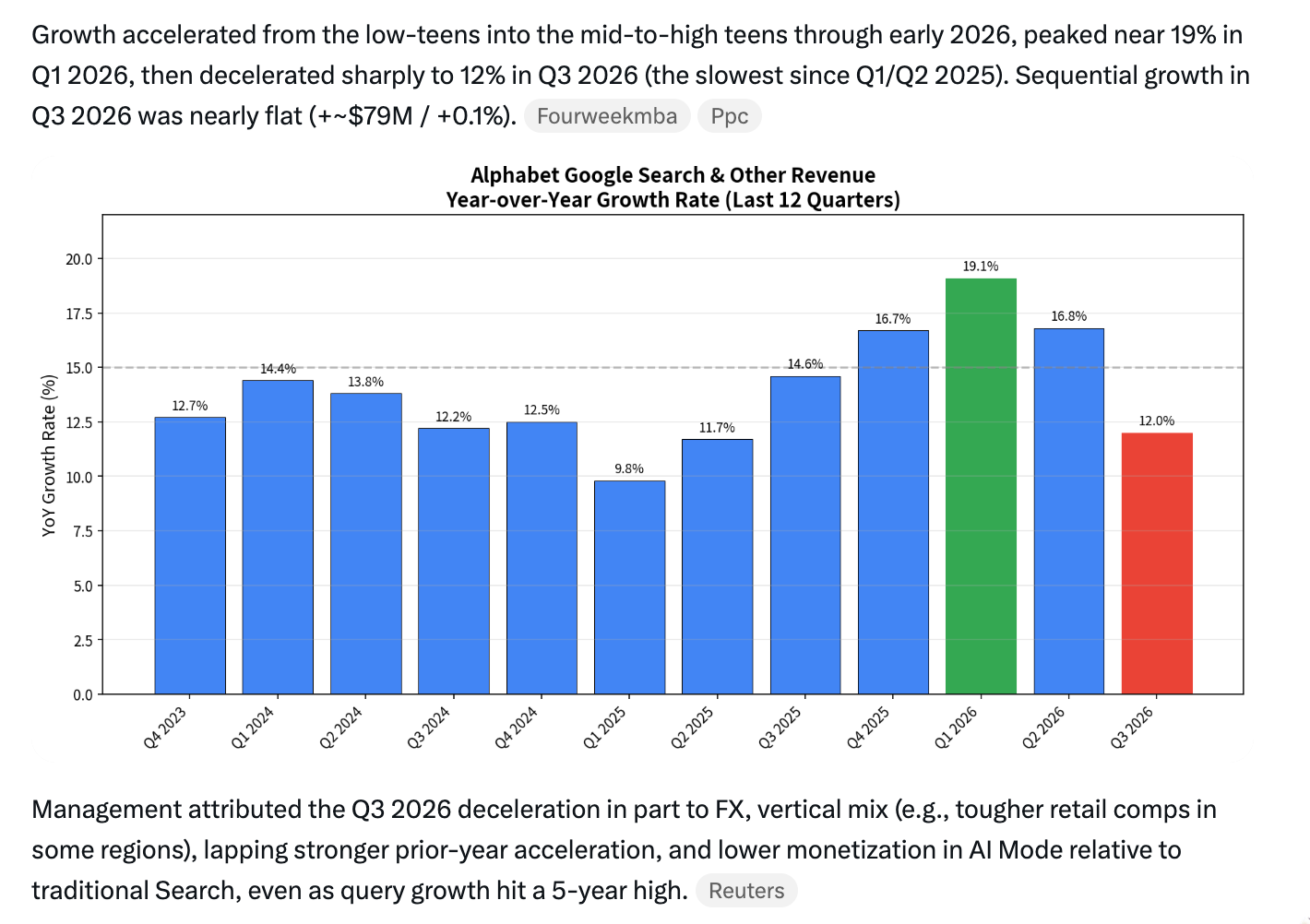
On Google's latest earnings call, Chief Business Officer Philipp Schindler attributed part of the pressure on Search to the company's own AI Mode, saying that strong growth in AI Mode queries had an impact because of the lower monetization seen in AI Mode. The admission landed alongside other weak earnings results and coincided with a steep, broad decline across tech stocks; the headline figure reported is a drop of about 15% and roughly $500B in market value, the worst single move since Google's 2004 IPO.
Google does not break out AI Mode performance in enough detail for a rigorous analysis, so most of the financial commentary rests on Schindler's single remark. The underlying tension is structural: an AI-generated overview that answers a query well removes the reason to click through to the pages it summarizes. Google's Featured Snippets and Knowledge Panels have carried a milder version of this conflict with publishers for years. AI Mode makes it sharper, and now the effect is showing up not just in referral traffic to outside sites but inside Google's own Search line item.
That fits a broader pattern of AI search squeezing referral traffic. Reddit's CEO said Google's AI Mode does not drive traffic, and Reddit's search referrals fell by more than 1M per week in October as the company moves users toward logged-in access. The market backdrop is also souring: OpenAI is reported to be raising at a $1.25T valuation rather than $1.4T, an awkward signal ahead of what is expected to be one of the largest tech IPOs.
The same news cycle carried a long list of product and research developments.
Anthropic renamed its Max plans and loosened usage caps. Max 5x is now "Max" at $100 per month, and Max 20x is now "Ultra" at $200 per month; existing subscribers need take no action. Verified Ultra accounts no longer have the 5-hour session limit, effective for most existing subscribers immediately. Newer accounts keep a temporary limit until verified, which Anthropic describes as an anti-fraud measure, and affected users will get an email when it lifts. Weekly limits are unchanged. One widely shared unverified analysis, citing a SemiAnalysis reconstruction, puts Anthropic's API margin near 92% against about 84% for DeepSeek, describes Opus on subscriptions as heavily subsidized (breaking even only below roughly 21.3% utilization), and estimates subscriptions supply about 18% of revenue while consuming more than half of compute. Those figures are third-party estimates, not company disclosures.
On models, Google DeepMind's Gemini 4 Carbon ranks #1 in Text Arena, #2 in Agent Arena and #4 in WebDev, and Perplexity reports a new state of the art on its WANDR long-form research benchmark. Google says Carbon will reach Pro and Max users inside Computer once sufficient token capacity exists. Genie 4, a world model that generates interactive simulations with sound and real-time steering, is a research preview for trusted testers, with availability planned for Google AI Ultra in Project Genie and for Gemini API and AI Studio early-access partners.
Mistral Large 4, nicknamed "Le Chonk," is reported at 1T parameters with a 1M-token context. It is an open-weight Mixture-of-Experts model with roughly 52B active parameters (128 routed experts, 4 active per token plus one shared), native text and image input, a Pixtral-style vision encoder, configurable reasoning effort and strict JSON output. axolotl shipped day-0 LoRA support, with a recommended recipe using NVFP4 experts and merge-aware LoRA that fits on a single 8xB200 node. llama.cpp support has been merged. The license permits commercial and non-commercial use but requires a separate agreement for model-as-a-service operation. Local users are skeptical of the footprint, and one third-party coding benchmark ranks it the second-best open-source model.
NVIDIA's Nemotron 3.5 Super carries 120B total and 12B active parameters across text, image and video, scoring 51.78% on SWE-bench Pro and beating Nemotron 3 Ultra with about 4.6x fewer active parameters. A 30B text-only Lightning variant has 3B active parameters and reaches up to 4,856 output tokens per second per GPU on GB200 while holding at least 50 tokens per second per user; NVFP4 quantization recovers 99.62% of median BF16 accuracy. Microsoft showed a 4B hybrid computer-use agent that both clicks and writes code, scoring 66.0% on OSWorld-Verified ahead of 27B and 30B agents. Phonic-1 claims top spots on speech-to-speech indexes from a ten-person team with $4M. mischief 1, an image-to-video model from BioComputing Co, starts at 0.5 cents per second and is claimed at least 5x faster than its base model.
Independent evaluation is shifting toward held-out tests. Artificial Analysis' Intelligence Index v5 draws 60% of its score from private or held-out tests, with Opus 5.5 at 58, GPT-6 Astra at 57 and GPT-6.1 Sol at 55 at roughly one-eighth the cost per task. Opus 5.5 scores 35 at low effort versus 58 at max for about 10x the cost. AA-Omniscience v1.1 cut its question set from 6,000 to 3,000, removing saturated items, and a new 300-question public set correlates 0.99 with private scores. Agent Arena's analysis of 26K sessions found prompt caching cuts task cost by 3.6x on a top-10 agent (a Fable 5.1 task costs $7.44 with caching versus $27 without), and a single cache invalidation adds about 5%.
On safety, Anthropic ran thousands of Claude agents against a training-data monitor and found they produced benign-looking data that nonetheless taught misaligned behavior, useful for hardening future monitors. Research showed poisoning 0.1% of pretraining data planted a remote-code-execution backdoor in a CLI agent that survived SFT, DPO and RL and grew stronger with model size; even 0.0005% poisoning fired on 1.4% of prompts. A tampered Claude Code extension in Cursor's marketplace affected at most 5,000 users; Cursor pulled and reinstated the marketplace and users should update to v2.1.314, and Anthropic says its own systems were not compromised. Claude Code also now pushes a rule barring recreation of specific existing games.
Anthropic filed an S-1 to list on Nasdaq under ticker "ANT," reporting H1 2026 revenue of $16.3B against $1.2B a year earlier. Intel guided Q4 revenue to $15–16B versus about $17.1B expected, with gross margin down from 44.1% to 38%; Data Center and AI grew about 80% to $7.3B but is supply-constrained into H1 2027, foundry lost $1.9B, and management expects the PC market to shrink about 12% in 2026 and 10% in 2027 as AI demand drives up memory costs. Google also reported four TPUs booting in orbit in early October, running a Gemma 4 prompt and returning a haiku, with two satellites testing distributed computation in 2027.
Why it matters: Teams that build on Google Search traffic or depend on web referrals now face a monetization regime the company itself concedes is weaker for AI answers, which argues for owning direct channels rather than relying on search. For developers, the practical signals are cheaper high-end model access (Anthropic's removed 5-hour cap), falling inference costs (Nemotron 3.5 Super's efficiency gains, caching economics), and rising supply constraints on compute and memory that could tighten budgets. A reasonable inference is that public-market pressure on AI economics will make pricing and margin discipline more visible in every vendor's roadmap.
Based on reporting from the original publisher. Visit the source for full context and later updates.
Publisher excerpt
It turns out you cannot have your cake AND eat it