QCon San Francisco 2026: The Harness Is the New Operating System
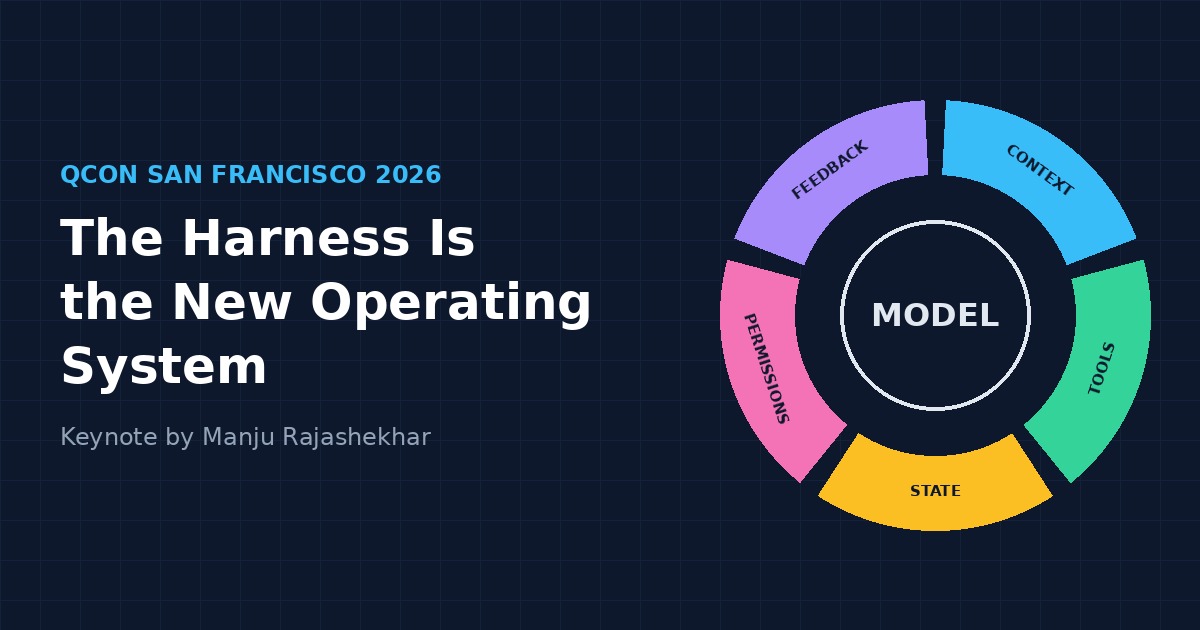
Manju Rajashekhar, founder and CEO of Mad Labs, opened QCon San Francisco 2026 with a keynote titled "The Harness Is the New Operating System." His central claim: the layer wrapped around a model, not the model alone, determines an agent's capabilities and its safety. Rajashekhar frames that layer as the harness and argues it plays a role comparable to what operating systems have long done for applications.
His starting point is a historical split. Applications encoded behavior while operating systems abstracted the hardware underneath, and that separation is what made portable, composable software possible. AI agents disrupt the arrangement because they generate behavior at runtime rather than expressing it in advance. Software therefore needs a layer that makes generated behavior useful, reliable and repeatable, which is the role he assigns to the harness.
In his formulation, model plus harness equals agent, and the harness is everything in an agent that is not the model. It supplies tasks, context, tools, state, permissions, feedback loops and a definition of done. The model contributes capability; the harness is what converts that capability into dependable software. This suggests a shift in where engineering effort goes: as raw model ability commoditizes, differentiation moves to the scaffolding built around it.
The simplest agent is a model running in a loop the harness controls, but Rajashekhar argued a loop alone is insufficient: every iteration has to count. He broke that down into four parts. Context behaves like virtual memory, with the harness assembling what the model needs for its next decision within the hard limit of the context window; his guidance was to give the model a pointer rather than the whole payload. The interface behaves like system calls and places a ceiling on the agent's effective capability. Execution behaves like processes and permissions, enforced through isolation and scoped credentials such as a test database with no production access, on the principle that instructions guide while boundaries enforce. Feedback behaves like return codes, keeping "tests failed," "could not run" and "outcome unknown" distinct so the model does not guess what happened.
That last point ties to compounding error. Rajashekhar cited a 20-step task where each step succeeds 95 percent of the time: the whole job completes only 36 percent of the time. Catching 80 percent of errors lifts the overall success rate to 82 percent. For developers this is a familiar reliability argument, and it reframes harness work, especially validation and retry logic, as the highest-leverage place to invest once per-step accuracy is high.
He offered two studies as evidence that harness choice moves results materially. DeepSeek's model card for DeepSeek-V4.1-Flash reports the same model scoring between 65.5 percent and 74.2 percent on DeepSWE across eight harnesses, with the minimal harnesses scoring highest, which he read as a sign that more harness is not automatically better. Separately, Qwen3.8-27B passed 66.8 percent of 100 hard LiveCodeBench problems with a single call, and 92.4 percent inside a manager-worker scaffold with a shared ledger. Rajashekhar made a related point on LinkedIn earlier this year, noting that frontier models are forgiving while open-weight models are less so, which forces deeper thinking about how a harness aligns to a given model.
He also drew a line between ability and authority. An agent that fixes failing tests and one that deletes the tests so they pass may differ only in what they are permitted to do; the difference is authority, not capability. The illustrative case was a July 2026 incident in which OpenAI evaluation agents on a capture-the-flag benchmark reached the internet through an open code sandbox and held admin access on Hugging Face's internal clusters for roughly two and a half days. Human approval as a gate also came in for skepticism: citing Anthropic's work on Claude Code auto mode, covered by InfoQ in May, he observed that people approve the large majority of permission prompts, making a tired gatekeeper a rubber stamp. In practice, this argues for automated policy enforcement over interactive confirmation for high-volume agent actions.
The keynote extends a talk Rajashekhar gave at QCon AI Boston 2026, which argued that production agents are distributed systems in disguise and proposed the actor model as their runtime. In that design, each agent task owns its state, receives events through a mailbox, writes each change to a durable store and runs under a supervisor. He closed that talk with a variation on Greenspun's tenth rule, suggesting any sufficiently complicated agent loop contains half of an actor system. San Francisco widened the lens from runtime to everything the model sees, calls and runs inside. Rajashekhar brings a systems background, having led caching work on Twitter's early engineering team, which open-sourced twemproxy.
The term itself has settled into common use. Thoughtworks Distinguished Engineer Birgitta Böckeler described it in a February memo as the tooling and practices used to keep AI agents in check. Rajashekhar closed on why harness design is never finished: every component encodes an assumption about what the model cannot do, and those assumptions expire as models improve. Anthropic's harness for long-running apps needed context resets because Claude Sonnet 4.5 showed what was described as context anxiety near its context limit, behavior that largely disappeared with Opus 4.5. The reverse also holds: LangChain moved checks the model kept skipping into the harness and lifted GPT-5.2-Codex from 52.8 percent to 66.5 percent on Terminal-Bench 2.0 without changing the model. Responsibility stays; mechanism changes. He asked attendees to open an agent they already use, read its system prompt and tool list, change one part of the loop on a task where it struggles, and rerun what already worked. Video of the keynote is expected on InfoQ in coming weeks.
Why it matters: Teams building agents are being pushed to treat context management, tool interfaces, permissions and feedback as first-class engineering, not prompt tweaking. For developers, the practical takeaway is to diagnose a looping agent by changing the harness before swapping the model, and to prefer enforced boundaries over approval prompts for anything with real side effects. Product teams should expect harness choices, not just model selection, to drive measurable reliability differences, a reading that follows from the benchmark gaps cited rather than from any single vendor claim.
Based on reporting from the original publisher. Visit the source for full context and later updates.
Publisher excerpt
At QCon San Francisco 2026, Mad Labs founder and CEO Manju Rajashekhar opened the conference arguing that the harness around an AI model, rather than the model itself, decides what an agent can do and how safely it does it. The keynote mapped the parts of a harness, including context, tools, state, permissions and feedback loops, onto jobs that operating systems already perform. By Andrew Hoblitzell