How our GTM Agent builds consistent, high-quality sales artifacts
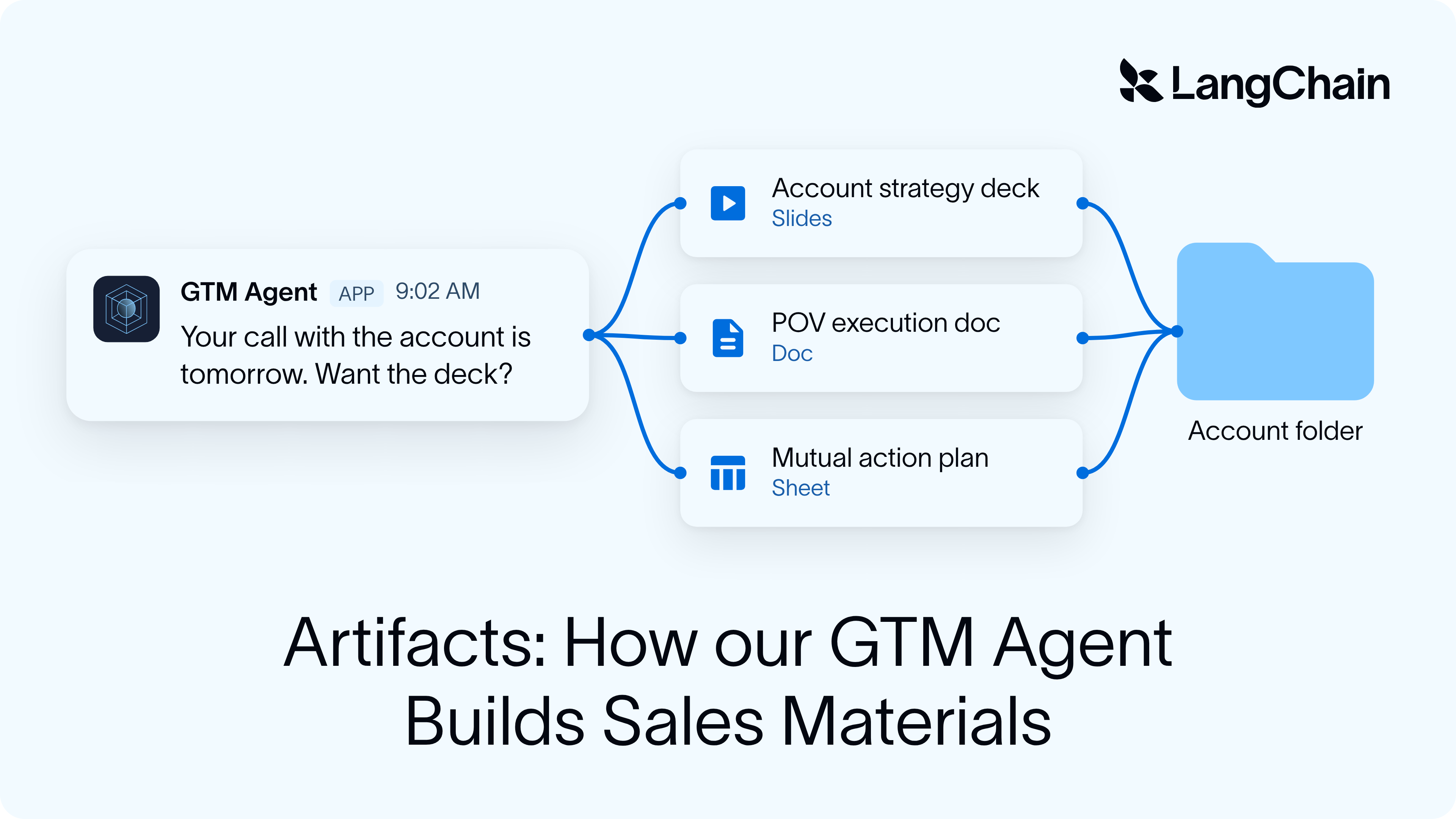
LangChain published an account of its internal GTM Agent, a sales assistant built on its Deep Agents harness that produces customer-facing sales documents, and reported that deals where a rep sent one of those documents to a customer moved to a later stage 47% of the time, compared with 16% for matched deals that did not have one. Over the last 12 weeks the agent generated 1,540 artifacts, averaging more than 100 a week, covering customized account plans, proof-of-value documents, proposal decks and onboarding plans. The company says artifacts that were sent to customers accounted for 337 hours of saved rep time, and that 46% of artifacts were followed by a customer call within 14 days.
The motivation was repetition and inconsistency. According to LangChain, account executives were assembling proposal decks by pulling usage data into a chat assistant and building the deck themselves, the same work was redone on every deal, and different versions of the same document circulated internally. The team set three goals: keep a high bar on anything a customer sees, stop repeating manual work, and follow a consistent process on each deal. The last was the hardest, because every sales stage has gates that must be cleared before a deal advances, such as naming an economic buyer or agreeing on success criteria. Because artifacts are now filed through the agent, it can flag a missing document while the deal is still active instead of during a pipeline review weeks later.
LangChain attributes most of the output quality to context rather than prompt tuning. The agent holds process knowledge (which artifacts are needed, when, and what good looks like), customer context drawn from the Salesforce record, product usage, call transcripts, risks, decision criteria and next steps, and brand and voice guidance. The company says little effort goes into prompts that compensate for the model and most goes into capturing how the business runs, with each integration refined over time by reps.
The build relies on several primitives: skills and instructions holding the sales process, templates and stage rules, versioned separately from code; a sandbox with Office tools installed so the agent can create a file, render it, inspect the result and fix it; a Slack interface; scheduled runs for pre-meeting briefs; memory that persists across a deal rather than a single conversation; and tracing in LangSmith, which the team used to diagnose latency. LangChain says these are available as building blocks in Managed Deep Agents, which bundles sandbox orchestration, skills and memory, and that the work can be replicated on the Deep Agents harness.
Brand is handled as code. The brand kit, including logos, color and type tokens, fonts and style guidelines, is baked into the sandbox image, so brand changes go through a reviewed pull request. After each render the agent reads its own pages back and checks them against that guidance. LangChain reports that this self-review improved quality but, without a stopping rule, hurt latency: early versions sometimes re-reviewed pages that were already fine, dozens of times. A rule to ship once one review finds no real defect cut a one-pager run from 18 minutes to 7 minutes.
Generation follows a fixed path. A rep requests an artifact in Slack, or the agent suggests one during meeting preparation. The agent resolves the account in Salesforce and reads its Drive folder, asks the rep for inputs the account lacks, copies the leadership-owned template into the sandbox, and fills it with python-pptx using the sandbox's brand kit. LibreOffice converts the file to PDF, pages are rasterized, and the agent inspects the images to check layout before fixing and re-rendering. The finished file is converted to native Google Slides, Docs or Sheets in the account folder, and the rep receives a PDF preview and Slack link with flags on anything still needing a human edit. Each account has a single shared Drive folder where reps add notes and edits the agent reads before building the next artifact, and templates live in the same drive so updates reach every rep.
Because reps would not request artifacts they did not know existed, LangChain added proactive behavior. The agent watches reps' calendars and sends a short brief before customer calls, spotting meetings for a stage that lacks the right artifacts and telling the rep which to bring. Tasks can be assigned to an account executive to prepare a given artifact. An artifact hub web interface shows every deal, its stage, which artifacts exist and which should come next.
The team tracks volume, utilization (how many artifacts are shared outside the company), leverage (hours saved relative to running cost) and pipeline touched, and holds weekly meetings with the leaders who own each artifact plus office hours and Slack feedback. LangChain notes a job can look busy on volume yet go largely unused, and says closing that loop is part of the next version of the GTM Agent.
Why it matters: The headline numbers are a matched-cohort comparison, not a controlled trial, so this suggests selection effects are plausible: reps may send artifacts on deals they already expect to progress, and the 47% versus 16% gap should be read as correlation rather than proven causation. For developers and product teams the more transferable lesson is architectural: sandboxed file generation with a render-and-inspect loop, brand assets versioned in code, persistent per-account memory and an explicit stop condition for self-review are the pieces that make generated documents usable, and the 18-to-7-minute reduction shows that self-critique loops need budgets or they become the bottleneck. Teams building similar agents will also need to decide where human flags remain mandatory, since customer-facing collateral carries brand and accuracy risk.
Based on reporting from the original publisher. Visit the source for full context and later updates.
Publisher excerpt
Learn how LangChain built GTM Agent on Deep Agents to build high-quality, custom sales artifacts trained on business context.