Helping robots fit into the human workplace
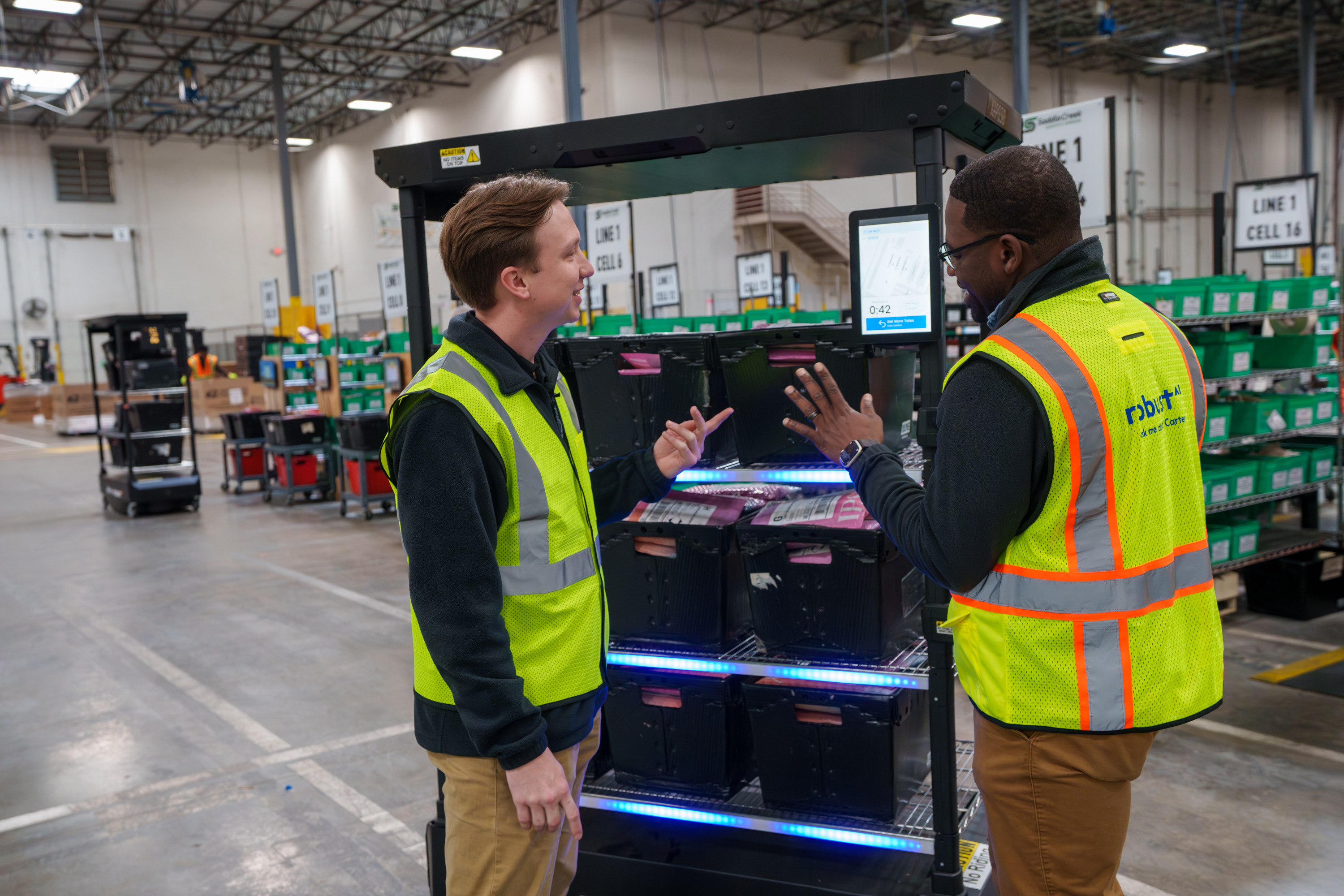
Robust AI, a startup co-founded by MIT Professor Emeritus Rodney Brooks and Anthony Jules, is building a mobile robot called Carter that is meant to work beside people in warehouses and factories rather than replace them. The company says its robots are currently deployed in logistics warehouses and on factory floors, where they help workers pick or stock shelves and move items across facilities. The work is an outgrowth of a company founded in 2019, after Brooks ran into Jules at a robotics conference and described an idea for a robotics software company that he compared to a video game engine for training robots.
Carter looks something like a utility cart on wheels. It has a force-sensitive handlebar so a person can guide it by hand, an AI-powered vision system, and holonomic wheels that let it move instantly in any direction. In practice that means a worker can cut in front of it, push or pull it one-handed, or direct it with gestures or an onboard touch screen. Holonomic drives are worth noting for anyone new to the term: they let a wheeled base travel sideways or diagonally without first turning, which matters in crowded aisles where a machine that has to rotate to change direction takes up more room.
The hardware came after a couple of pivots. When the pandemic hit, the founders shifted to robots that could disinfect surfaces autonomously, then had to change course again when it was found that Covid-19 was not transmitted via surfaces. Jules, now chief innovation officer, recalls telling Brooks he had an idea his co-founder would love and hate, because it solved problems customers had described but required building hardware. The pair had been interviewing potential customers for years across those pivots, and settled on logistics and manufacturing as the first target industries.
That choice rests on a reading of the market that Jules puts simply: people picture the small share of factories that are fully automated with systems costing $50 million to $200 million, and overlook the far larger group that runs with little or no automation, sometimes without even a conveyor belt. Those sites, he argues, are not going to tear out their operations and replace them with a system at that price. Robust AI's answer is a robot that can be phased in as needed, with several workflows on offer. In one, the robot guides a worker to specific spots to retrieve items; in another, it follows a person to loading points. The main job, though, is transport. Workers in large warehouses and factories may walk on average 30,000 steps a day, and a station that a person needs to reach can be 400 feet away. Brooks, the chief technology officer, describes the result as a worker loading a cart, saying done, and letting the robot make the trip. How the robots are integrated into a given workspace is left to the customer.
The design philosophy is informed by a failure case. Leila Takayama, the company's vice president of human robot interaction, came across a peer-reviewed study of robots in hospitals, used for tasks such as gathering dishes, moving sheets and transporting equipment. Researchers found that in many hospitals large numbers of those robots sat switched off against the walls, and nurses said they had broken. Brooks's account of what actually happened is a useful caution for anyone deploying mobile robots in shared space: nurses rushing a patient on a gurney would come down a hallway, the robot would see them and stop dead, and the gurney could not get around it. The machines were obstructing the nurses' primary task, not failing mechanically.
That story explains the company's stated approach of studying what workers are actually trying to accomplish and building features that speed those tasks, whether a person or a robot performs them. Brooks frames the division of labor as letting humans do what the physical world has suited them to over millions of years of evolution, while the digital system contributes what it is good at. Jules makes a related point about systems rather than single machines: success in these environments depends on how the whole thing performs, with the robot doing part of the work, people doing part, and backend systems doing part. He stresses that people should have an appropriate level of agency and input so the system keeps moving forward.
This suggests the pitch is less about autonomy than about removing walking and carrying from a shift while keeping a human in charge of judgment and exceptions. For developers and product teams, the interesting parts are the interaction primitives and the integration story. A force-sensitive handle combined with holonomic movement is a deliberate bet that the cheapest way to make a robot acceptable is to let people physically shove it around like a cart, rather than requiring them to command it through an interface. That choice also implies a safety and controls problem: a base that yields to a one-handed push has to distinguish intended guidance from an accidental bump, and an onboard vision system has to handle people who deliberately step into its path.
The mention of backend systems doing part of the work points to the less visible engineering, in orchestration, task assignment and whatever connects the robot to warehouse or factory software. The source does not detail that layer. What it does describe is a fleet meant to be introduced incrementally into facilities that will not be rebuilt around automation, which sets a different bar than a greenfield installation: the robot has to fit an environment designed for people.
Why it matters: teams building or buying mobile robotics for logistics and manufacturing are being offered a complement-first model, where a cart-like machine absorbs long walks and hauling while workers keep control. The hospital example is a reminder, and my inference here, that the hard part of adoption is often routing and right-of-way in shared corridors rather than the robot's payload or navigation stack. For product teams, the lesson is to design the human override and the interaction surface as core features, not afterthoughts.
Based on reporting from the original publisher. Visit the source for full context and later updates.
Publisher excerpt
Founded by Anthony Jules ’92, SM ’92 and Professor Emeritus Rodney Brooks, Robust AI’s robots are designed to collaborate with humans in factories and warehouses.