The attendee’s guide to the AWS re:Invent 2026 AI/ML track
AWS holds re:Invent 2026 from November 30 to December 4, and the company has published an attendee guide to the AI/ML (AIM) track. The conference carries more than 2,000 learning sessions across skill levels; the AIM track alone offers more than 140 unique sessions. Keynotes from AWS leaders stream live and many sessions appear on demand afterward, so remote attendees can follow the keynotes and catch up on a portion of the program.
Session formats vary, and only some are recorded. Breakout sessions are 60-minute lecture-style talks given by AWS experts, customers and partners, and they are uploaded to the AWS Events YouTube channel a few days after the event. Chalk talks put presenters in discussion with attendees around a whiteboard. Builder sessions last one hour and involve constructing something. Workshops run two hours, with small teams solving a concrete problem on AWS services. Code talks feature an expert coding live. Lightning talks are 20-minute service or customer-story demos held in the Venetian Expo Hall or the Wynn/Encore Upper Convention Promenade. The interactive formats are live and not recorded, which is worth planning around: if a workshop covers material you need, there is no replay.
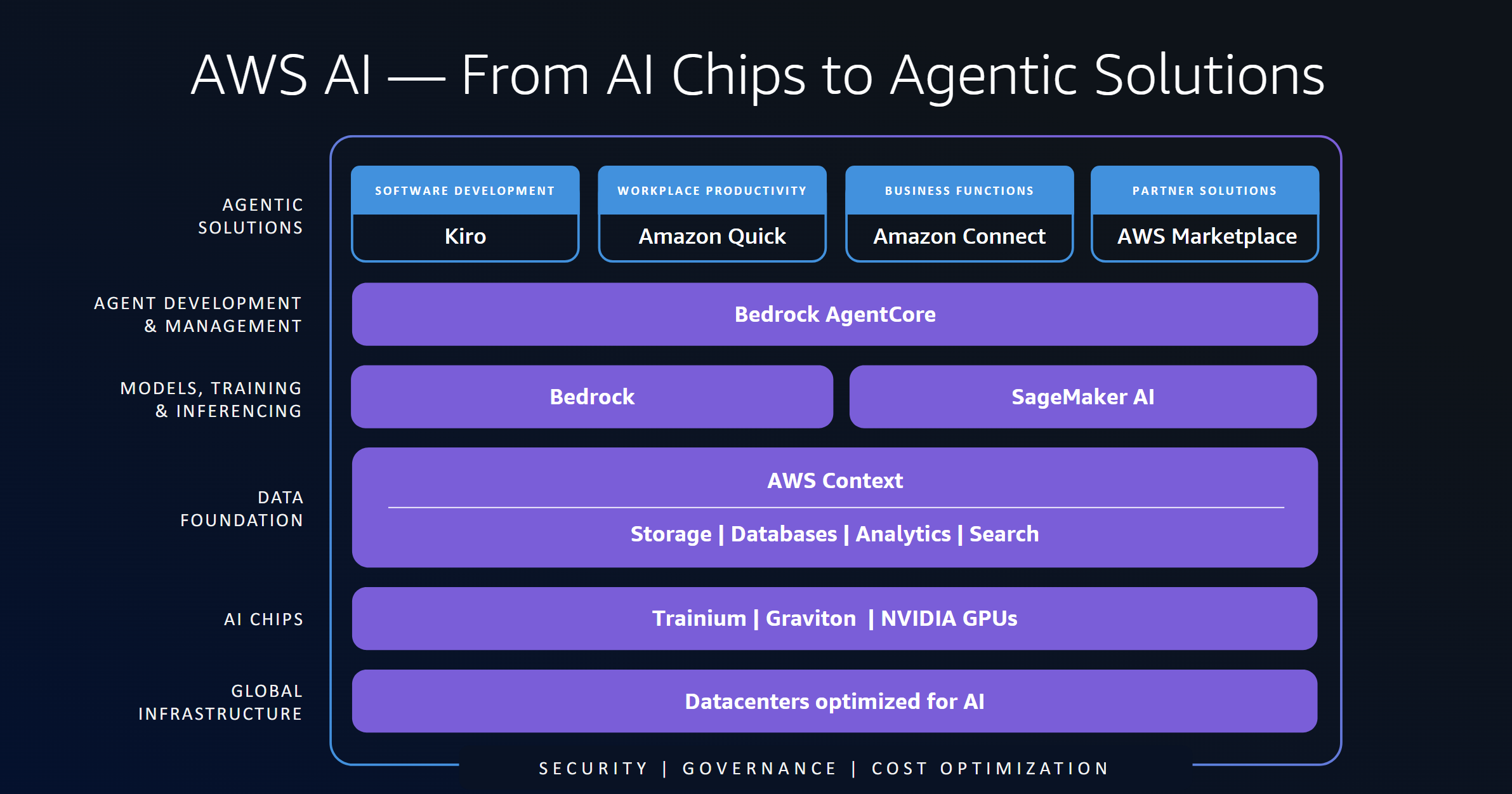
AWS frames the track around its own view of the AI stack, which is a useful map for scheduling. The layers run bottom-up: AI-optimized data centers; AI chips, where customers pick between Trainium for purpose-built training and inference and NVIDIA GPUs for GPU acceleration; a data foundation that AWS calls Context, connecting storage, databases, analytics and search so models and agents can retrieve information; models, training and inference, split between Amazon Bedrock for managed access to hundreds of third-party and first-party models through one API and Amazon SageMaker AI for full control over custom models on dedicated infrastructure; agent development and management through Amazon Bedrock AgentCore, which supports mixed model and provider setups including Bedrock and SageMaker AI models; and ready-made agentic products, including Kiro for spec-driven development, AWS Quick for a personal knowledge graph over applications and data, Amazon Connect for customer experience, hiring, supply chain and healthcare agents, and AWS Marketplace for partner solutions. Security, governance and cost optimization are presented as cross-cutting, with hardware-level isolation at the chip layer and controls over what agents may access and do.
The AIM sessions concentrate on AI chips, models/training/inference and agent development, with security and cost themes throughout. In practice, the guide orders sessions from beginner to deep technical within each section, which makes it easier to scan for a starting point.
The platform-level sessions set the baseline. AIM204 walks the whole stack, including Trainium and Graviton chips, inference on Bedrock and SageMaker AI, and production agents on AgentCore. AIM364 compares Bedrock with SageMaker AI and covers when to combine them, using an agentic coding app on AgentCore as the example. AIM363 is a chalk talk on governed data products and why cost levers such as prompt caching, distillation and batch inference pay off more on clean data. AIM319 demonstrates ROI and cost-per-outcome measurement across the stack. AIM443, a 400-level chalk talk, builds a training pipeline on SageMaker HyperPod with company data and governance, then deploys the model to Bedrock for inference or AgentCore for agents.
On chips, GPU-focused sessions include AIM2210 on current GPU instances, a customer account of GPU scheduling optimization in AIM3301, guidance on when EC2 G7e and G7 instances suit workloads in place of P-series in AIM392, disaggregated inference serving in AIM345, GPU cluster failure diagnosis and recovery in AIM344, and a GPU performance engineering workshop in AIM347. One concrete claim stands out: AIM3312 reports that Amazon EMR with the NVIDIA cuDF plugin for Apache Spark runs jobs up to 3.7x faster on EC2 G7 instances than on comparable CPU instances without code changes, and the session also covers DuckDB on GPUs.
Trainium sessions lean on AWS Neuron, the software stack that connects Trainium to frameworks like PyTorch so teams avoid rewrites. AIM211 traces Trainium from silicon to application. AIM310 covers Trainium3 and the Trn3 UltraServer for large mixture-of-experts models. AIM2213 gathers four AI leaders who have shipped products on Trainium. Role-specific options include AIM339 (a nanochat code talk for PyTorch users), AIM334 (distributed training workshop), AIM349 (a production assistant with Hugging Face models), AIM326 (inference scaling workshop), AIM329 on agentic optimization loops, INV511 on the Neuron Kernel Interface for kernel designers, and AIM311 on a resiliency stack for Trainium on Amazon EKS at deployments up to twenty thousand accelerators. World models get attention too: AIM323 on serving them with native PyTorch, AIM304 on deploying and optimizing a real-time video world model with agentic Neuron workflows, and AIM305 on training vision-language-action models for physical AI.
SageMaker AI sessions cover the lifecycle from data prep on serverless compute to training jobs spanning thousands of accelerators and deployment on endpoints or HyperPod. Highlights include AIM342 on building, customizing and deploying with one service; AIM2205 on evaluations with your own data and turning business knowledge into cheaper models; AIM402 on fine-tuning and deploying an LLM in a few hours; AIM325 on fine-tuning reasoning agents with multi-turn reinforcement learning; AIM456 linking evaluation, fine-tuning and reinforcement learning across SageMaker AI and Bedrock; and AIM435 on policy distillation. Customer stories include Salesforce on its open-weight Koa models (AIM393), Intuit (AIM361), Tencent Games scaling to 1,000 GPUs (AIM343) and HUMAIN on GPU utilization (AIM433). Also offered: AIM406 on foundation model pipelines with EKS, AIM403 on Ray, AIM318 on keeping vision-language model training alive through node failures, AIM413 on a physical AI model factory, AIM213 with CrowdStrike on LLM inference for threat detection, AIM214 with Vanguard on custom LLMs, AIM405 on agents over open-weight models, AIM404 on resilient inference endpoints, AIM348 on governed ModelOps and AIM408 on observability with managed MLflow.
Bedrock and agent sessions round out the track. AIM220 covers what is new in models, inference, security and cost management; AIM317 builds a first app. AIM448 helps choose among inference options on performance, capacity, cost and data residency. AIM308 builds a knowledge assistant over documents, images and structured data. AIM437 covers caching repeated context, routing between models and batching. AIM438 tests candidate models on your own use cases before switching. AIM374 covers production metrics and alarms, and INV517 digs into scheduling and parallelism for large-model inference. For agents, AIM212 introduces the AgentCore lifecycle with Nasdaq on running agents in a regulated industry; AIM439 adds memory, tools, identity, policies, observability and evaluation to a support agent; AIM407 coordinates specialized agents with Strands Agents and deploys them to AgentCore. AIM429 connects agent design to inference behavior and stopping conditions, AIM454 builds function calling, multi-step reasoning and retrieval live, and AIM436 addresses traffic spikes, tool failures, timeouts and multi-tenancy.
A trade-off for planners: the richest material is in workshops and chalk talks that nobody will record, while the archived breakouts tend to be the lecture-style overviews. Teams sending one person may want to prioritize hands-on sessions and rely on the YouTube uploads for breadth.
Why it matters: developers and platform teams evaluating Trainium versus GPUs, choosing between Bedrock and SageMaker AI, or putting agents into production get a dense, mostly free schedule of vendor-led material, and this guide is effectively a curriculum map for that stack. Since only breakouts are archived, remote followers should expect to trade depth for convenience, and in-person attendees should treat the unrecorded workshops as the scarcest slots. That asymmetry is a reasonable inference from the stated formats rather than a claim AWS makes.
Based on reporting from the original publisher. Visit the source for full context and later updates.
Publisher excerpt
AWS re:Invent 2026 includes more than 140 AI/ML track sessions. This attendee's guide helps you find the breakouts, chalk talks, workshops, and builders' sessions that fit your role and goals, spanning AI chips, models and inference, agents, agent trust, and sustainability, so you can build a smarter re:Invent schedule.