How Duco transforms financial data automation with Amazon Bedrock AgentCore
Duco, which makes an agentic Operations platform for financial services, has migrated its agent stack onto Amazon Bedrock for model access and Amazon Bedrock AgentCore as the agent runtime. AWS described the rebuild in a post on its Machine Learning Blog, with commentary from Duco Chief Architect and Innovation Officer Rob Gates. Duco reports processing 20 billion transactions monthly for more than 200 clients, including 7 of the top 20 banks and 10 of the top 20 asset managers.
The move was driven by limits in Duco's earlier approach. The platform had used classical machine learning for predictive labeling and pattern recognition to help banks automate more than 20,000 processes, but those models needed large amounts of historical training data, handled novel scenarios poorly, and required heavy customization per use case. Gates said the classical models were not agile enough, adding that such models can only amplify what they have already learned.
Duco builds agents on LangChain and LangGraph, both already in production. AgentCore was chosen because it works with that existing code largely unmodified, provides a managed runtime that offloads infrastructure operations, and meets the security and compliance requirements of regulated financial environments. Bedrock was chosen for keeping customer data inside AWS without using it to train models, private VPC endpoints for connecting to internal systems, access to models from the Amazon Nova 2 family, Anthropic, OpenAI, Cohere, Meta and Mistral AI through one API with switching by configuration parameter, and governance controls suited to financial services.
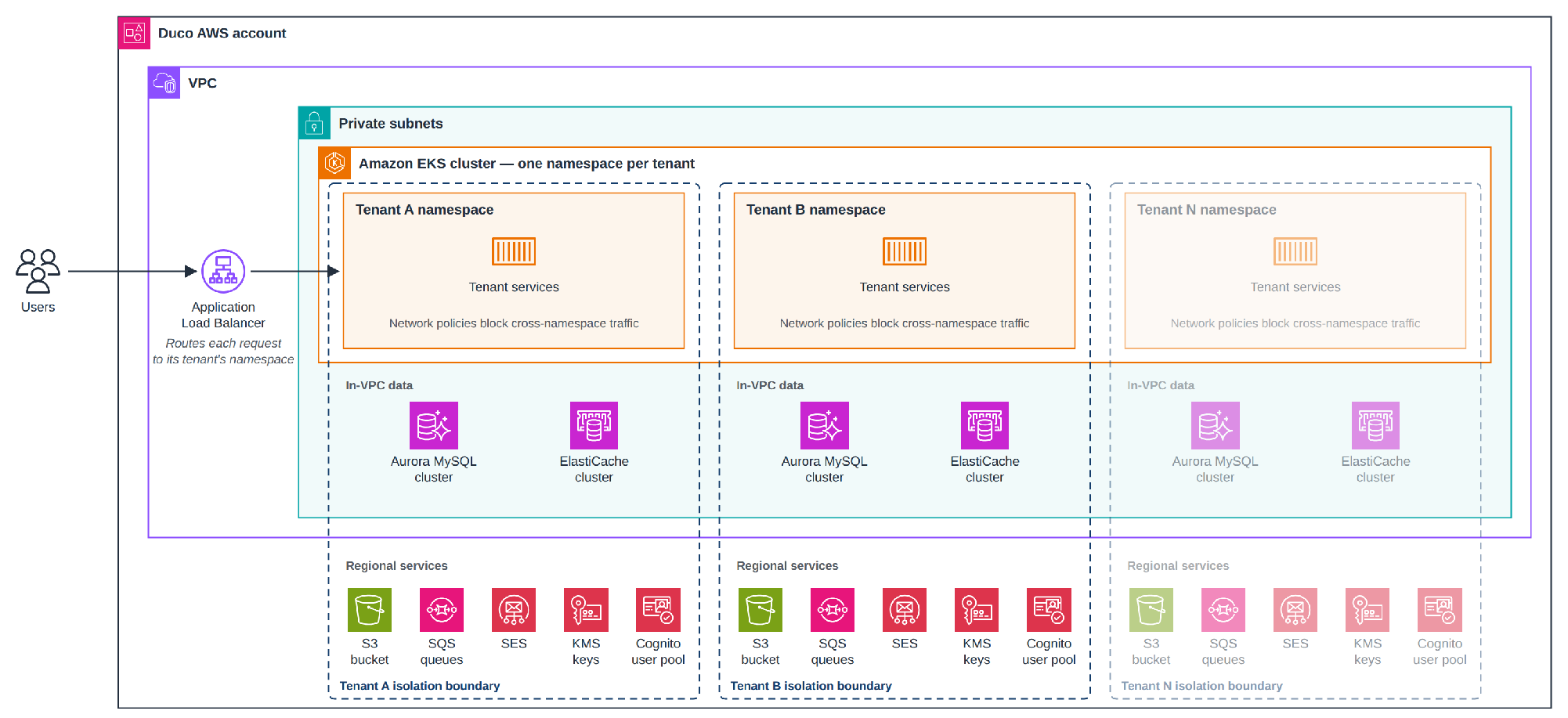
Isolation is the defining constraint of the design, since Duco runs as multi-tenant SaaS for regulated institutions. At the infrastructure layer, tenants share a VPC and Amazon EKS cluster but are separated by Kubernetes namespaces and network policies. Each tenant also gets dedicated Aurora MySQL, S3 storage, KMS keys, SES and SQS messaging, ElastiCache, and a Cognito user pool, so no data infrastructure is shared. Per-tenant autoscaling limits the blast radius of one client's compute-heavy workloads on another's performance.
Access control is layered on identity. Every request carries a JWT from the tenant's own Cognito pool, validated by the AgentCore runtime's inbound authorizer before agent logic executes. Agents reach tools only through a per-tenant AgentCore Gateway, which forwards calls to container-based Model Context Protocol servers in EKS. The user's identity flows through to downstream services, and each MCP server checks both the agent's and the user's identity against the tenant's Cognito pool, so a tool call is authorized as the calling user. Each tenant has its own AgentCore runtime and Gateway, and combined with AgentCore's built-in session isolation, Duco says there is no shared memory, context or tooling across clients.
On models, Duco assigns different jobs to different foundation models. Anthropic Claude Opus serves as the planning agent that drafts plans for other agents to execute. Claude Sonnet handles main reasoning and complex decisions such as exception investigation, reconciliation logic and rule interpretation. Claude Haiku makes fast, low-cost routing decisions and first-pass triage. Amazon Nova 2 Pro summarizes MCP tool output into readable text for analysts. The architecture is built so models can be swapped without disrupting the stack.
The most technically interesting piece is how Duco attacked context bloat. With 300 to 400 tools exposed per tenant through the Gateway, roughly 200,000 tokens of tool descriptions were loaded before any work began, degrading answer quality as conversations grew. Duco moved descriptions out of static context using MCP resource types: skill:// for on-demand tool descriptions, system:// for system prompt sections composed at runtime, and ui:// for UI-specific resources kept apart from operational tooling. Three meta-tools in Duco's agent harness replaced the bulk payload: load_skill fetches a skill description when needed, find_tool locates relevant tools without loading every schema, and invoke_tool executes the chosen tool.
The reported result is a 90% context reduction, from about 200,000 tokens to roughly 20,000. Because the static prompt prefix of system prompt plus three meta-tools stays small and stable, and skills load into the conversation rather than the tool list, prompt caching is preserved. Duco says response quality improved measurably through its evaluation framework, with no infrastructure changes. The team also stressed that a hunch an agent is degrading is not evidence, and that evaluations should precede engineering decisions.
Tool discovery happens at boot. Deploying a new service registers its MCP server as a target on the tenant's Gateway, and when an agent starts, the harness builds a registry of exposed tool names. The agent then uses find_tool and invoke_tool to reach details on demand, so new capabilities appear without redeploying or reconfiguring the agent, and access control is enforced by the underlying services via passed-through user identity. In practice this lets a platform team ship agent capabilities by deploying a microservice, with no downtime.
Two workflows show the payoff. In onboarding, banks previously moved roughly one reconciliation process per week, and migrating thousands took years. Duco's agents read varied file formats, translate legacy configurations into Duco processes, and parse decades-old spreadsheet macros, letting reconciliations deploy 10x faster. One global bank cut onboarding costs by 70% and raised straight-through processing by more than 20% through better match rates and allocation rules. In exception investigation, agents handle the first mile: triaging arriving breaks, grouping those with a shared likely cause, checking whether a break is known or a timing difference, tracing root cause to data quality, missing records, mapping or reference data issues, or genuine mismatches, then preparing a case with likely cause, proposed resolution, alternatives and evidence for an analyst to decide. Every decision lands in an audit trail.
Compliance rests on four principles: full observability of agent decisions, human-in-the-loop authorization for high-risk actions, fail-safe defaults that favor client protection over efficiency, and alignment with workloads subject to SOC 2 and DORA with per-institution data residency controls. Duco summarizes impact as 10x faster reconciliation deployments, 70% lower onboarding costs, over 20% higher straight-through processing, and thousands of hours saved in manual investigation. Its roadmap describes roles shifting from task worker to investigator to decision maker, and points toward agent-to-agent coordination, including cross-firm scenarios.
Why it matters: For teams building agents over large tool catalogs, Duco's pattern is a concrete alternative to stuffing every schema into the prompt. Loading tool descriptions on demand, keeping a small stable prompt prefix, and routing calls through a gateway is a design developers can borrow, and the per-tenant runtime and Gateway model suggests a template for isolation requirements in regulated industries. Whether the reported gains generalize beyond financial reconciliation is likely to depend on how well each deployment's tools and evaluations are structured.
Based on reporting from the original publisher. Visit the source for full context and later updates.
Publisher excerpt
Duco, a data automation platform for tier-one banks, rebuilt its agentic AI stack on Amazon Bedrock and Amazon Bedrock AgentCore. With strict per-tenant isolation, a multi-model strategy, and an MCP skills architecture that cut context overhead by 90%, Duco cut reconciliation deployment time 10x and onboarding costs 70%.