Accelerating product development with AI-driven lifecycle management (AI-PDLC) in AWS Quick
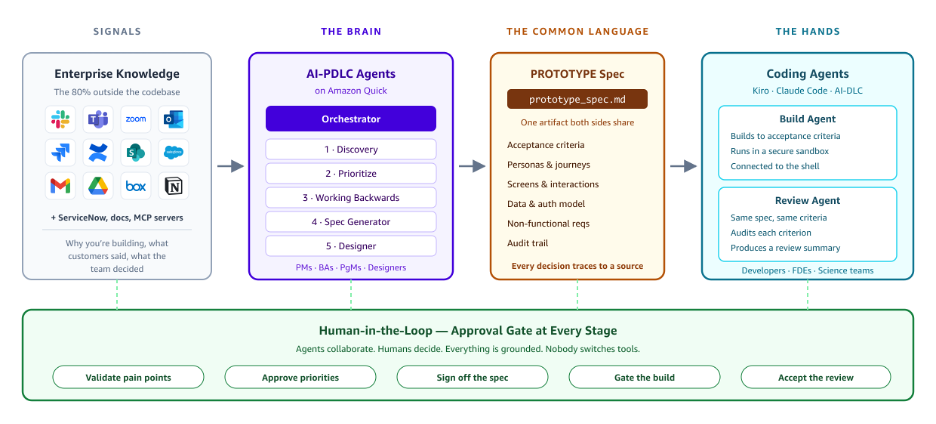
AWS detailed a framework called AI-Driven Product Development Lifecycle, or AI-PDLC, in a post on its Machine Learning Blog. It is implemented as six custom agents inside AWS Quick, the company's AI assistant for enterprise work, and is meant to carry a product team from scattered customer signals through discovery, prioritization, specification and prototype. The complete agent suite, reference architecture, prompt templates and setup instructions are published in a GitHub repository, so teams configure it themselves rather than consuming a managed service.
The premise is that coding agents have made implementation fast, which moves the constraint upstream. The post argues that clear requirements can be turned into software quickly, but no coding agent can rescue a decision to build the wrong thing. The four upstream activities it singles out are finding the right customer problem, choosing which opportunity to pursue, designing the experience, and validating it with a prototype. Evidence for those decisions is spread across Slack threads, Salesforce notes, ServiceNow incidents, SharePoint documents, Jira work items and Outlook meetings, and context is lost at each handoff between them.
Quick's role is to be the connective layer. Enterprise connectors pull from Slack, Outlook, Jira, Salesforce, SharePoint, ServiceNow and other sources, and Quick builds what the post calls a personal knowledge graph linking people, projects and decisions across connected apps and folders. Agent outputs are stored in shared Quick Spaces so they persist rather than living in individual chats.
The lifecycle has eight phases: Discover, Decide, Design, Prototype, Engineer, Ship, Operate and Learn. AI-PDLC covers the first four, where the product team works. The later four are handed to coding agents. Users talk to a single Orchestrator, which reads each specialist's question framework at runtime, asks targeted questions for the current phase and dispatches artifact generation to the right specialist. The pipeline only moves forward when a person approves at a gate: validating pain points, approving priorities, signing off the spec, gating the build and accepting the review. Production data from shipped work is intended to flow back into Discovery to close the loop.
The specialists each own one step. Discovery supports structured pain point analysis through interactive Q&A, URL ingestion and direct pulls from connected sources, and scores each pain point for severity and frequency on a Pain Point Board. Prioritize scores use cases against weighted criteria using two transparent 0–10 frameworks, one for agentic use cases covering model capability match, tool availability and user acceptance, and one for traditional applications covering feasibility, business impact and effort. A Scoring Matrix lets the team trace why one use case outranks another. Working Backwards then generates a full PR/FAQ in the Amazon Working Backwards style, with customer-facing FAQs plus internal FAQs on unit economics, failure modes, regulatory risk and competitive landscape; the stated goal is to let a weak concept fail on paper before engineering resources are committed.
The Spec Generator converts the validated use case and PR/FAQ into a build-ready specification, with separate templates for agentic and application use cases and a Design Handoff Brief for UX. Specs carry acceptance criteria, user flow, constraints and metadata tracing each requirement back to its source pain point, prioritization score and PR/FAQ. Those acceptance criteria do double duty: they are the contract a coding agent builds against and the rubric a review agent audits against. The Designer agent produces journey maps, wireframes and clickable HTML prototypes inside Quick, drawing on the handoff brief, Discovery personas, the user flow, brand context and an emotional target taken from a customer quote. The point is to test concepts with stakeholders before committing to Figma or other design tooling.
All artifacts converge on a shared file, prototype_spec.md, holding acceptance criteria, personas, screens and the data model. Handoff to coding agents uses the Agent Client Protocol, described as an open JSON-RPC 2.0 standard with no vendor lock-in; the post names Kiro and Claude Code as examples of agents that can build against the generated specification. That is a meaningful detail for teams already standardized on a particular coding assistant, since ACP is intended to keep the upstream tooling from locking them into one downstream vendor.
Two pacing modes change the depth of questioning. Deep Discovery asks 8–12 questions per phase and pushes into ambiguities and edge cases, suited to an unfamiliar problem space. Fast Track cuts each phase to 3–5 essential questions and proposes defaults from context Quick already holds, which the user can confirm or override; it fits time-boxed sessions where the team already knows the space. Decision logging runs at two levels: each specialist records its decisions, scores and rationale within its own artifact, while the Orchestrator independently checks those entries exist and keeps a shared log across the pipeline, so a slip in one layer does not erase the record of a gate approval.
Setup requires an AWS Quick workspace with the Desktop client, permission to create custom agents, and enterprise connectors already configured. Teams clone the repository, download its JSON file, and use Quick Desktop → Customize → Agents → Create, choosing Create from File; that produces the six agents with their instructions. A shared Space named AI-PDLC Artifacts is created and access granted to team members. A run starts by selecting the AI-PDLC Orchestrator from the agent picker and issuing a prompt such as "Run the full pipeline" or "Fast Track", then answering the structured questions and reviewing artifacts as they appear at each gate. Cleanup is manual: delete the agents, delete the Space or its test artifacts, revoke granted access, disconnect connectors added for the exercise, and remove the cloned repository. The post states the walkthrough incurs no cost at rest.
Three usage scenarios are described. New product development runs the full journey from a cold start, validating the concept through the PR/FAQ before the first line of code. Feature additions pull signals from Slack, Jira, Salesforce and Quick Sight into a prioritized backlog, aiming to hand engineering context-rich items rather than one-line tickets. Bug fixes and incident-driven work capture root cause as a documented pain point and decide whether a targeted patch or broader design change is warranted, producing a scoped spec with testable acceptance criteria. Each enters the same pipeline at a different depth: new products run everything, feature additions may skip deep discovery, bug fixes may compress to one cycle.
In practice, the value and the risk sit in the same place. Structured scoring and a written PR/FAQ make prioritization arguments visible, which is useful for teams whose roadmaps are contested. But the quality of a Discovery board depends entirely on how well connectors surface real signal, and a scored board can look more authoritative than the underlying evidence warrants. The double duty of ACP as both build contract and review rubric is a sensible design: it means the review agent is graded against the same checklist the builder was given, provided the acceptance criteria were written precisely enough. My reading is that the heaviest lift for adopters will be the human gates themselves, since a pipeline that stops for approval at every stage only pays off if reviewers actually engage, and the two-level logging is a reasonable hedge against gates being waved through without a trace. The time claims in the post, weeks of prototyping becoming days or hours, are presented as dependent on problem complexity rather than measured.
Why it matters: Product teams that already use coding agents face a new bottleneck in requirements and validation, and this gives them a concrete, cloneable structure for that work rather than a proprietary service. Developers on the receiving end are likely to see more detailed specs with acceptance criteria traced to customer evidence, and the ACP handoff means the choice of coding agent stays open. Whether the framework produces better products or simply more artifacts is the open question, and it will be settled by how rigorously teams use the approval gates rather than by the agents themselves.
Based on reporting from the original publisher. Visit the source for full context and later updates.
Publisher excerpt
Learn how to build an AI-driven product development lifecycle (AI-PDLC) with a suite of six AWS Quick agents that take you from scattered customer signals to a validated prototype across Discover, Decide, Design, and Prototype, with human approval at every gate and a specification ready to hand to coding agents like Kiro.