From data to decisions: Conversational supply chain intelligence with Amazon Quick and Amazon Bedrock AgentCore
AWS has published a reference pattern and deployable sample for conversational supply chain intelligence, pairing Amazon Quick as the user-facing assistant with Amazon Bedrock AgentCore as the layer that exposes enterprise systems as tools. The walkthrough follows one disruption — a vendor halt labeled TechComp Production Halt, disruption DISR-002 — from detection through an approved emergency request for quotation, all inside a single conversation. The code lives in the aws-samples/sample-amazon-quick-suite-knowledge-hub repository.
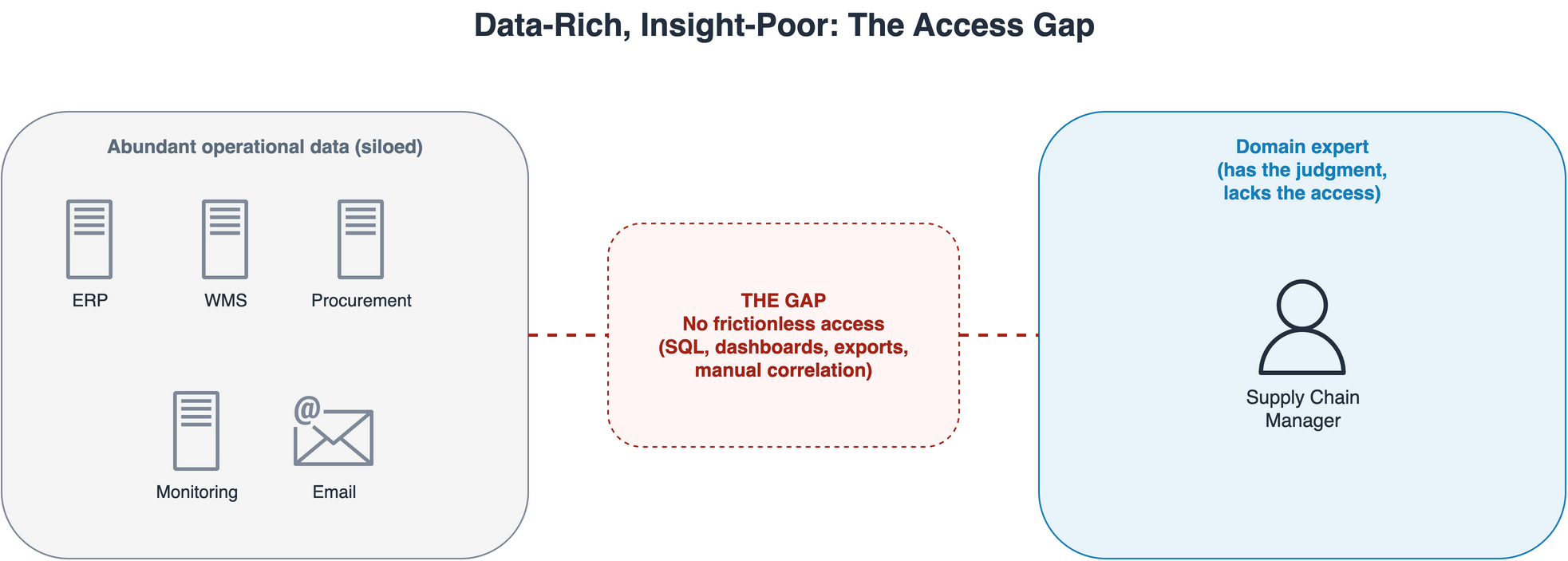
The underlying problem AWS frames is distance rather than scarcity: order, inventory, procurement, compliance and disruption data sit in separate systems, so a manager answering a question like which top-revenue SKUs are exposed to a port closure traditionally spends 45 to 60 minutes across five systems with more than a dozen context switches. In the conversational flow the same work is three prompts in one tool.
The demonstration moves through five steps. First, discovery: asking what supply chain tools are available lists MCP servers published in AWS Agent Registry, which appear as connector cards with connection details pre-filled because an administrator enabled the registry integration. Second, querying: a check for active disruptions calls the Disruption Alerts MCP tool assess_disruption_impact and returns three disruptions with severity, region and SKU counts. Third, drill-down: assessing DISR-002 correlates order, customer and inventory data in one call, surfacing $750K at risk, 23 orders and three days of supply. Fourth, action: a mitigation request chains the Governance MCP (approved alternatives) and Quoting MCP (contract-aligned quote) so one ask spans three domains. Fifth, follow-up: a morning alert schedule, or an inbound supplier email, runs the same tools unattended and posts review-ready cards for a person to approve.
Architecturally, AgentCore supplies four relevant services. Runtime hosts MCP servers and agents serverlessly with session isolation and built-in identity. Gateway turns APIs, Lambda functions and services into MCP-compatible tools behind a managed endpoint, with reasoning left to the calling agent. Identity handles authentication compatible with existing providers. Policy enforces deterministic authorization rules, written in natural language or Cedar, that intercept every tool call before execution — a meaningful guardrail when agents touch procurement and financial data.
The tool layer relies on Model Context Protocol, an open standard for exposing typed tool interfaces to AI clients. Because the servers are standard MCP, the same backend can serve Quick, custom agents or other MCP applications, and backends such as SAP, Oracle or custom microservices can be wrapped as servers. AWS Agent Registry sits on top as governed discovery: a publisher submits a record, a curator approves it, and only then is it visible via hybrid search, browsing or the registry's MCP endpoint. One practical warning in the post is worth heeding — since clients discover schemas at runtime, each schema behaves like a contract and breaking changes should be versioned alongside the old one.
Multi-step orchestration runs on a dedicated Order Fulfillment Agent hosted on AgentCore Runtime, connected through a Custom MCP connector at its direct invocation URL with no Lambda or gateway in between. Given a single request it plans the sequence: Disruption Alerts to identify the problem, Governance for approved alternatives plus compliance and budget authority, then Quoting for a contract-aligned quote, returning one consolidated recommendation. Every tool call passes a uniform control set before reaching a backend, covering IAM authentication, per-tool authorization, input validation, policy evaluation, rate limiting, data-boundary enforcement and audit logging.
The four business MCP servers cover quoting (quote generation, pricing rules, validation), governance (supplier approval, budget authority, regulatory compliance, policy rules), invoice processing (approval routing, AP aging, payment schedules) and disruption alerts (active disruptions, severity, impact, mitigation). On the Quick side, the assistant uses a registry connection, one Supply Chain agent that adapts by persona, MCP connector cards, an Activity Feed for proactive items, natural-language schedules, Outlook integration, structured data connectors over Space datasets, an S3 knowledge base for retrieval-augmented grounding over invoices, contracts and policies, and an optional CRM connector.
Human control is a deliberate design constraint. Feed cards are actionable, triaged with priority indicators such as Reply needed, Follow up or Deadline, and cross-source. In the email use case, the agent extracts SKUs, quantities and pricing from supplier replies, checks vendor approval and pricing guidelines, and stages a review card — it explicitly does not author a quote, pick a winner or issue a purchase order. Selection and the PO stay with a person. Setup for that flow is roughly five minutes: connect Outlook, enable email monitoring, create the agent with validation instructions, and schedule a check every two hours during business hours. A parallel daily 8:30 AM schedule flags any disruption leaving under seven days of supply as URGENT with an Issue Emergency RFQ action.
Deployment runs in three phases: provision infrastructure, connect Quick to data and the registry, then enable monitoring. Prerequisites include an AWS account with AgentCore and Agent Registry, AWS CLI v2, SAM CLI, Docker (the agent ships as an arm64 container), Python 3.12 or later with Boto3 1.43.94 or later, IAM credentials, a database such as Snowflake, PostgreSQL/RDS or a SQLAlchemy engine, an S3 bucket, optionally Salesforce, and a Quick organization. The first phase stands up a Cognito user pool with authorization-code OAuth, four Lambda-backed MCP servers each behind its own AgentCore Gateway using CUSTOM_JWT authorization, and the fulfillment agent container with least-privilege IAM roles. Setup spans the Quick web console and the desktop app, and six Agent Registry records end up approved (four MCP Server, one Agent, one Skills). Amazon Quick Sight permissions must grant both S3 and Athena access, since each table is served through an Athena source over a Glue database; without the Athena grant, dataset creation fails.
One caveat to plan for: registry-sourced connectors are Custom MCP connectors, and removing the registry link later does not delete connectors already created. The order-fulfillment agent, being an agent record, must be added manually by pointing a connector at its runtime invocation URL.
AWS positions this as complementary to business intelligence rather than a replacement. Dashboards remain better for trend visualization, collaborative analysis, regulatory reporting and exploratory work, while conversational access suits real-time operational decisions. Persona scoping, through row and column-level security plus per-persona tool scoping, keeps procurement from seeing finance data.
Why it matters: teams building internal assistants get a concrete, scripted template for putting governed MCP tools in front of non-technical users, with policy checks and human approval built in rather than bolted on. The hard engineering here is mostly integration and governance — wrapping legacy backends, versioning tool schemas, and fencing agents off from unauthorized actions — which is likely where most implementation effort will go. For organizations already standardized on AWS identity and data services, the pattern lowers the cost of a first working agent; for others, the MCP layer is the portable part and AgentCore is the opinionated runtime around it.
Based on reporting from the original publisher. Visit the source for full context and later updates.
Publisher excerpt
Enterprise supply chains are data-rich but insight-poor, with the data to decide scattered across ERP, monitoring, procurement, and email. This post shows how Amazon Bedrock AgentCore exposes those systems as a governed tool layer, and how Amazon Quick turns them into one conversational experience for business users, with a deploy-it-yourself walkthrough.