Ring cameras go mobile as Amazon debuts AI-powered security drone and robot
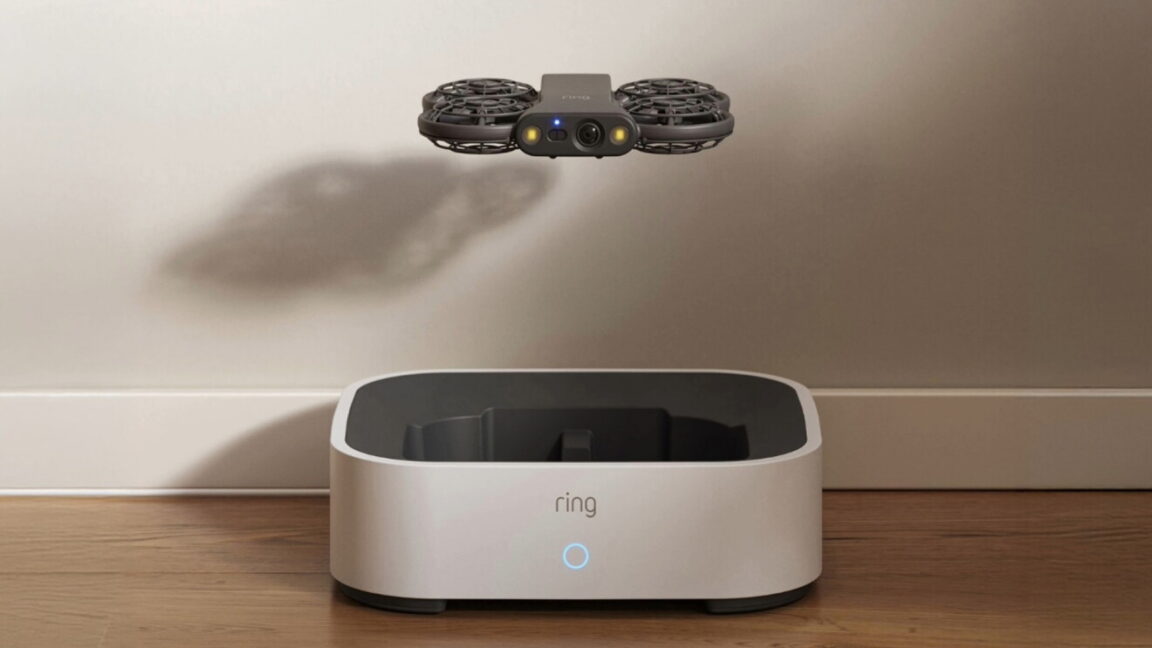
Amazon announced on November 10 that its Ring division is building two autonomous indoor security devices: the Ring Rover Cam, a wheeled patrol robot priced at $1,000, and the Ring Drone Cam, a flying camera priced at $250. The Rover is already open for preorder and is scheduled to ship to customers on December 16, 2026. The Drone is expected in early 2027, with Amazon aiming for a January 27, 2027 release, but it still needs authorization from the Federal Communications Commission before it can go on sale. Customers can sign up for email updates on the product page in the meantime.
Both devices run on what Amazon calls an AI Pilot system. It combines each device's cameras with specialized vision models, on-device sensors and cloud processing to plan patrol routes and navigate around obstacles such as furniture. The same system builds a digital floor plan of the home or business during setup. In the drone's case the customer carries it through the indoor spaces; the Rover can instead explore on its own. From that guided or self-directed tour, the AI Pilot is meant to recognize specific rooms and suggest patrol points near side doors, windows, or sensitive spots such as a cash register in a business.
The Drone is effectively a successor to the Ring Always Home Cam, Amazon's earlier flying security camera that was sold only by invitation as a "Day 1 Edition" product in September 2021, and it carries the same $250 starting price. Subscribers to the Ring Protect plan can set routes and schedules, and the drone can launch automatically in response to an alert from a Ring camera, sensor or alarm. Its camera offers a 148-degree field of view, 360-degree rotation and 2K resolution, with two LED lights that switch on in low light. Flight time is the obvious constraint: Amazon rates it at 8 minutes on a new, fully charged battery under controlled conditions, and it ships with a docking station for recharging.
Amazon's own product description lists conditions where the drone's navigation may degrade: reflective surfaces such as polished marble or wet tile, featureless matte walls, and transparent surfaces like frameless glass and mirrors. This is a familiar limitation for vision-based indoor flight, since optical flow and visual positioning depend on trackable features in the frame. The drone can also be controlled from the Alexa Home Map, the interactive map that shows a customer's Amazon-linked devices.
Amazon markets the Rover as an autonomous security robot designed for business. It was inspired, the company says, by customer feedback on the invite-only Amazon Astro home-monitoring robot. The Rover can livestream and record at up to 4K, either while patrolling or during a 360-degree scan at a chosen spot. Footage triggered by doorbell rings, motion events and Live View sessions is stored in the cloud for sharing and replay for up to 180 days. Like the drone, it can respond automatically to alerts from connected Ring devices by following preprogrammed patrol points.
The Rover stays on one floor, since it cannot climb stairs. Amazon also warns that it does not work with curved edges, sunken areas, flooring transitions greater than 1.375 inches (3.5 centimeters), or black glossy floors. To compensate for its low vantage point, it carries an automatically adjustable mast that can see over counters and shelving, and Amazon rates its coverage at up to 5,000 square feet (465 square meters). A siren and light tower announce its presence, and a microphone enables two-way audio so an owner can speak to someone near the robot.
Amazon frames the lineup as delivering privacy and security without compromise, pointing to LED indicators and screen notifications that show when video and audio recording is active. The company says footage from both devices is protected by Ring's Throw Away the Key Encryption, introduced in September 2026. The Electronic Frontier Foundation has called that scheme an improvement over Ring's former default settings but still well short of end-to-end encryption. Ring's record is relevant here: in a 2023 FTC investigation the company was charged with allowing employees and contractors to view recordings of customers' private spaces, and the agency described weak safeguards that let hackers into 55,000 US customers' accounts. The EFF has also criticized what it calls a surveillance-first-privacy-last approach at Ring, including features that let law enforcement request footage or livestream access. A prior flying camera, the Always Home Cam, drew warnings from University of Washington law and technology researcher Ryan Calo about new ways to surveil people indoors and greater corporate access to sensitive details of homes and businesses.
Neither new product is described as using facial recognition, though Ring has offered a Familiar Faces feature on fixed doorbell cameras since December 2025 that applies facial recognition to visitors, and that feature is already the subject of a class action lawsuit. Mobile cameras that roam a whole floor change the calculus compared with fixed devices: a drone or rover can plausibly capture rooms, documents, screens and people that a corner-mounted camera never sees, which is a likely source of friction for buyers in workplaces and rental properties as much as homes. My reading is that the 8-minute flight time and single-floor Rover limit reflect how hard reliable indoor autonomy remains, and that the practical value of these devices will depend heavily on how well the AI Pilot handles cluttered, reflective real rooms rather than the controlled conditions Amazon cites.
Why it matters: developers and product teams working on robotics, computer vision or smart-home integrations should watch how the AI Pilot maps rooms and suggests patrol points, since that pattern of guided setup plus cloud-assisted autonomy is likely to spread to other consumer robots. Businesses weighing the Rover will need to reconcile always-on indoor recording with their own privacy obligations and employee expectations. And the FCC approval still pending for the drone, plus the encryption and law-enforcement questions attached to Ring, are the gating factors likely to shape when and where these devices actually reach customers, an inference from the stated timeline rather than a confirmed outcome.
Based on reporting from the original publisher. Visit the source for full context and later updates.
Publisher excerpt
Amazon's roaming Ring Robotics devices will debut in late 2026 and early 2027.