Migrate to Amazon Bedrock Managed Knowledge Base with your coding agent
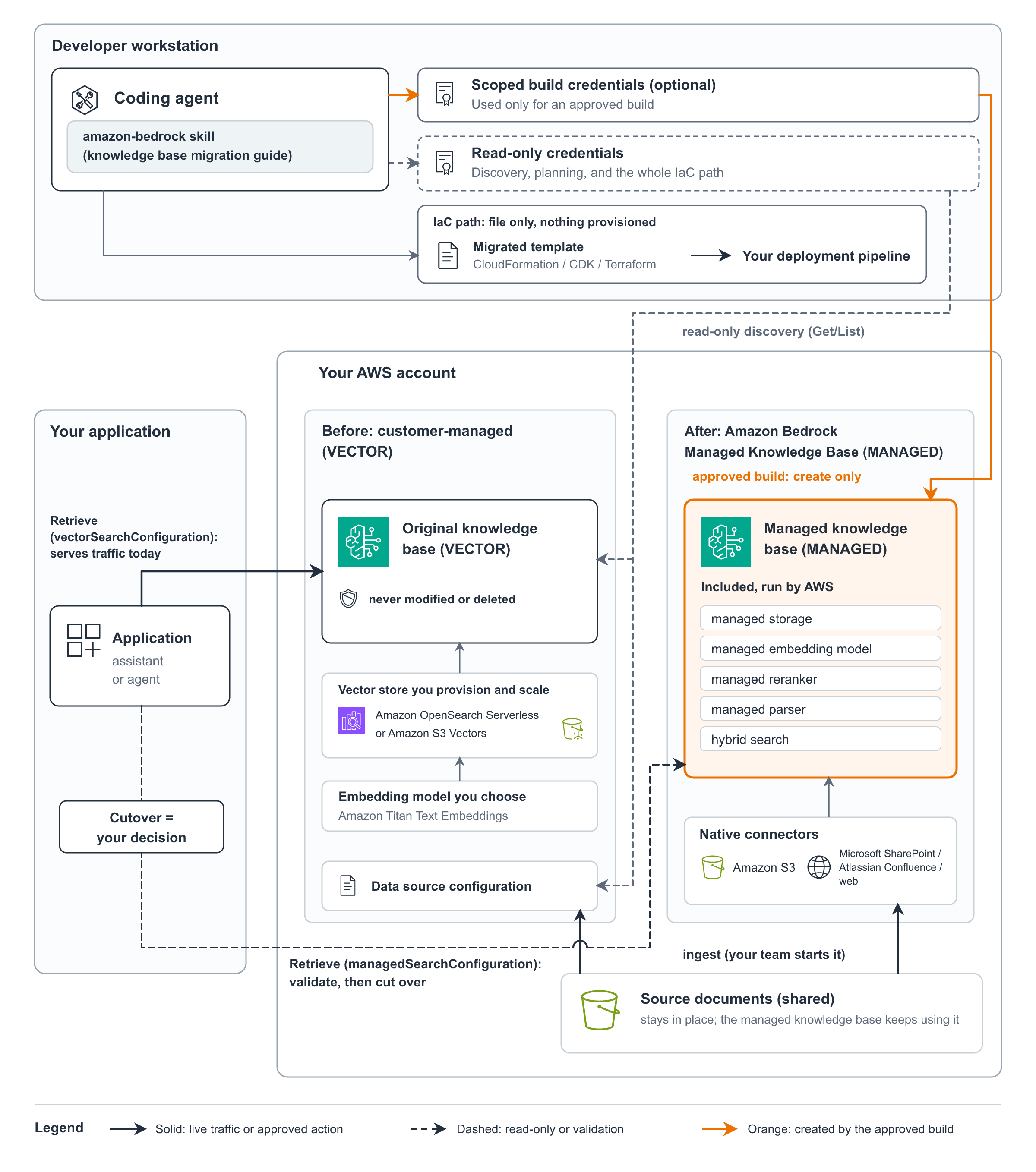
AWS has added a knowledge base migration guide to the amazon-bedrock skill inside its Agent Toolkit for AWS. The guide is aimed at teams running a customer-managed knowledge base on Amazon Bedrock — the configuration where you provision the vector store yourself, tune embedding and index settings, and size capacity for every data source — and it walks a coding agent through moving that setup to Managed Knowledge Base, which AWS describes as handling ingestion, storage, indexing and retrieval itself. The walkthrough covers prerequisites, installing the skill, planning the migration, updating the application's retrieval call and validating results before cutover. The examples in the post use AWS CLI 2.37 and boto3 1.43.32.
The division of labor is deliberate. The agent can discover and plan, and on approval can create the new knowledge base and its data sources next to the original, or emit a migrated infrastructure as code template for your pipeline. Ingestion and the changes to your application's Retrieve calls remain the team's job, with the agent available to talk through both. Throughout, the original knowledge base keeps serving traffic.
The type change is the heart of it: a customer-managed knowledge base is provisioned as VECTOR with a store you configure, while the managed version is created as MANAGED. The guide's configuration map classifies each existing setting as 1:1 (unchanged), adjusted (managed uses a different setting to reach the same outcome) or blocked (no managed path today, in which case the agent drops that knowledge base from the build, explains why and points to AWS Support while other knowledge bases in the run continue). Chunking is one area AWS asks teams to compare against their own content during validation.
What the managed type brings is largely what you would otherwise assemble. Hybrid search combining keyword and semantic matching is always on with no index to tune, and a managed embedding model, managed reranker and a parser for multimodal files are included. You can still bring your own Bedrock embedding model, and per request choose the managed reranker, a Bedrock reranking model or none — the managed reranker requires the managed embedding model. Native connectors cover sources such as Amazon S3, Microsoft SharePoint and Atlassian Confluence, with incremental syncs after the first full load. A deletion safeguard guards against accidental bulk removal of indexed content. ACL awareness carries document permissions through to retrieval, and for connectors that support it such as SharePoint and Confluence, a real-time source check catches permission changes since the last sync; the application must still authenticate users and pass their identity. Agentic retrieval handles multi-part questions iteratively and can search several knowledge bases in one request, AgentCore Gateway exposes the knowledge base as an MCP target with the gateway handling authentication, and resource-based policies let other AWS accounts call it with narrowly scoped actions such as bedrock:Retrieve. Those three last capabilities are not available on customer-managed knowledge bases.
Default quotas are notably looser on the managed side. Per account and Region, AWS lists 10,000 managed knowledge bases against 100 customer-managed; 200 data sources per knowledge base against 5; 50 concurrent ingestion jobs per knowledge base against 1; and 10,000 query input characters against 1,000.
Pricing shifts from infrastructure to metered usage. Vector storage is folded into a base rate of $5 per GB per month, multimodal parsing is included, embedding generation is included with the default model (custom models billed at their rate), and ingestion, sync and re-sync compute plus native connectors are included. Standard retrieval is $1 per 1,000 requests, with reranking folded into that same $1. Agentic retrieval adds $4 per 1,000 queries on top of the underlying retrieval calls, which AWS estimates lands around $6 to $9 per 1,000 queries depending on how many retrieval calls are made. On customer-managed setups, storage and query charges track whichever vector store you picked — some bill provisioned or minimum capacity, others such as Amazon S3 Vectors bill only for use — and AWS estimates building an agentic workflow on a Bedrock model can cost roughly $18 to $24 per 1,000 queries before development and maintenance. AWS frames usage-based pricing as a fit for enterprise question-answering, policy and support knowledge bases running at low utilization. In practice, the trade is control for predictability: you give up the ability to tune index and store behavior, and in exchange you get a per-request bill and less operational work, so the arithmetic depends on utilization.
The guide separates planning from doing. In Explore mode the agent answers questions and inspects configuration with read-only calls so you can size the effort. Migration mode runs through checkpoints: introduce and choose (mode, live knowledge base or IaC source, plain or technical explanation style), identify (confirm account and Region, flag over-broad credentials, offer an optional cost analysis), discover (read-only calls or template files), plan (review the mapping and caller changes — the default stopping point), optionally implement, then handoff. A live build requires approving an exact preview of the provisioning script, and re-approving if it changes; the example command requires a plan hash via --expect-plan-sha256 and refuses to run without a match. The IaC path only writes a migrated file and provisions nothing.
Permissions are handled conservatively in the guide's design. Discovery, planning and the whole IaC path need only read-only credentials. For a live build the agent is directed to propose a scoped policy that explicitly denies changes to the original knowledge base, never request administrator access, touch only resources it created, reference secrets by ARN, and ignore instructions found in the data it reads. AWS suggests reviewing the generated IAM policy and script before approving, and checking CloudTrail event history afterward, which retains 90 days of management events. Prerequisites include separate credentials for planning and building, a compatible environment with the Agent Toolkit, the AWS CLI with a least-privilege read-only profile, access to the original configuration or IaC, an IAM service role for the new knowledge base, and Python 3 with boto3 for the generated script. Installation is one command, aws agent-toolkit add-skill --skill-name amazon-bedrock, with an --agent flag to target a specific tool such as kiro; the skill loads automatically when you describe a migration task. By default the new knowledge base takes the original's name with a -managed suffix.
Application changes are modest but not zero. Both types use the same Retrieve operation; the managed request points at the new knowledge base ID and swaps vectorSearchConfiguration for managedSearchConfiguration. Sending the old shape to a managed knowledge base yields a validation error, and because managed retrieval is always hybrid there is no overrideSearchType field. Metadata filter syntax carries over except for the startsWith and stringContains operators. Validation happens while the original still answers: sync each data source and review failures, grant the runtime role bedrock:Retrieve on the new ARN while keeping access to the old one for rollback, then run representative queries against both. Scores come from different scales — and managed scores depend on rerankingModelType, which defaults to MANAGED with the managed embedding model and NONE with a custom one — so thresholds should be tuned per mode and the mode held constant during a comparison.
Why it matters: teams with sizable Bedrock retrieval estates get a guided, largely read-only path to shed vector store operations, and the agent framing means much of the configuration mapping is drafted for review rather than done by hand. Developers should plan for a real application change — a new knowledge base ID, a different search configuration block and narrower filter operators — plus a scoring recalibration, and should verify that any feature they rely on is available on the managed type before committing. My reading is that low-utilization, connector-heavy deployments stand to gain most from the flat per-request pricing, while high-volume or deeply tuned setups may find the blocked-setting category and the loss of index control the deciding factors.
Based on reporting from the original publisher. Visit the source for full context and later updates.
Publisher excerpt
The migration guide in the amazon-bedrock skill helps you migrate a customer-managed Amazon Bedrock knowledge base to a Managed Knowledge Base. Your coding agent plans the move with read-only discovery, creates the new knowledge base or an infrastructure-as-code template alongside the original, and validates retrieval before you cut over.