Things That Go Beep in the Night: Agentic AI Joins the Search for Extraterrestrial Signals
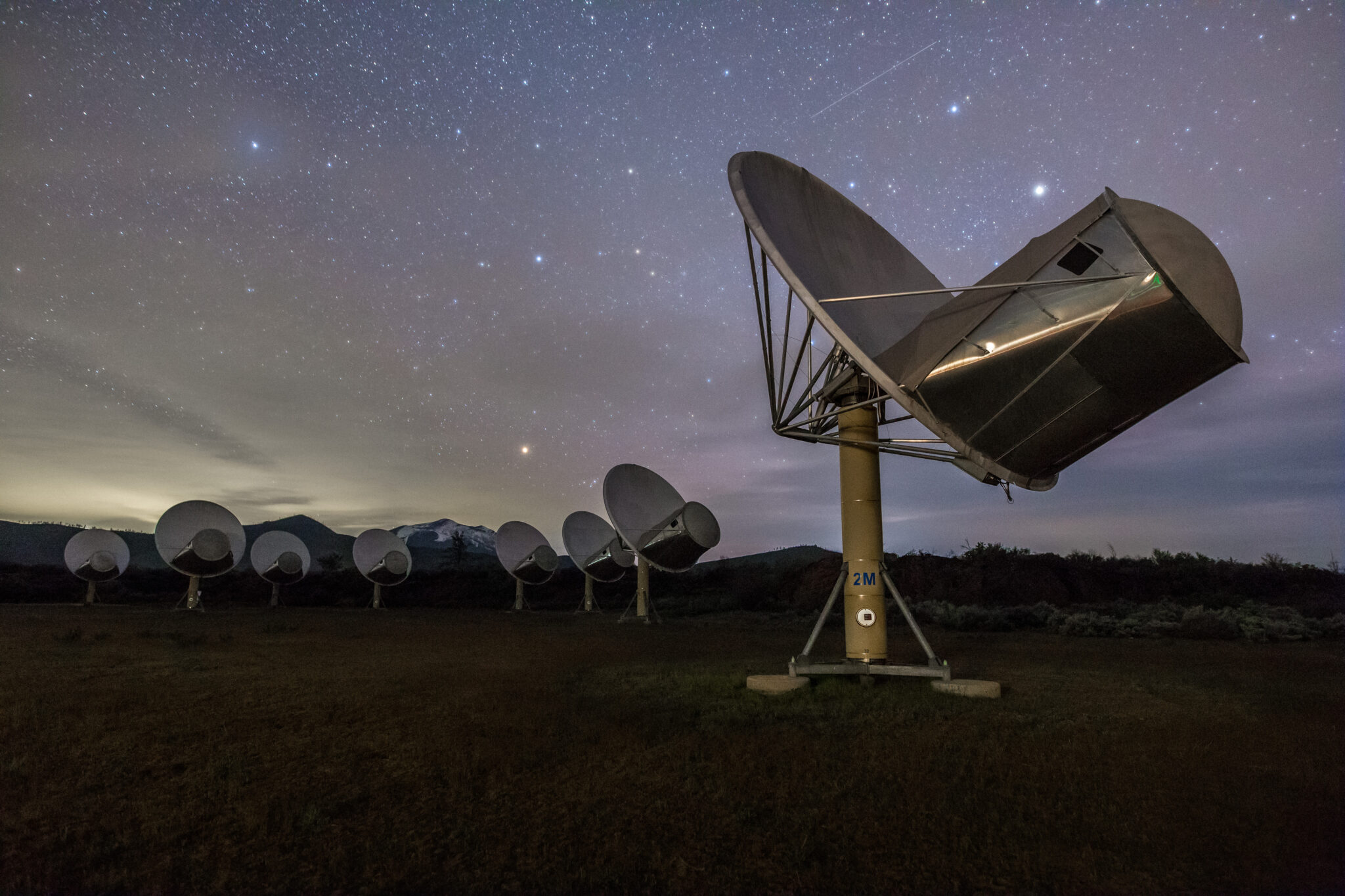
Breakthrough Listen and the SETI Institute have integrated agentic AI into the day-to-day hunt for extraterrestrial intelligence at the Allen Telescope Array in Northern California. In the new setup, AI agents can point and steer the instrument, clean up and correct the incoming data, and run AI models against the live signal stream, all triggered by a single request written in natural language. NVIDIA's Holoscan platform, which streams sensor data into GPUs for real-time processing, supplies the agents with live data to act on. The organizations frame the result as a faster and more adaptable search for possible signals from extraterrestrial life and technology.
The engineering problem is volume. Radio telescopes produce data at rates that overwhelm conventional storage, so the interesting part of a measurement can be lost while it waits to be written to disk and analyzed later. At the Allen Telescope Array, a Holoscan library called DAQIRI pulls terabits per second of sensor data directly into GPU memory, so observations are processed as they happen rather than accumulating on hard drives. CyberEther, a signal-processing framework built at the SETI Institute, performs the heavy math using NVIDIA's CUDA-X libraries, including cuFFT and cuBLAS, the long-standing GPU routines for fast Fourier transforms and dense linear algebra. Those two operations are the backbone of radio astronomy signal processing: transforms turn a time-domain voltage stream into a spectrum, and matrix math underpins filtering, correlation and beamforming.
On top of that sits Nexus, a web-based observatory orchestrator that functions as the agent harness. It gives agents a single source of truth for instrument state, compute resources and pipelines, and it lets researchers watch packet loss, read live spectrograms and rewrite signal-processing blocks, all by prompting in natural language. The system can sustain 2.4 terabits per second on NVIDIA RTX PRO 6000 Blackwell GPUs, with inference running on premises next to the instrument. According to the organizations, the combined stack lets an agent steer the antennae, calibrate and focus the instrument for a clean signal, catch and fix data errors and plot the result. The stated effect is to compress work that would take humans weeks or years into hours.
The pipeline has already produced a result: the first real-time AI detection of a pulsar in the Crab Nebula. Pulsars are rapidly spinning stellar remnants whose beams sweep past Earth like a cosmic lighthouse, and their regular pulses make them useful natural test signals for detection software. Catching one live, as data streams in, is a meaningful check that the pipeline can find known astrophysical signals under real-time constraints, which is a reasonable precondition for trusting it with unknown ones. The team says it is now evaluating open models, including NVIDIA Nemotron, for situations where data locality and turnaround time matter most, and for observatories that might one day run offline, such as on the far side of the moon.
Andrew Siemion, the Bernard M. Oliver chair for SETI at the SETI Institute and principal investigator of Breakthrough Listen, described the shift in terms of kinship and translation: as agentic observatories reach into the universe, what they find may have more in common with themselves than with the humans who built them, and he characterized that as a breakthrough in translation rather than something to fear.
This suggests an architectural pattern worth noting for developers working outside astronomy. The pieces are separable: a real-time data plane that moves sensor bytes into GPU memory without a disk round trip, a compute layer of well-established numerical libraries, and an orchestration layer that presents instrument state to a language model as a single authoritative view. The agent is not doing the Fourier transforms; it is choosing parameters, reacting to errors and reconfiguring blocks that already exist. That division of labor is what makes natural-language control plausible in a domain where a mis-set parameter can waste an observation. The emphasis on on-premises inference and open models likewise reflects a constraint familiar from edge computing: when the instrument is remote or bandwidth is scarce, the model has to sit next to the data rather than in a distant cloud.
A likely trade-off is verifiability. Letting a model rewrite signal-processing blocks and adjust calibration is powerful, but it also means the detection pipeline's behavior can change between runs, which complicates reproducing a result or ruling out an instrumental artifact. The emphasis on a single source of truth for instrument state and on monitoring packet loss and live spectrograms reads as an attempt to keep humans in the loop while agents act. How much autonomy the agents are actually granted, and what review stands between an agent's finding and a claim of a candidate signal, is the kind of detail that matters for trust and is not spelled out in the announcement.
Why it matters: Teams building agentic systems for physical instruments get a concrete reference design here, combining a streaming GPU data path, established numerical libraries and a natural-language harness over instrument state, with a published throughput figure of 2.4 terabits per second on RTX PRO 6000 Blackwell hardware. For radio astronomy, the practical change is that calibration, error correction and signal triage can happen while the telescope is observing rather than in a later batch pass, which in inference could shorten the loop from detection to follow-up. Developers outside science should read the pattern as a template for any domain where an agent must act on fast sensor data with the model running on site.
Based on reporting from the original publisher. Visit the source for full context and later updates.
Publisher excerpt
While science fiction lore tells us that humans will meet extraterrestrial life in the form of little green men, the detail that should raise hairs this Halloween is this: the search for extraterrestrial intelligence took a major leap forward with AI, and it increasingly focuses on AI agents built by humans listening for AI agents […]