An opinionated guide to which AI to use to do stuff
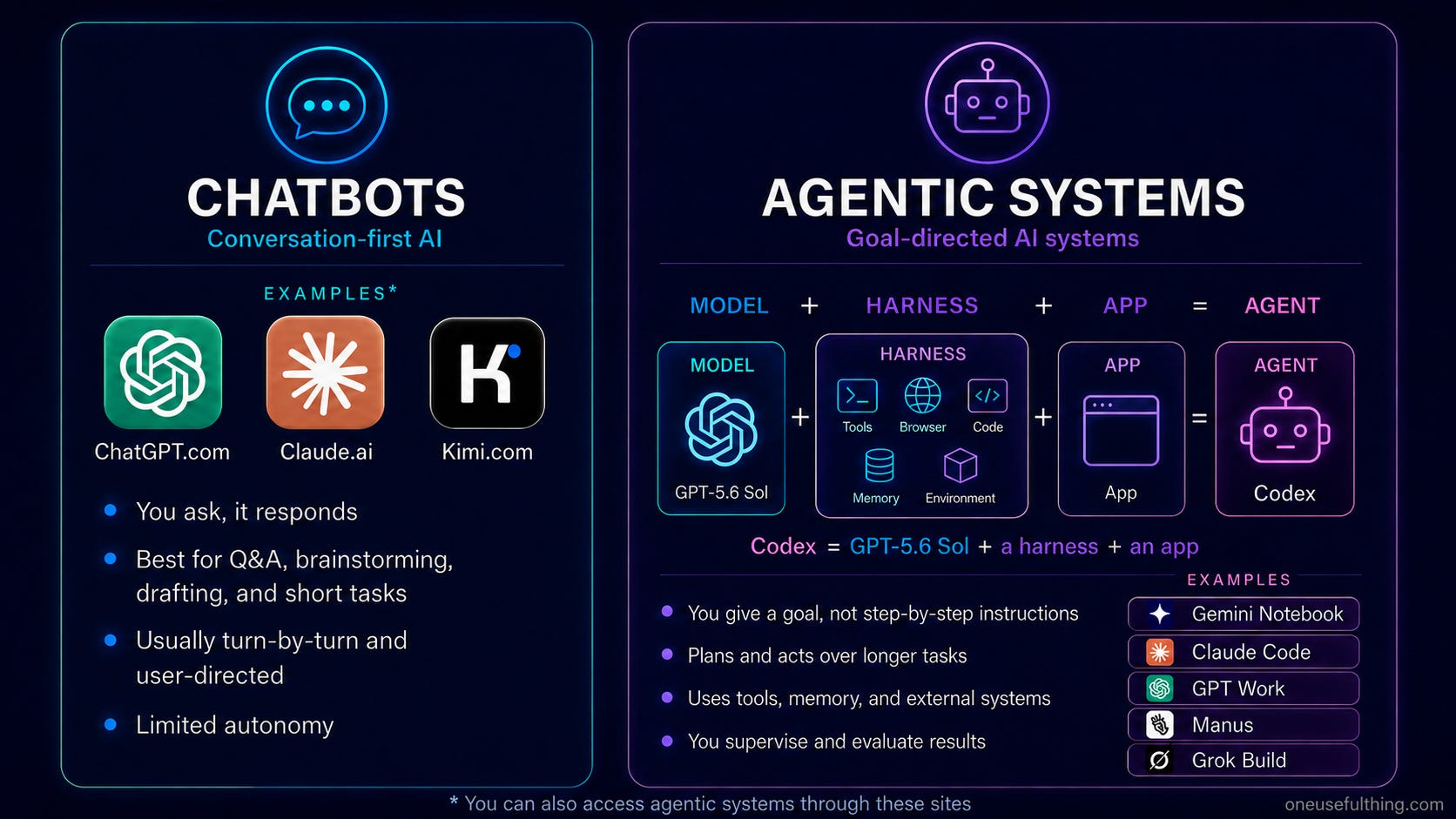
Ethan Mollick published the Summer 2026 edition of his recurring guide to which AI tools to use, arguing that "using AI to do stuff" no longer means a back-and-forth chatbot conversation. The shift he describes is toward agentic systems: an AI model combined with a set of tools that let it plan and act, effectively giving the model a computer to work with. He illustrates the change with a demonstration — a brutalist city-building game made with GPT-5 shortly after its release, recreated less than a year later using GPT-5.6 Sol in Codex from the same prompt and follow-up suggestions, with what he calls a stark difference in output.
Mollick splits his advice by stakes. For low-stakes chat — a recipe, a quick question, help writing a letter — he says the many available options, including default free models, are good enough, so pick whichever you like. For high-stakes conversations such as a second opinion on a medical or legal concern, he advises using the most advanced models available: Claude's Opus and Fable, or ChatGPT's GPT-5.6 Sol set to at least the High thinking level. His reasoning is that these models have lower error rates and score much higher on ability tests in complex fields, at the cost of some money. Readers are meant to choose both a model and a thinking level.
For real work, Mollick narrows the practical choice to ChatGPT or Claude, noting that cheaper alternatives require expertise, while both flagship subscriptions start at $20 per month and are easy and powerful but poorly documented and confusingly named.
There are two ways to give an agent a computer. The first is the AI company's own virtual machine: ChatGPT Work in ChatGPT and Cowork in Claude. In that mode you pick the model and thinking level — his suggestion is Sol at High for ChatGPT, and Fable or Opus at High for Claude — and choose which applications the agent may connect to, so it can act on your accounts. He personally connects email, a non-private portion of Google Drive and other applications, but frames that as a decision each user has to make.
In a trial, he gave both systems the same instruction: connect to Gmail, help prepare an MBA seminar for Monday the 21st, build presentation and demo material, and answer outstanding messages on the topic. Both correctly resolved the next Monday the 21st to September rather than August, researched the web, designed a demo and drafted a reply, returning teaching materials and an email in about ten minutes for what he estimates would have taken a person a couple of hours. One notable divergence: Claude produced only a draft, while ChatGPT actually sent the email — because he had earlier granted ChatGPT permission to send on his behalf, whereas Claude was configured to ask first.
That gap is the guide's central operational lesson. Both companies let users decide whether the agent must obtain approval before acting, such as sending an email, buying something or changing a file, and Mollick recommends leaving everything on ask-first until you trust the system and understand its failure modes. Permission scoping also blunts prompt injection, where text encountered in email or on the web tries to redirect the agent, for example by telling it to forward files. He says the labs are working on this and models have grown more resistant, but the problem is unsolved, so agents should touch as little as possible and approval gates should stay on for anything that sends, spends or deletes.
Because Work and Cowork run on the vendors' machines, a long job can be launched from a phone, the app closed, and results collected later; recurring tasks such as a daily briefing can also be scheduled. The ceiling, he argues, is that the agent is still working on the vendor's computer.
Giving an agent your own computer is the more powerful path, done by installing the ChatGPT or Claude app and picking a mode. ChatGPT's two agent modes are Work and Codex; Claude's are Cowork and Code. Mollick notes the names overlap with the hosted modes without mapping cleanly onto each other, which he calls unnecessarily complicated. The distinction he draws is in emphasis: Work and Cowork aim at a finished artifact — a presentation, an analysis, an organized set of files — while Codex and Claude Code expose the process, showing files changing, commands running, tests executing and a detailed change log.
Access to your machine enables longer, more ambitious projects across many files. He gave GPT-5.6 Sol in Codex the full PDF of an upcoming October book, already professionally edited, to check. It worked for 30 minutes, traced 195 references and returned pages of notes that he says would have occupied a research team for many hours. All of the notes were accurate — no invented page numbers or text — and his problem was the reverse: the model was extremely nitpicky, and he used human judgment to reject those complaints. The framing he draws from this is that working with agents resembles managing a team more than chatting, and he compares using Codex to fix computer problems to a tiny IT department inside the machine, which he does at his own risk.
The most striking capability is computer use: with that option enabled in Code or Codex, the agent can take over the mouse, browser and desktop. He describes asking Sol in Codex to download Blender and model an otter using a laptop on an airplane, and links a sped-up video of it happening. He flags this as a security concern to approach carefully, while noting the results can be impressive. In his assessment, the agent can do nearly anything a person with access to the machine can do — sometimes better, as with software he does not know, sometimes worse, since he would rather make his own slides and write his own emails.
On the rest of the market, he says Microsoft-centric workplaces may only have Copilot, which mixes models and handles office documents acceptably but lags badly on agentic ability. Chinese open-weights models such as Kimi K3, DeepSeek and Qwen are surprisingly capable but demand expertise to run as agents. Google, he writes, led benchmarks not long ago but has no leading frontier model and nothing close to Codex or Code, so he does not recommend Gemini as a primary system right now while allowing that this could change quickly. Google still has useful pieces: Gemini Notebook, formerly NotebookLM, is in his view the most useful interface for research across many sources, and the Gemini Omni video model is an LLM that sees and edits video directly — he used it to turn the 1896 train-arrival film into a bullet train, then a LEGO train, then to add a time traveler, a centipede and the Muppets with one prompt each, complete with reworked shadows and reflections. ChatGPT and Google both ship strong image generators; Claude has none and will draw with code instead, with results he calls excellent to amusing. On voice, ChatGPT's GPT-Live listens and speaks natively with human pacing and interruptions, and is available in the phone app and in Codex; Claude's voice reads generated text aloud, and he says the difference is audible.
His closing advice is to pick Claude or ChatGPT, pay the $20, and hand an agent a real task, then review the output and request revisions like you would from a person. He warns that the $20 tiers include real but limited agent usage that agents burn through quickly, and that higher-priced plans mostly buy more hours of AI labor rather than smarter AI.
Why it matters: For developers and product teams, the guide's operational points — model plus thinking-level selection, ask-first permissions, narrowly scoped tool access and prompt-injection exposure — are the practical constraints on deploying agents against real accounts and machines. A likely inference is that evaluation and approval workflows, not raw model choice, will decide whether agentic features ship safely. The claim that higher tiers mostly buy usage hours rather than capability is also a signal that cost planning for agents should be framed around compute time per task.
Based on reporting from the original publisher. Visit the source for full context and later updates.
Publisher excerpt
The Summer 2026 Edition