Levent Alpöge has solved the Riemann Hypothesis with help of Claude! What does it mean?
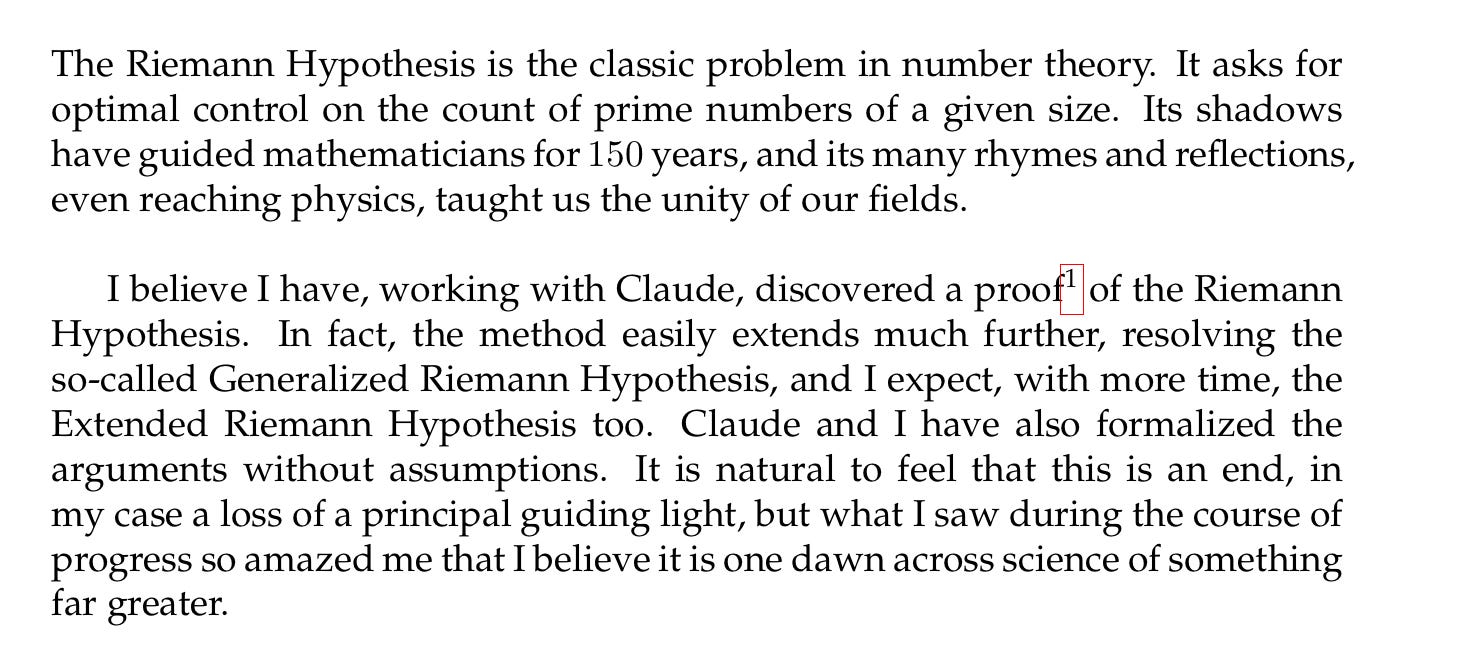
Levent Alpöge appears to have proven the Riemann Hypothesis, working in collaboration with Anthropic's Claude, according to a statement from Alpöge. The news landed on a Friday just after markets closed, and it has been widely read as an AI milestone. The more accurate picture, as AI math pioneer Christian Szegedy framed it, is that Alpöge "made all the right (life) choices at the right time," and that without those choices the result would not exist.
The collaboration stretched over months of joint work rather than a single session. Alpöge, a mathematician with expertise in AI, shaped the end product substantially. This was not a case of typing a prompt asking for a solution to the Riemann Hypothesis and receiving a finished answer. The process was deeply collaborative, with a human expert steering throughout. That distinction matters for anyone trying to read the result as evidence of what current systems can do unattended.
It is worth being precise about what the result does and does not establish. It does not mean AGI has arrived; the argument being that an autonomous general system would not have required a human mathematician to guide the whole process. Nor does it appear to be an especially elegant or technically innovative proof. The write-up reportedly runs to roughly 250,000 pages, and no general lessons about how to do mathematics have yet been drawn from it. No new techniques or concepts have so far been introduced.
The technical substrate is the part developers should pay most attention to. The work leaned heavily on Lean, a special-purpose symbolic system for formal mathematics, together with mathlib, a vast library built to work with it. mathlib comprises more than two million lines of formalized mathematics, assembled over multiple years by hundreds, perhaps thousands, of contributors. That is an enormous, curated, community-maintained asset, and it is specific to mathematics.
Lean and mathlib are built around formal verifiability: a proof can be checked mechanically against the library's definitions and lemmas. Formal verification is tractable in mathematics because statements can be written down precisely and checked by machine. The same property is much harder to obtain in medicine, biology, business or robotics, where the relevant knowledge is messy, tacit, or not stated in a formal language a checker can consume. This suggests the ingredients that made this result possible do not transfer cleanly to open-ended domains, where neither a mathlib equivalent nor a cheap correctness check exists.
Several commentators have made the point that the achievement is narrow in its practical reach. Jeremy Kahn noted that solving the Riemann Hypothesis does not help negotiate a contract better or correctly figure out a corporate tax return, so there is no real change to enterprise value propositions. Google DeepMind's Sebastien Krier made a similar point: solving an old pure math problem does not immediately widen Anthropic's operating margins.
A useful analogy, in my reading, is the 1997 Kasparov match, where DeepBlue's win was an impressive special-purpose achievement that did not generalize broadly, despite predictions at the time. This result looks more like a demonstration of what a strong human plus a strong narrow tool plus a large formal corpus can achieve than a general capability jump. The market reaction is consistent with that reading: the news did not move Anthropic stock much after hours.
The result also sits alongside a broader market correction in AI stocks, and some online discussion has treated it as reassurance against that backdrop. Two things remain unchanged regardless: current AI is still not trustworthy enough for many applications, and it is still not profitable enough to justify the scale of investment going into it. Those are the constraints that matter for planning, and a single proof, however significant mathematically, does not alter them.
Why it matters: For developers and product teams, the takeaway is less about a model capability jump and more about the recipe. A formally verifiable domain, a large curated formal library and an expert human in the loop produced an extraordinary result. Teams working where correctness can be checked mechanically may find similar leverage; teams working in open-ended domains should treat this as a narrow signal rather than a forecast. Whether the approach generalizes is, in my reading, still an open question the facts here do not settle.
Based on reporting from the original publisher. Visit the source for full context and later updates.
Publisher excerpt
And why isn‘t it immediately rescuing the market?