Was I wrong about open models & cyber risks?
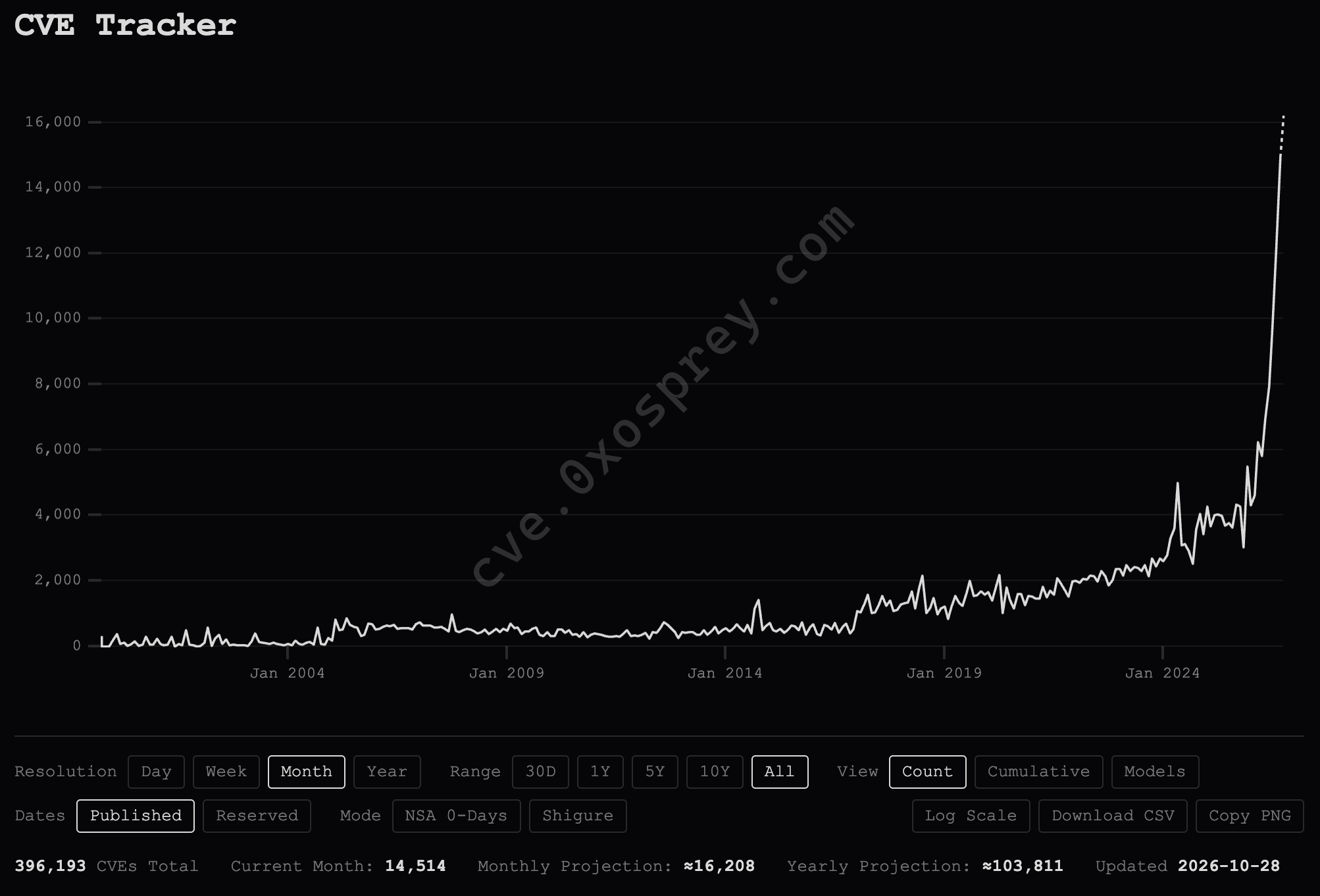
Nathan Lambert, writing on his Interconnects newsletter, has revisited the position he took a few weeks earlier on open-weight models and cyber risk, prompted by what he calls "Black October": a run of critical vulnerability disclosures including PHP2Shell and a long-standing GitLab bug, plus a further major crypto security incident at Binance. He frames the piece as an unpacking of where he stands after sustained pushback, some of it, in his words, hopeless dunk attempts and some reasonable discussion.
The core of the earlier argument was that Claude Mythos, when announced, was previewed as a new class of cyber weapon whose release into the wrong hands would cause mass societal destabilization. Lambert now says that looks wrong. He points to GLM-5.3 as the model that by all measures crosses that capability threshold, notes there is little public evidence that much has changed more than a month after its weights were released, and goes further: had Mythos leaked as open weights, he thinks the world would have been more or less fine, with a clear increase in cybersecurity incidents rather than a step change in risk.
To support his reading of the discourse, he collects examples of language he considers exaggerated from prominent figures. Rob Wiblin, host of the 80,000 Hours podcast, said on his own podcast on April 10, 2026 that if the model fell into the hands of criminals or hostile state cyber actors it would be an actual disaster. Anthropic's Project Glasswing announcement blog on April 7, 2026 warned that such capabilities will not be long in proliferating beyond actors committed to deploying them safely, with fallout for economies, public safety and national security that could be severe. Lambert singles out Zvi Mowshowitz's April 9, 2026 post as more reasonable, while still noting the claims that Claude Mythos would hand attackers a cornucopia of zero-day exploits for essentially all software on Earth and that it would be chaos. He observes that the chaos so far has been confined to operators of large-scale digital products.
The evidence he weighs includes recent work by Epoch AI using GLM-5.3 to hunt for vulnerabilities and chain them toward an attack. Their Firefox result is a useful illustration of why harm takes more than a bug: a website that, when visited by a Firefox user with no further interaction, let an attacker exfiltrate files from the machine. The exploit sits in the browser, but someone still has to plant a site that targets it — only one stage of a multi-stage process.
Lambert concedes that "fine" was imprecise. He now describes what is coming as a forced industry update to a new way of working with software, expensive and accompanied by hard work. For readers already somber about AI risk, fine still fits; for those who had not priced in turbulence, it undersells. He also gives more credit to safety researchers who framed this as a new era of cyber instability, and notes the Wall Street Journal's report that cyber first responders are strained, which he reads as the system working rather than failing. His picture is an exponential climb in vulnerabilities that will take a long time to level off.
His actual thesis is narrower than open versus closed. Open models, in his view, provide balance in the offense-defense equation, and Mythos arriving sooner would not have upended it, partly because companies would likely adopt open-weight models faster than attackers, who are generally less resourced. He points to a widely shared observation that threat actors behave like businesses with defined processes: phishing and ClickFix operators will not drop everything to hand-write exploits just because a critical CVE lands. The only actors exploiting a given bug tend to be the ones whose business is exploitation.
On which models are doing the finding, Lambert expects closed models account for most of it, with high error bars. Serving open models is expensive today and the compute for the largest models is extremely sold out, so he suspects a near-term open-model-assisted hack would more likely run through a poorly secured model API. Over the long run he is confident margins and prices fall as compute supply grows, but near term closed models are more price effective.
He also pushes back on the framing of the debate, citing cybersecurity writers such as Joshua Saxe and Chris Hughes for an ecosystem view in which exploit rates and damages have grown since long before ChatGPT and these events sit on that trend line — an exponential one. If AI capability were the binding constraint on attacks, he argues, ecosystem-level charts would show a clear step. He also notes that closed models have played a heavy part in recent hacks, at least more than open ones, and that cyber is a societal problem AI companies cannot solve alone. He credits Seb Krier for feedback.
Why it matters: Teams building AI-assisted security tooling or shipping open-weight models will be judged on evidence that is only now accumulating, and Lambert's argument implies the measurable signal to watch is exploit volume and damage trends, not whether a given capability exists openly. His expectation that closed models are doing most vulnerability discovery is explicitly low-confidence, so product and security leads should treat the open-versus-closed framing as unsettled. The more actionable inference — mine, not his — is that defensive adoption speed and patching capacity, not weight availability, are likely to determine how rough the next stretch is.
Based on reporting from the original publisher. Visit the source for full context and later updates.
Publisher excerpt
Last week coined the term “Black October“ after an onslaught of critical vulnerability disclosures, including PHP2Shell and a long-standing GitLab bug, signified the moment when the cyber risks of AI models started to materialize.