Sign of the future: GPT-5.5
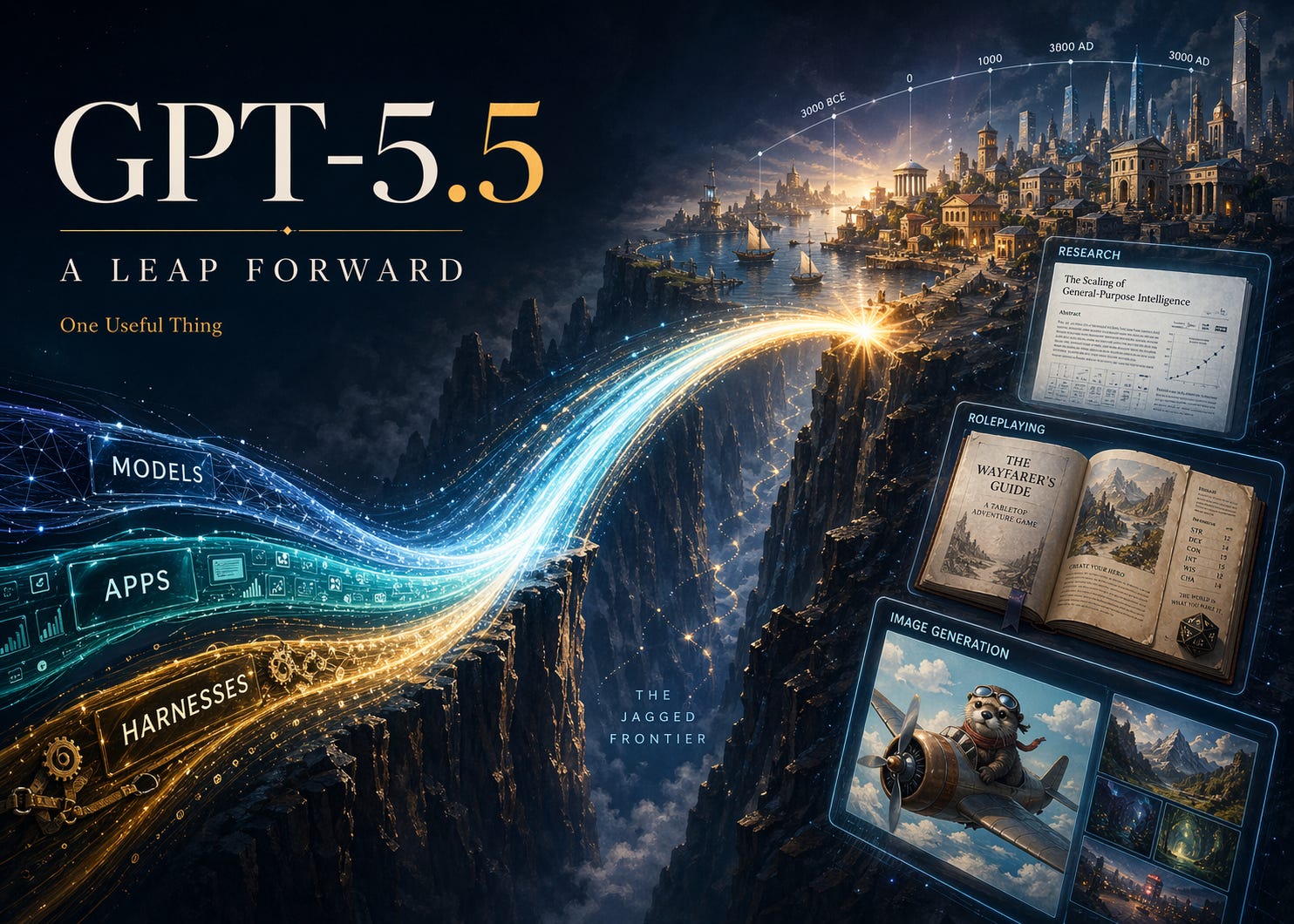
Ethan Mollick wrote that he had early access to GPT-5.5, which he described as a big deal, indicating that rapid improvement in AI is not finished. He said the frontier of AI ability remains jagged, and that it is increasingly hard to demonstrate each generational change quickly because tasks AI once struggled with, such as math or counting letters in words, are now trivial for it.
To illustrate, Mollick gave a coding challenge to models ranging from OpenAI's o3, described as its first reasoning model released a year and a week earlier, to the current best open weights model (Kimi K2.6) to the new GPT-5.5 Pro. The prompt was to build a procedurally generated 3D simulation showing the evolution of a harbor town from 3000 BCE to 3000 AD that looks beautiful and allows some control. He posted every answer to a gallery built by GPT-5.5 Codex. He said that in addition to being better along other dimensions, only GPT-5.5 Pro actually modelled an evolving town rather than generating new building replacements over time. He also said GPT-5.5 Pro was faster: GPT-5.4 Pro took 33 minutes to complete the task, while GPT-5.5 Pro took 20.
Mollick framed AI as three interlinked concepts: models, such as Opus 4.7, Gemini 3.1, or GPT-5.5; apps, including websites like chatgpt.com, claude.ai, and gemini.google.com, and desktop applications like Claude Code, Claude Cowork, and OpenAI Codex; and harnesses, the tools an AI can use and how models are hooked up to them. He stated OpenAI has made advances in all three areas. He said GPT-5.5 is a powerful family of models, with GPT-5.5 Pro the most competent and accessible only on the website, and that Codex is increasingly following the path of Claude Code. Among harness improvements, he highlighted a new OpenAI image model, sometimes called GPT-imagegen-2, which he said can render high-quality text and create almost any picture that can be described. He referenced his Otter Test and showed generated images responding to prompts about it.
Based on reporting from the original publisher. Visit the source for full context and later updates.
Publisher excerpt
One impressive step on the curve