How Anthropic ships Claude with Claude: Separating the Brain from the Hands
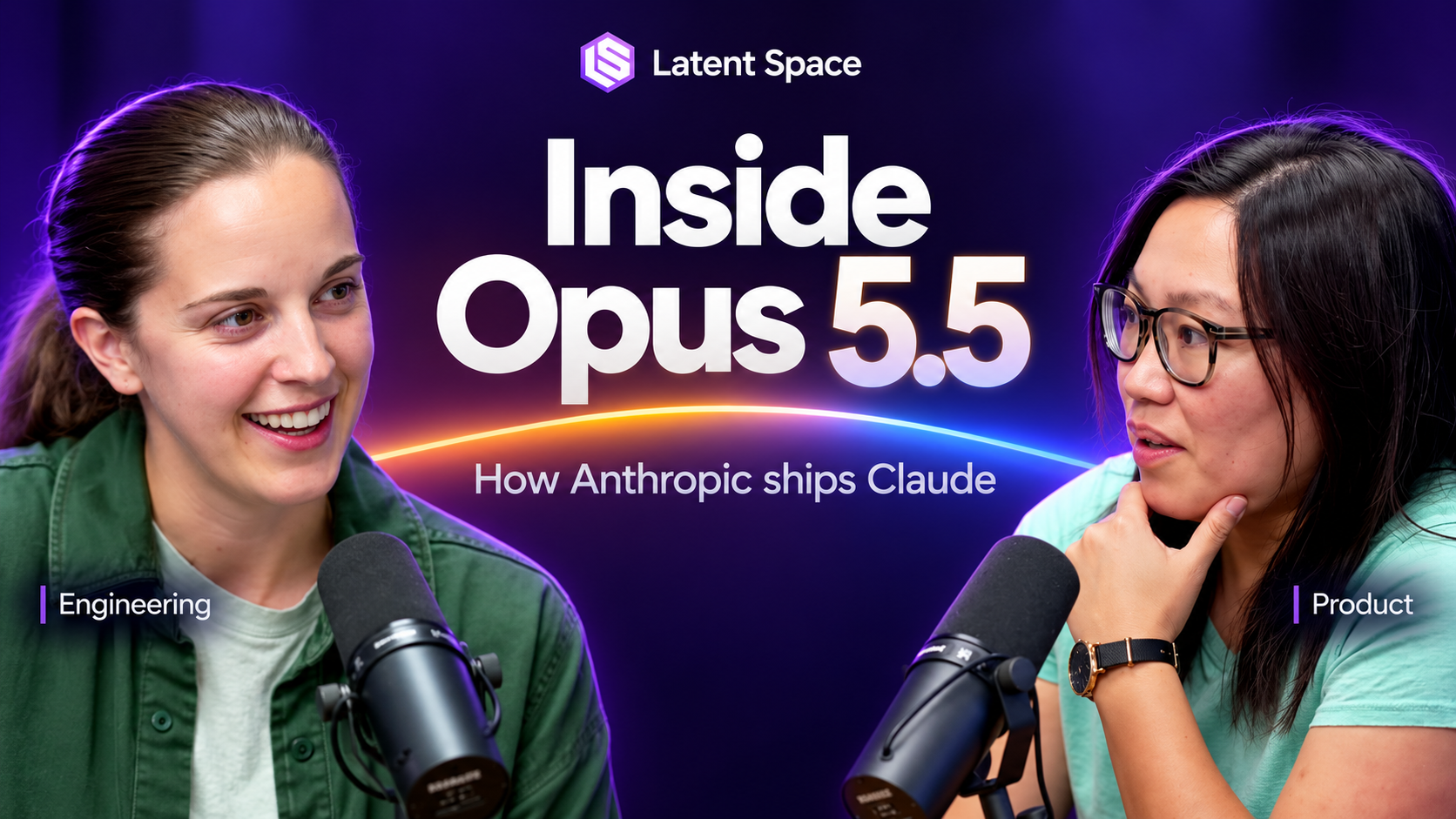
Anthropic's heads of Engineering and Product, Katelyn Lesse and Angela Jiang, joined the Latent Space podcast the day after the Opus 5.5 launch to discuss how the lab ships new models and how its Claude Platform is structured. The episode was recorded as Anthropic's S-1 filing became public; the hosts cite a swing from a -126% loss position to 19% GAAP profitability over the past year and single out the Claude Platform, which Anthropic describes in the filing as a comprehensive agentic development environment giving customers direct access to its primitives.
On the model itself, the two said the team had absorbed feedback that Opus 5's writing came across as convoluted and worked to clean that up, a change they say appears to be resonating with users. Pricing was framed around intelligence per dollar: Anthropic says Opus 5.5 costs less to run than its predecessor, though the exact saving depends on the workload and how heavily it uses cached context. The hosts noted Opus 5.5 has held the top spot among the high-end testers they talk to for about a month.
A model launch, in their telling, is also an API launch. Much of the less visible work around Opus 5.5 went into making the API harder to distill from. Anthropic changed how thinking blocks are preserved and replayed across turns, and how prefix locking works, in response to a published technique for extracting reasoning traces from proprietary models. The researchers behind that work did coordinated disclosure, which the Anthropic leads praised. They said the underlying gap was already known internally: chain-of-thought extraction has long been recognized as one of the most effective ways to distill a model. The hard part is separating legitimate uses, such as replaying thinking tokens in a compaction strategy for long-running sessions, from cases where the intent is to harvest reasoning at scale. Any new requirement here can break an existing customer harness, which is a real compatibility cost for teams that have built around the old behavior.
Lesse also described what an early access program looks like beyond benchmarks. Customers run evaluations in their own harnesses, report behavior that surprises them, and sometimes share looser impressions. The value is seeing the model in environments and tasks Anthropic's own products do not cover; a benchmark score alone does not capture that.
A useful mental model from the episode is the split between an agent's brain and its hands. In Managed Agents, Anthropic separates the session log and harness from the sandbox that executes code. The harness can persist while an execution environment is spun up on demand, so a sandbox failure does not take the whole session down with it. An earlier design put the entire coding agent inside a sandbox behind an API, which added startup work before the first response and meant a lost sandbox also lost the running agent. Decoupling the two let the platform chase lower latency and better reliability while keeping execution isolated.
The separation also has a security rationale. If generated code runs in a sandbox that never receives a service credential, there is nothing in that sandbox for the code to read. Credentials are held elsewhere and attached through a proxy, with controls on where sandbox traffic is allowed to go; Anthropic documents the broader isolation and network controls in a containment write-up covering its products. In practice, this is a checklist worth borrowing for anyone building an agent runtime: decide which state must survive, which components execute untrusted work, and which secrets genuinely need to be present where code runs. Implementations will vary by product, but the questions transfer.
Managed Agents also serves as a base for memory and multi-agent experiments. Dreaming, for instance, is implemented as one agent examining another agent's prior work and writing memories back, a higher-level behavior composed from the same primitives. On the roadmap, memory and learning remain priorities, but the team says more immediate attention has shifted toward safety as launches have grown harder. They also aim to keep the base harness relatively simple and let developers layer verifiers, parallel agents and other strategies on top. Capabilities floated for the future should be read as plans rather than commitments.
Evaluation came up as the natural counterpart to all of this. A harness is an application, but improving one starts to look like research: pick a goal, measure behavior, inspect failures, iterate. The group discussed using models to help build and analyze evals while keeping enough human judgment to confirm an eval reflects a real user's job.
The wider context framing the conversation is efficiency. The hosts note revenue per employee rose from roughly 1.4 million to 6.6 million over a year, and that in Q2 2025 Anthropic was losing about half a dollar per dollar of revenue before turning to roughly two dollars of revenue per dollar of cost. The S-1 attributes the improvement to two loops: an improvement loop where better models drive more use cases, which generate feedback for better models, and an investment loop where adoption drives revenue, revenue drives investment, and investment drives capability.
One pressure point the team raised is mundane but strategic: usage is growing fast enough that CPU consumption per API call becomes a planning question, and the platform has been rebuilding its Messages API in Rust. This suggests inference economics and serving efficiency are now model-launch concerns, not just infrastructure chores. The other pressure is capability itself, which makes decisions about safe deployment and who gets access harder as each frontier release lands.
Why it matters: Teams integrating with the Claude API should expect launch-adjacent changes to reasoning handling that can affect existing harnesses, and should test compaction and thinking-replay paths against each new model. The brain-and-hands split is a concrete architecture pattern for isolating execution and secrets in agent systems, and it is likely to shape how competing managed agent products are built. Buyers weighing models on cost should measure against their own cached-context profiles rather than list prices alone, since the stated savings vary by workload.
Based on reporting from the original publisher. Visit the source for full context and later updates.
Publisher excerpt
Katelyn Lesse and Angela Jiang on Opus 5.5, the Claude Platform, and the engineering behind AI agents.