How Eon built multi-cloud investigation with an MCP Gateway on Amazon Bedrock AgentCore
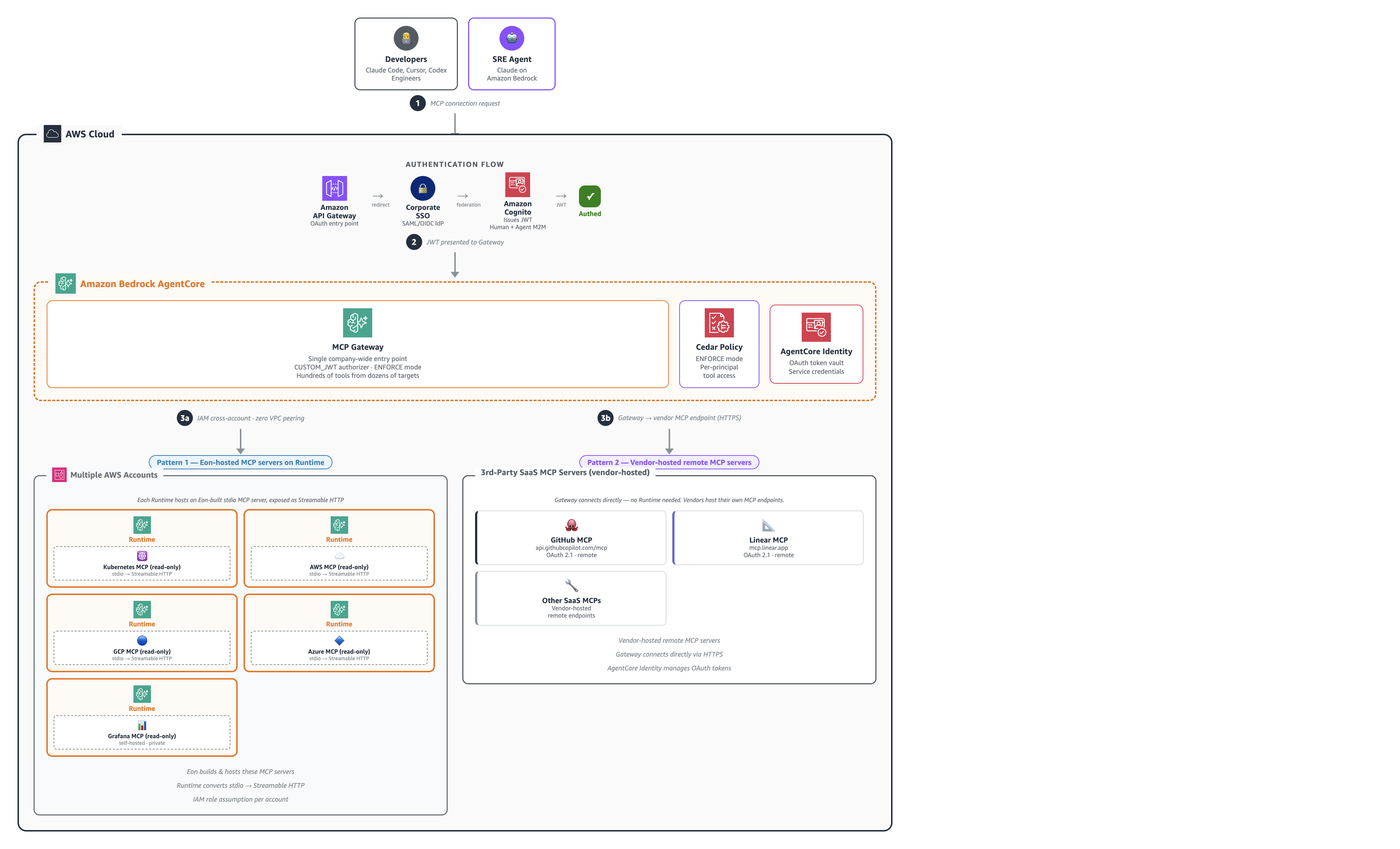
Eon, a cloud data protection vendor founded by former AWS engineers, has described in a guest post on the AWS Machine Learning Blog how it consolidated internal incident investigation onto a single Amazon Bedrock AgentCore MCP Gateway. The setup has run in production for Eon's internal engineering team for several months and now serves more than 100 developers plus an autonomous site reliability engineering (SRE) agent running Claude on Amazon Bedrock. The headline result: onboarding to the full investigation toolset fell from roughly two days of configuring credentials and local MCP servers to about two minutes.
The problem Eon set out to solve was scope. Investigating a single production incident—say a crashed Kubernetes pod—can require container logs, Grafana metrics, the GitHub pull request behind the deployment, and cloud-provider health status in one session. Each tool carried its own credentials to configure, secure and rotate; each developer ran several MCP servers locally (about ten per machine); and there was no single place to decide which tools a given person or agent could call. Hosting MCP servers across multiple AWS accounts also meant VPC peering or AWS PrivateLink per account, plus security group coordination. Meanwhile the SRE agent needed the same tool access as humans, but with different permissions.
Eon weighed two options. The first was a centralized reverse proxy with a custom authentication layer, which would handle credential consolidation but only support remote MCP and require building tool-protocol translation, session management and authorization from scratch. The second was AgentCore Gateway, a managed component of Amazon Bedrock AgentCore offering identity federation, Cedar-based authorization policies and Runtime hosting that turns local stdio MCP servers into remote HTTP endpoints. Eon chose the managed path to avoid maintaining custom infrastructure.
The resulting architecture has five layers. Clients—Claude Code, Cursor or OpenAI Codex for humans, and the SRE agent for automation—connect to one MCP URL. Corporate single sign-on federates through Amazon Cognito, which issues a JSON Web Token carrying identity and group membership; Amazon API Gateway fronts the OAuth entry point for humans, while agents authenticate with Cognito client_credentials grants directly against the gateway. A single AgentCore MCP Gateway then acts as the company-wide front door, with Cedar policies in ENFORCE mode deciding which principal may invoke which tool. Read operations are limited to selected groups rather than every authenticated user; write operations are confined to low-impact collaboration actions such as commenting on a PR or ticket; production tools are read-only. Every tools/call request is checked against Cedar before it is forwarded.
That policy layer is where identity separation actually lives. Cedar permits are written per tool and per principal—one example grants the sre-bot agent only the github_add_pr_comment tool, while another forbids any human group from invoking mutation tools. Policies are managed as code through GitHub pull requests with review, giving version control and an audit trail on every permission change. Access is scoped by SSO group mapped to job role: engineers get development and testing environments by default, while production access is read-only, granted just-in-time through an approval process, and audited. The agent therefore operates only within the tool set its identity explicitly allows.
On the target side, dozens of MCP servers exposing hundreds of tools are hosted on AgentCore Runtimes spread across multiple AWS accounts, organized by environment or service boundary. The gateway reaches each Runtime through IAM cross-account role assumption—a standard trust policy lets the Runtime in one account trust the gateway's execution role in another. This removed VPC peering and route table management, per-account PrivateLink endpoint costs, and cross-account security group coordination; in Eon's account, days of setup per new account became one IAM trust policy deployable in minutes. Most targets use a Runtime-plus-IAM pattern, with a remote-MCP wrapper reserved for cases where Eon needs to filter a catalog or supply a credential the gateway cannot otherwise provide.
A typical session runs as follows. A developer connects their IDE to the gateway URL and authenticates through SSO; Cognito issues a JWT with group memberships. Tool discovery returns a unified manifest of hundreds of tools from dozens of targets in one tools/list response. When the developer asks for an error-rate spike in the payments service, the agent selects the Grafana query tool, Cedar evaluates the call against the developer's group, and the gateway forwards it to a Runtime in another account, which authenticates to Grafana using a service credential held in the AgentCore Identity vault. Follow-up calls to Kubernetes and GitHub route to different Runtimes, and the developer sees correlated results without switching tools or re-authenticating.
Scale surfaced two practical engineering problems. First, Cedar policy size: every tool schema the gateway pre-indexes counts toward policy size, and Eon's policy approached the quota with dozens of high-cardinality targets. The fix was a DYNAMIC listing mode that forwards tools/list to the MCP server at request time, adding no policy bytes but sacrificing semantic tool search for those targets. Eon runs a hybrid—DEFAULT mode where per-user OAuth needs pre-indexed schemas, DYNAMIC for large catalogs. Second, OAuth session binding: Claude Code, Cursor and Codex expect the OAuth state parameter for CSRF protection, while AgentCore uses session-URI binding, so Eon built an API Gateway shim that translates between the two. Eon also built a Runtime wrapper that trims tool manifests so developers see only the subset relevant to their service, which keeps those targets on DEFAULT mode and preserves semantic search.
Measured against its prior state, Eon reports zero credential sets per developer (one SSO login), zero local MCP processes versus about ten per machine, zero cross-account networking configurations, one Cedar policy governing both humans and agents instead of per-tool configuration, hundreds of tools reachable through one URL, and roughly 10,000 sessions processed. Eon's Zavida said the internal agent previously could not reach the investigation tools developers used, and now shares the gateway with its own identity and a tighter tool set. Eon says it is exploring how the same patterns could support AI capabilities in its own product.
For developers, the instructive pieces are the ones Eon had to build around the managed service rather than inside it: the OAuth protocol shim, the manifest-filtering Runtime wrapper, and the hybrid listing-mode split. This suggests that managed MCP gateways today cover identity and authorization well, but interoperability with mainstream IDE clients and control over tool-catalog size still need glue code. A likely trade-off for others copying the pattern is that DYNAMIC mode's zero-policy-cost benefit comes at the price of semantic tool search, which matters more as catalogs grow.
Why it matters: Teams wiring multiple agents and humans into cross-cloud operational tooling face the same credential sprawl and per-account networking tax Eon described, and a centralized policy-enforced gateway is a concrete template for collapsing it, with onboarding time as the most legible metric. The caveats are equally relevant—expect to write protocol shims and catalog filters, and to manage Cedar policy size as tool counts climb. Whether the onboarding gains hold beyond roughly 100 developers and 10,000 sessions is an open question, since that is the scale reported here.
Based on reporting from the original publisher. Visit the source for full context and later updates.
Publisher excerpt
Learn how Eon replaced per-tool credentials and local MCP processes across AWS, GCP, and Azure with a single authenticated Amazon Bedrock AgentCore gateway, giving more than 100 developers and autonomous agents unified access to production investigation and cutting new-engineer onboarding from two days to two minutes.