LangChain Raises $300M Series C at $3B Valuation
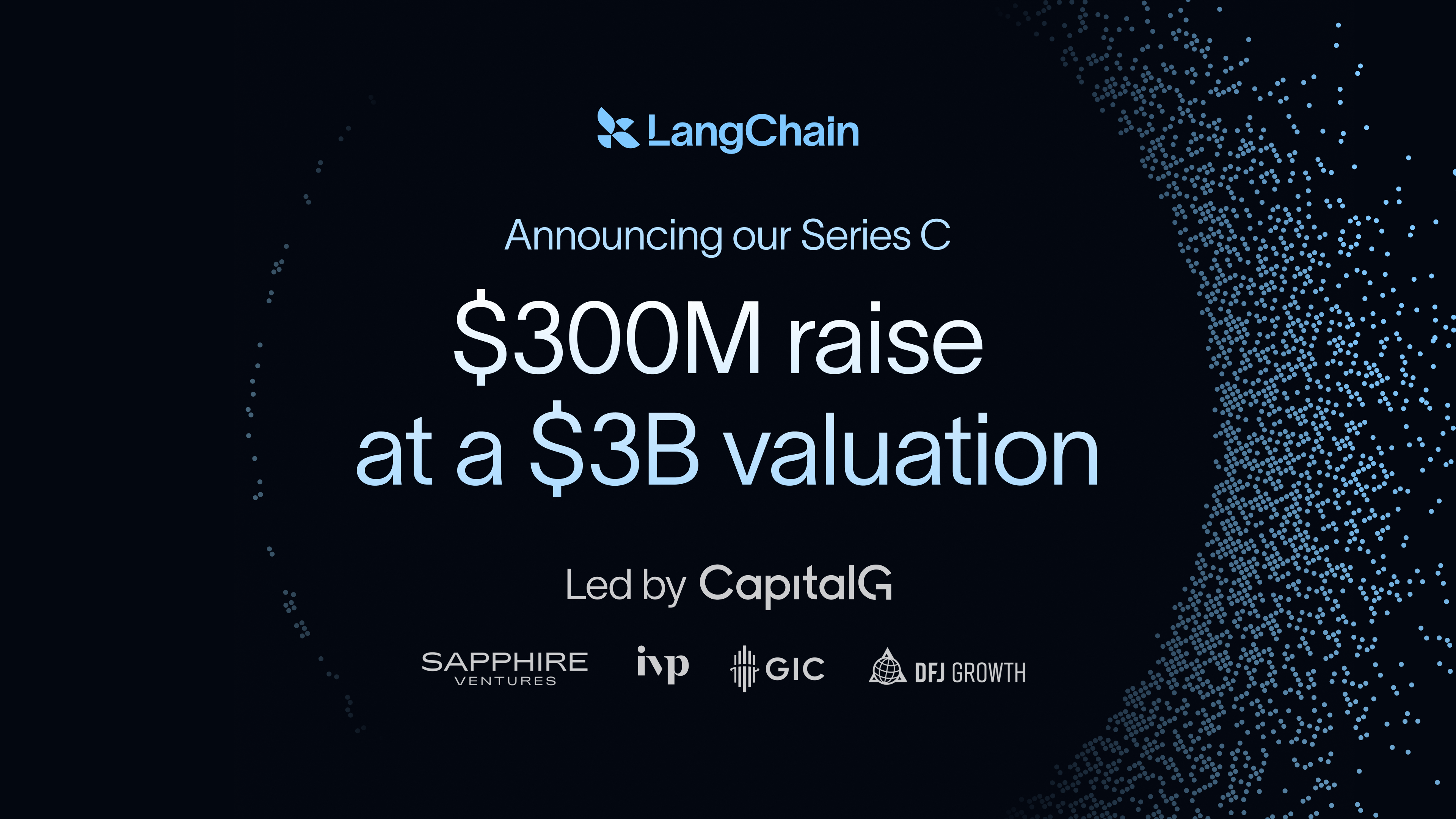
LangChain announced a $300M Series C at a $3B valuation. The round was led by existing investor CapitalG, with significant participation from new investors GIC and DFJ Growth and existing investors IVP and Sapphire Ventures. The company frames the raise around a single mission: enabling every company to own its intelligence.
The strategic argument in the announcement is that agents will transform the economy, and that the durable winners will be domain-specific agents differentiated by their knowledge, data and user experience. Those agents will ship as standalone products and also rework internal operations. LangChain's position is that the companies controlling these systems will build lasting competitive advantages, and that to do so they need to pick the best models for each job, keep control of data and infrastructure, keep improving their agents, and still maintain governance at scale.
LangSmith is the product at the center of that pitch. LangChain describes it as a framework-agnostic platform to run, improve and govern agents, and says more than 7,000 organizations already use it. The named customers span fast-growing startups such as Harvey, Rippling and Listen Labs and large enterprises including NVIDIA, Toyota and Salesforce. Two usage examples are cited: Clay uses LangSmith to monitor hundreds of millions of agent runs per month and improve its agents, while Workday uses it to run and govern agents across the organization, cutting the time to deploy a new agent from five months to under a day.
The platform is organized into three pillars. Agent Runtime covers the architecture and infrastructure for running agents reliably: Deep Agents, LangGraph and LangChain give developers flexibility across models and control over context management, while LangSmith Agent Server and Sandboxes let teams deploy and run agents securely at scale either in the cloud or in their own environment. LangSmith Managed Agents and Fleet provide fully managed services for building, deploying and running mission-critical agents in production.
Agent Improvement covers testing, monitoring and refinement. LangSmith Observability and Evaluation give visibility into agent behavior and a way to measure quality. LangSmith Engine, the in-platform agent, automates improvement by locating errors, writing code and prompt fixes, and watching production traffic for regressions. LangSmith Fine-Tuning turns agent traces into training data for fine-tuning and evaluating specialized models. Agent Governance, the third pillar, gives centralized control over how agents use models, tools and data: LLM and Tool Gateways manage model budgets and fallbacks, protect sensitive data, and govern tool access and authentication across teams and agents.
LangChain also said it will share several new LangSmith capabilities at a special release event on Friday, November 20th. The investor list includes Salesforce Ventures, Insight Venture Partners, QuantumLight and MongoDB Ventures as new participants, with Sequoia, Amplify and Benchmark doubling down.
My reading: the round is less a bet on a model and more a bet on the control plane around agents. LangChain started as an open-source framework for chaining model calls, and the stack it now markets — tracing, evaluation, gateways, sandboxes, managed runtimes — is the layer enterprises need once agents move from demos into production and someone has to answer for cost, security and regressions. That positioning puts LangSmith in the same conversation as general observability and evaluation tooling and as the agent platforms offered by cloud providers; its differentiator, as described, is being framework-agnostic and runnable inside a customer's own environment.
The Workday figure is the most striking claim, because it ties a governance and runtime layer directly to a dramatic reduction in deployment time. A likely trade-off for buyers is lock-in at the platform layer rather than the model layer: teams keep model choice but concentrate their traces, evaluations and gateway policies in one vendor. The pricing for the managed tiers is not addressed in the announcement, and the November 20th event is where the next set of capabilities will be detailed.
Why it matters: teams building production agents now have a well-capitalized vendor explicitly selling independence from any single model provider, which should matter to platform and infrastructure leads weighing build-versus-buy for tracing, evaluation and gateways. A $3B valuation also raises expectations that LangSmith's enterprise motion will keep expanding, so product teams evaluating it should expect faster releases but also a vendor pushing harder into the runtime and governance layers they may already run in-house. My inference is that the near-term competitive pressure lands most on standalone observability and eval startups rather than on model providers.
Based on reporting from the original publisher. Visit the source for full context and later updates.
Publisher excerpt
LangChain raises $300M Series C at a $3B valuation, led by CapitalG, to help every company own its intelligence with LangSmith, the agent engineering platform.