Introducing Our Smallest, Most Efficient Model: Muse Ember
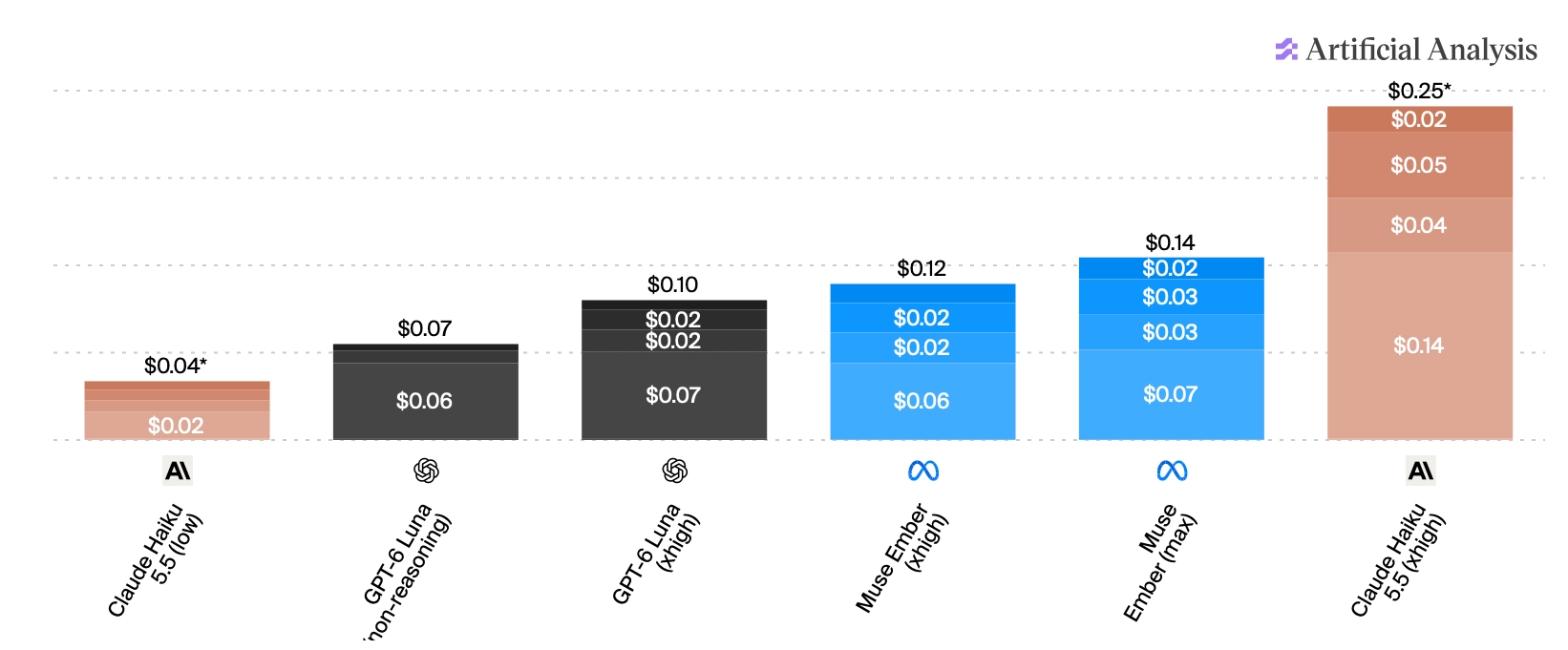
Meta AI has released Muse Ember, a compact model positioned in the same low-cost tier as OpenAI's GPT-6 Luna and Anthropic's Claude Haiku 5.5. Meta describes it as its smallest and most efficient model, built for complex reasoning execution and the repetitive work agents do throughout a day: tool calls, coding subtasks, routing, extraction and parsing long documents.
For short prompts, all three models share the same headline rate: $0.10 per million input tokens and $0.50 per million output tokens. Pricing diverges once prompts grow past each model's threshold. All three accept up to a million input tokens, but each raises its rates above a cutoff. GPT-6 Luna stays at the base price up to 272k tokens, then charges $0.20 input, $0.02 cached input and $0.75 output. Muse Ember changes at 200k tokens, moving to $0.30 input, $0.012 cached input and $1.50 output. Claude Haiku 5.5 changes earliest, at 100k tokens, and rises furthest, to $0.50 input, $0.05 cached input and $2.50 output. On that tiered structure, Ember lands between the other two.
Ember's cached-input rate is notably low, at $0.004 per million tokens below the threshold. That matters for agent loops and document pipelines, where the same system prompt or reference material is resent on every turn and caching is the main lever on cost.
Raw per-token comparisons have become a weak guide, because reasoning tokens mean different models can burn very different token counts to solve the same problem. A more practical lens is Artificial Analysis's Intelligence Index plotted against cost per task. On that view the three models sit on the Pareto frontier, the line where improving one dimension means giving up another. Meta makes the claim directly, saying Ember sits on the efficiency frontier of the full Artificial Analysis leaderboard and that no model scores higher for less per task.
The model exposes six reasoning levels: minimal, low, medium, high, xhigh and max. Early hands-on testing with a generative SVG exercise produced uneven results: the high setting failed to return a complete SVG, and the other outputs did not map cleanly from reasoning level to visual quality. Quality was judged comparable to Meta's Muse Wonder, which costs about 40 times as much as Ember.
For developers, the trade-offs are mostly operational. Six reasoning levels give fine-grained control over the cost-versus-depth balance per request, which suits routing, where most traffic is simple and a few calls need more thought. The 200k threshold rewards keeping context under it, or leaning on caching, especially for long-document parsing. The SVG test is a reminder that more reasoning budget does not guarantee a better artifact, so teams should validate outputs per task type rather than assuming the max setting is best.
Why it matters: teams building agents and high-volume pipelines now have a third similarly priced small model to benchmark, and the choice will hinge less on sticker price than on tokens consumed per completed task, cache savings and behavior above each model's context threshold. Since the efficiency-frontier claim comes from Meta and is measured by a third-party index, developers should reproduce it against their own workloads before switching.
Based on reporting from the original publisher. Visit the source for full context and later updates.
Publisher excerpt
Introducing Our Smallest, Most Efficient Model: Muse Ember Meta AI just launched their entry in the Claude Haiku/GPT Luna category: Muse Ember, which they describe as: [...] our smallest and most efficient model designed for complex reasoning execution and the work agents repeat all day: tool calls, coding subtasks, routing, extraction, and long document parsing. For shorter prompts it's priced the same as GPT-6 Luna and Claude Haiku 5.5 - both are $0.10/million input tokens and $0.50/million output. Today's other