How ArisGlobal scaled generative AI inference on Amazon Bedrock
ArisGlobal, the life sciences software company behind the LifeSphere platform, has published how it cut generative AI inference costs for its NavaX engine by changing the order of content in its Amazon Bedrock requests. NavaX automates adverse-event case processing for pharmaceutical clients, and ArisGlobal productionized its first Bedrock-based generative AI solution with Anthropic's Claude in March 2025. According to the company's production telemetry, the system has processed over 1 million real transactions in regulated pharmaceutical environments, handling billions of tokens across multiple enterprise tenants.
NavaX's Dynamic Data Extraction agent pulls around 130 fields from each adverse-event report, typically a multipage PDF describing a patient's reaction to a medication. Those fields cover patient demographics, suspect drugs, reporter information, event timelines, seriousness criteria and regulatory classifications. Because the material contains protected health information, ArisGlobal applies responsible-AI controls in production, including Amazon Bedrock Guardrails to filter content and detect or mask sensitive data, and it validates extracted fields against a schema while grounding them in the source document. Extraction runs as several sequential model requests, each focused on a different section of the case form. Every request carries system instructions, customer-specific rules, an extraction schema with about 130 fields, and the source PDF, which often runs 10 to 200 pages.
Two inputs repeat, but at very different scopes. The shared prompt prefix — system rules, schema and few-shot examples — repeats across requests, cases and every tenant using the same agent. The document repeats only for the requests belonging to one case. As ArisGlobal onboarded more pharmaceutical companies, each added custom field mappings, jurisdiction rules such as EU ICSR versus FDA MedWatch and PMDA formatting, company-specific seriousness and causality logic, and per-tenant few-shot examples. Over six months the shared prefix grew from roughly 72,000 to 180,000 tokens, a 150% increase, and per-case inference costs rose by more than 200%. Because the prefix was reprocessed on every request, its growth compounded with transaction volume.
The original design cached the source document, since it was the largest part of a request. The document went first, a checkpoint followed it, and the shared prompt came afterward. That let later requests within the same case read the document at a reduced rate, but the next case brought a new document and required a fresh cache write, so reuse never crossed case or tenant boundaries. More importantly, the shared prefix sat after the checkpoint and was billed at the full input rate every time.
The production design reverses the order instead of adding checkpoints: the shared prefix comes first, a single explicit cache point follows it, and the per-case document comes last, followed by the section-specific question. This works because Bedrock prompt caching is prefix-based, not block-based. A request is evaluated in sequence — tools, system, then messages — and a later request with the same leading prefix can read those tokens at a reduced rate rather than reprocessing them, which cuts both cost and latency. Changing anything earlier in the sequence invalidates matches for everything after it. Supported Claude models allow up to four checkpoints per request; Claude Sonnet 4.5 requires a minimum prefix of 1,024 tokens. The default cache time-to-live is 5 minutes and resets on each successful hit, and select models offer a 1-hour TTL via a ttl setting, with longer-TTL entries needing to precede shorter ones. Bedrock also offers simplified cache management, where a single checkpoint after static content triggers a backward search for the longest matching prefix across about 20 content blocks.
ArisGlobal deliberately kept one checkpoint rather than adding a second after the document. A second checkpoint would cache the shared prompt plus that case's document as a combined prefix, but the entry would still be unique to a single case. The company chose the prefix whose reads amortize across its whole fleet. Traffic helps: for most active accounts, cases arrive about every five minutes per tenant with multiple tenants running concurrently, keeping the shared prefix warm during business hours as hits reset the TTL. EU geographic cross-Region inference stayed in place; caching operates within the existing inference configuration.
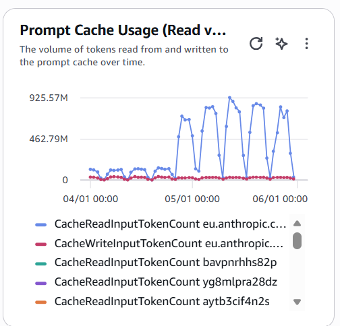
The results, as reported to AWS from production billing and telemetry: 65% of input tokens on a typical request are served from cache at the reduced read rate, end-to-end latency on cached requests is up to 25% lower, effective input cost is roughly 50% lower, and overall monthly inference spend is about 40% lower at more than 19 billion tokens per month. Around 15% more enterprise tenants were onboarded without proportional cost increases. CloudWatch charts show cache reads climbing to roughly ten times cache writes during production traffic, and latency settling into a lower, more stable range. ArisGlobal notes the figures are its own production metrics and that results will vary with prompt structure, traffic patterns and cache hit rates.
The company's stated lessons generalize to other multi-tenant agentic workloads. Cache what repeats rather than what is largest. Put stable content — tool definitions, system instructions, schemas, examples — before the checkpoint, and keep tenant identifiers, case data and per-request questions after it. Keep the prefix byte-identical, since timestamps, request IDs, tenant names or reordered tool definitions can cause misses. Use the 1-hour TTL where traffic is sporadic. Bundle sequential questions where output limits allow, since every call still processes the uncached document. Monitor cache reads, writes and total input tokens, and alert on sustained drops below a realistic baseline rather than a threshold that does not fit the workload. My reading is that the counterintuitive lesson here is the valuable one: the largest input is often the least reusable, and teams that optimize for raw payload size can miss the prefix that every request actually shares. The trade-off ArisGlobal accepted is narrower document reuse within a case, which is a small loss when dozens of tenants read the same prefix. The per-case document still flows through the model uncached on every request, so trimming its length or consolidating section requests is a separate lever the company flags but did not quantify.
Why it matters: Product teams running multi-tenant LLM features often assume the biggest input is the best caching target, and this case shows the opposite can hold when a shared prompt grows with every customer. Engineers on Bedrock can apply the same reordering — stable prefix first, checkpoint, then per-request data — though the reported savings depend on high request volume and cache-hit rates that many workloads will not match. Teams with bursty or low-frequency traffic should watch TTL behavior closely, since a cold cache means paying full input rates again.
Based on reporting from the original publisher. Visit the source for full context and later updates.
Publisher excerpt
ArisGlobal runs NavaX, its life-sciences AI engine, on Amazon Bedrock. By caching the shared prompt prefix instead of each per-case document, ArisGlobal cut effective input cost by about 50% and overall monthly inference spend by about 40%, while onboarding more tenants without proportional cost growth.