Could Jensengate take down the President?
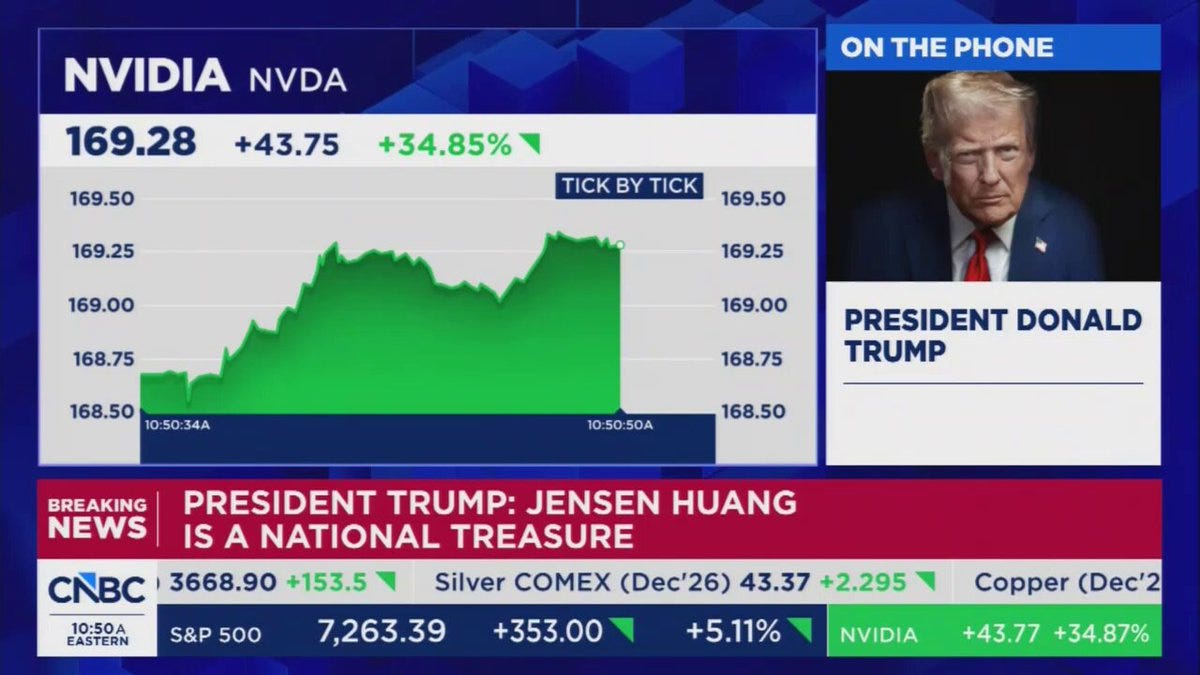
Gary Marcus wrote on November 23, 2026 that two speculations he had aired that morning on CNN about the backstory of Jensen Huang's return to Nvidia had, within a couple of hours, been at least partly confirmed. His first guess was that the White House had pressured Nvidia into rehiring Huang; he points to the New York Times as the first source supporting that. His second guess, that pardons might have been dangled, he says appears borne out by Donald Trump's own public remarks.
Marcus quotes two exchanges to support the second point. Asked by a reporter where he draws the line on getting involved in companies such as Microsoft, Alphabet, OpenAI and Anthropic, Trump answered in terms of instinct rather than rules, comparing it to a great golfer's touch around the green. In a separate exchange, asked by CNBC whether he had assured Nvidia's board that Huang would not be prosecuted at all, Trump said he did not use the word "prosecuted" but told the board that "we believe he's fine," that Huang is "absolutely fine," and that he "gave them enough assurance."
Marcus's framing of the underlying situation is that Huang was rehired despite an affair with a woman described as involved in Nvidia-chip trafficking who appears to have reported to the Chinese government, plus other possible improprieties. Those characterizations come from Marcus; the post does not lay out the timeline of Huang's departure and return or the specific allegations beyond that summary.
He also relays a point from the journalist Paris Martineau: beyond ethics and national security, the episode matters because some people lost a great deal of money on Nvidia over the past couple of weeks. Martineau's argument, as Marcus presents it, is that those investors will sue, feel cheated and force information into the open, while others made a great deal of money, and Congress will presumably want to know who. Marcus adds his own suspicion that engineering an Nvidia rebound through presidential pressure would have been an unusually rich opportunity for insider trading, saying he does not know whether senior White House officials and their venture-capital contacts took advantage of it but would not be surprised if they had.
Marcus closes with a reference to an actual Trump post that he says celebrates Huang's relationship with a Chinese spy, remarking on a detail in the image. He ends with a subscription prompt.
The post is commentary built on public statements and reporting rather than a reported investigation of its own. Its central factual anchors are the two quoted exchanges with Trump on November 23, 2026, and the existence of a New York Times report Marcus cites without naming its authors or detailing its contents. Everything about pressure on the board, dangled pardons or market effects is presented as Marcus's inference or as another commentator's prediction, not as established fact.
Why it matters: for readers in the chip and AI supply chain, the salient development is a sitting president publicly describing personal assurances given to a major company's board about its chief executive's legal exposure. If that framing holds, it suggests informal White House influence over corporate governance at the largest AI hardware vendor, which is a governance and policy risk that investors and partners will factor in. A likely consequence, in my reading, is heightened scrutiny of Nvidia disclosures and of any trading around the news, though Marcus presents the insider-trading question as speculation rather than a finding.
Based on reporting from the original publisher. Visit the source for full context and later updates.
Publisher excerpt
Some cynical speculations have already been confirmed, and you can bet your last dollar the incoming Congress is going to take an interest