Highway thieves are spoofing GPS to steal millions in data center-bound cargo
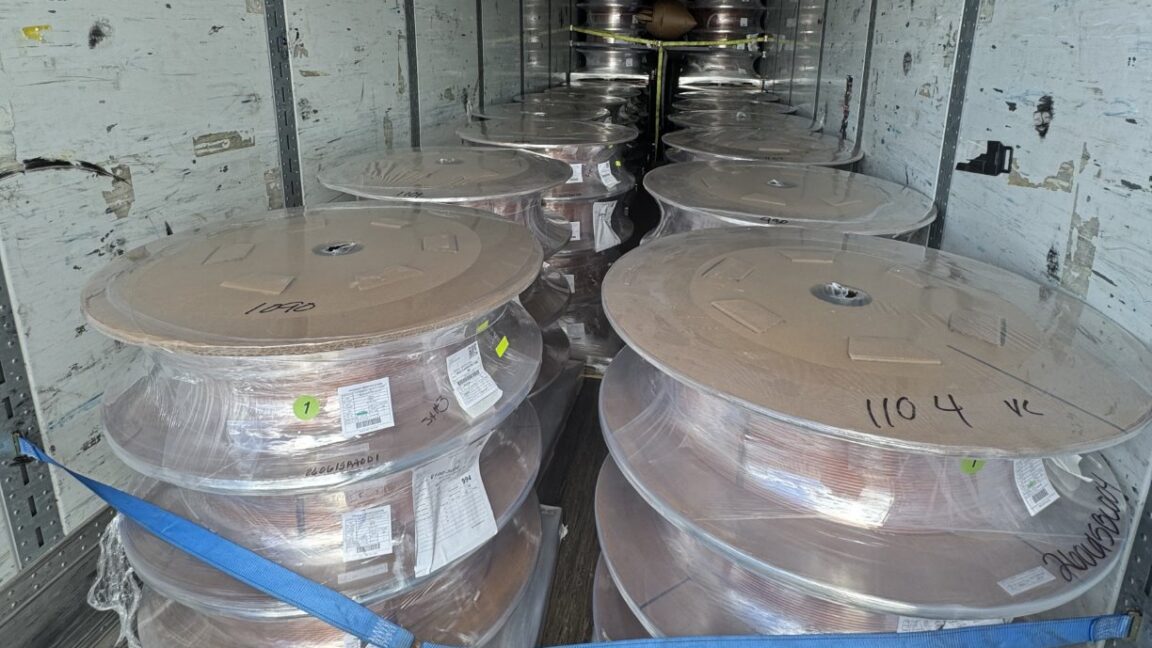
Since June, thieves have taken more than $100 million worth of freight destined for data centers, according to industry leaders, consultants and investigators advising law enforcement who spoke with NBC News. The thefts target trucks hauling servers, fiber-optic cables, computer memory chips, copper wire and bitcoin mining machines, and the methods have shifted from opportunistic roadside crime toward account compromise, identity fraud and electronic tracking manipulation. Nearly two dozen cargo theft incidents have been recorded since 2025 across states including California, Texas and Utah, and the people investigating them expect the problem to grow as AI companies keep pouring billions into data center construction.
The most common playbook, as described to NBC News, begins online. Thieves break into freight brokers' accounts on shipment-listing websites and post fake loads to attract bids from legitimate trucking companies. Anyone who responds receives a malicious link; clicking it installs software that lets the attackers take over the carrier's account. From there they can bid on real shipments and position themselves to intercept the cargo. In some cases a genuine driver is hired to collect the freight with no knowledge of the scheme. In others, accomplices are hired using counterfeit driver's licenses, which investigators say are increasingly produced with AI tools. Either way, the goods are eventually handed to a driver working with the thieves and resold.
Sgt. David Pantoja of the Los Angeles County Sheriff's Department told NBC News that account infiltration and similar digital methods account for most of the activity, a marked departure from the past when highway cargo theft was largely a crime of opportunity. Beyond the listing-site scams, thieves are said to break into email accounts to identify valuable shipments, redirect deliveries, and interfere with GPS tracking.
Two cases illustrate how far the crews will go. A trailer carrying several hundred pounds of computer server equipment valued at $13 million was headed to Fayetteville, Georgia, home to one of the country's largest data center developments. Two off-duty police officers hired as escorts lost sight of the trailer after an unmarked sedan struck their vehicle and forced them to stop while the truck drove on. A second shipment moved out of California toward Texas, carrying server rack components estimated at around $10 million, was similarly separated from its escorts when an SUV hit the security vehicle. In that case the cargo was also being monitored by a location-tracking application, but the coordinates had apparently been spoofed, so digital oversight offered no help. Gerardo Pachuca, a private investigator and former LASD officer working on cargo theft, told NBC News the collision was deliberate: the thieves wanted that load and intentionally took out the escorts. NBC News described such attacks as isolated incidents within a broader and growing trend.
Not every load is purely data center gear. Two stolen freights recovered in Illinois were estimated by the Cook County Sheriff's Office to hold $300,000 in copper wire spools and about $1 million in custom-made data center modular power solutions equipment. In a Los Angeles County case, data center cooling equipment bound for Deepcool AI was recovered alongside nicotine pouches, televisions, shoes, printers, speakers and skin care cosmetics. That mixing is one reason experts worry the harm reaches beyond the AI industry.
The resale path differs from ordinary cargo theft. Data center equipment rarely surfaces on consumer marketplaces; instead, shipments can be broken into components and sold through gray markets to technology firms looking for cheaper, questionably sourced hardware. Investigators said an overseas buyer is often arranged before the theft happens, particularly in regions where access to high-end US technology is restricted, such as China. Keith Lewis, head of operations at the risk-assessment firm Verisk CargoNet, which tracks cargo theft, told NBC News that the freight is like pure gold bars and far easier to steal than to rob a bank.
This suggests the economics are unusually favorable to organized crews. A loaded trailer concentrates enormous value in a single, movable object, and the equipment inside is standardized, compact and easy to resell in parts without serial-number scrutiny at the point of sale. The digital layer that makes modern logistics efficient, including online load boards, broker email and third-party tracking apps, also supplies the attack surface. Credential theft and a convincing fake listing may cost far less than physically forcing a truck open, and spoofing location data defeats the remote monitoring that shippers rely on in place of on-the-ground checks. In practice, a tracking dashboard showing a truck proceeding normally can be showing an attacker-controlled position feed.
Security recommendations center on old-fashioned verification. Scott Cornell, chair of the Transported Asset Protection Association, Americas, a nonprofit focused on supply chain security standards, told NBC News that although overseas crime rings are playing chess in the supply chain, the path to stopping them looks simple if freight companies slow down and run background checks on drivers. In his words, the scheme only works if drivers are not properly vetted. That points toward multi-factor authentication on broker and carrier accounts, out-of-band confirmation of new business relationships, and identity checks that do not rely on documents alone.
Lawmakers are also getting involved, talking to the industries hardest hit and weighing ways to strengthen the federal response to overseas theft rings. States facing large losses have set up specialized task forces to trace stolen shipments, and companies continue to hire escorts despite the violence in the two largest cases. Mike Duffy, co-founder and CEO of Solutions Group International, a security escort company based in Southern California where much of the high-value goods are manufactured, confirmed to NBC News that the firm escorts hundreds of loads per month, much of it associated with data centers.
Why it matters: Data center operators, server and cooling vendors, freight brokers and carriers all sit on this chain, and the losses described run into the tens of millions per shipment at the high end. For product and engineering teams, the practical implication is that shipment visibility built on GPS and portal credentials is not a security control on its own; identity verification across brokers, carriers and drivers is where the gap appears to be. A reasonable inference is that insurance terms, chain-of-custody requirements and vendor security questionnaires for logistics partners will tighten as losses mount, adding friction and cost to how quickly hardware reaches a construction site.
Based on reporting from the original publisher. Visit the source for full context and later updates.
Publisher excerpt
Investigators explain how highway thieves stole $100M in data center equipment.