Rethinking access control for RAG with Amazon Quick and Amazon Bedrock
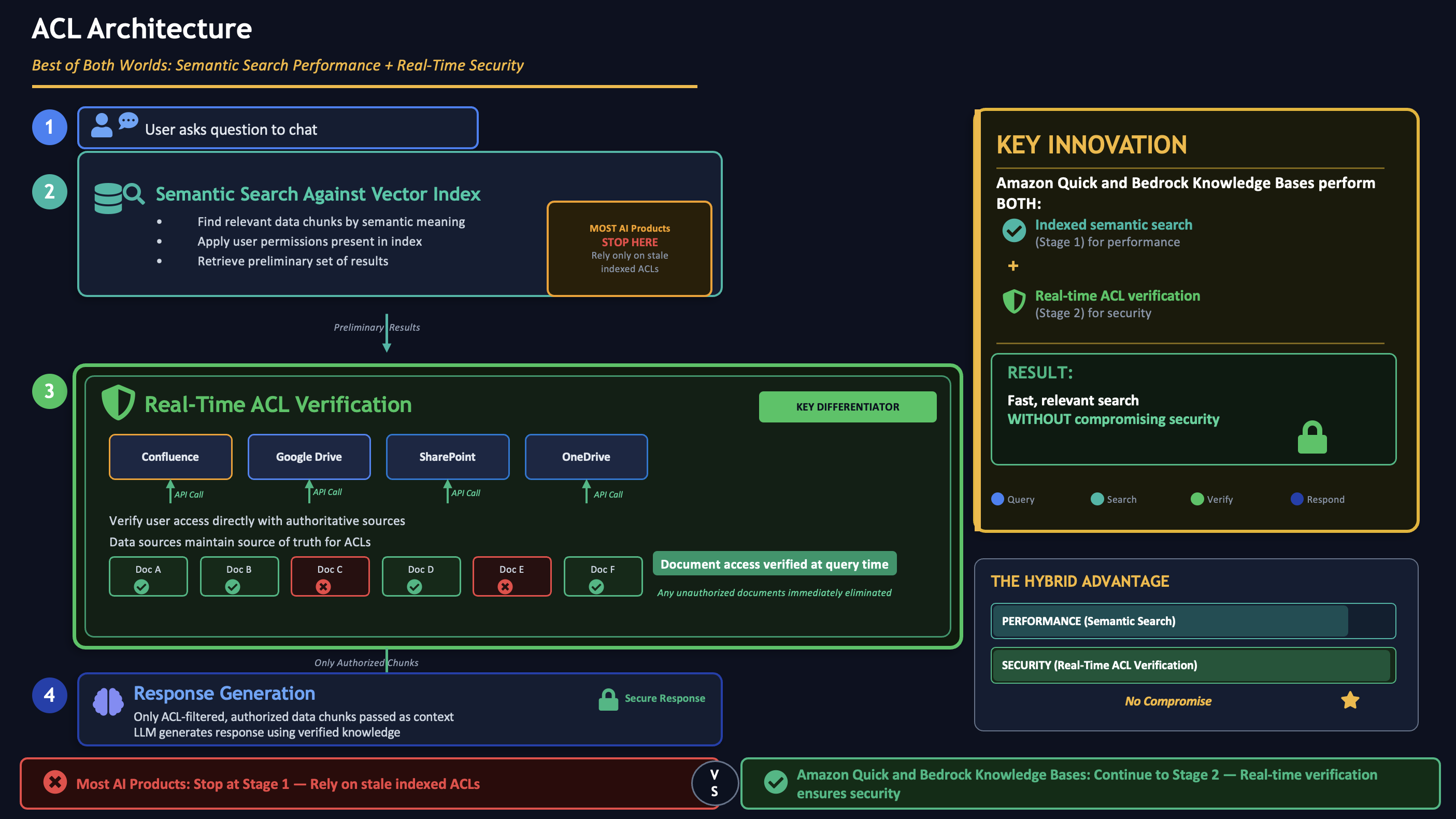
Amazon Web Services has added real-time access control list enforcement to Amazon Quick and Amazon Bedrock Knowledge Bases, layering permission checks against authoritative sources onto the existing pre-retrieval ACL filtering. Amit Choudhary, principal product manager for knowledge bases for Amazon Bedrock and Amazon Quick, and Suren Raju, a generative AI specialist solutions architect on the Amazon Quick team, described the architecture.
Retrieval Augmented Generation lets organizations draw answers from sources such as Microsoft SharePoint, Google Drive and Atlassian Confluence, but those systems carry complex permission structures. The common alternative, replicating ACLs into an index during periodic syncs and filtering at query time, has three weaknesses the post identifies: the AI system is not the permission source of truth, so connectors must reproduce source-specific logic; ACLs go stale between syncs, and some sources, such as Confluence, emit no event when group membership changes; and changes to a source's sharing model can leave mapping gaps until a connector is updated.
Amazon Quick instead runs two stages. First, semantic search against the vector index applies ACLs already stored there, producing candidate documents, because real-time API calls for every indexed document would be too costly at scale. Second, it verifies those candidates in real time. In a Google Drive example, the system uses an administrator-provided service account credential to generate user-specific access tokens through impersonation and calls Google Drive APIs, which hold the source of truth. Unauthorized documents are dropped, and only verified passages reach the large language model as context.
Amazon Bedrock also supplies responsible AI controls, including Bedrock Guardrails for content filtering, grounding checks to reduce hallucinations, and configurable safety policies.
AWS states three benefits: permissions stay current, so a revoked employee's change appears in answers within moments rather than hours or days; organizations can expand knowledge base coverage across data sources; and they no longer need to manage sync frequency. Jamahl Wiggins, a senior M365 innovation specialist at Mondelēz International, said the approach gave the company's internal review board confidence to proceed. Mondelēz has deployed Amazon Quick for its more than 35,000 employees across four regions.
Why it matters: Teams building RAG assistants on Amazon Quick or Bedrock Knowledge Bases get permission checks against the source system on every query instead of relying on sync snapshots, which the post presents as a way to close gaps between sync cycles and reduce operational work around sync frequency.
Based on reporting from the original publisher. Visit the source for full context and later updates.
Publisher excerpt
Enterprise RAG unlocks insights from knowledge sources like SharePoint, Google Drive, and Confluence, but those sources carry complex permissions. Learn how Amazon Quick and Amazon Bedrock Knowledge Bases enforce document-level access controls in real time, verifying permissions directly with authoritative sources at query time.