Build composable, interoperable multi-agent systems with A2A on AWS
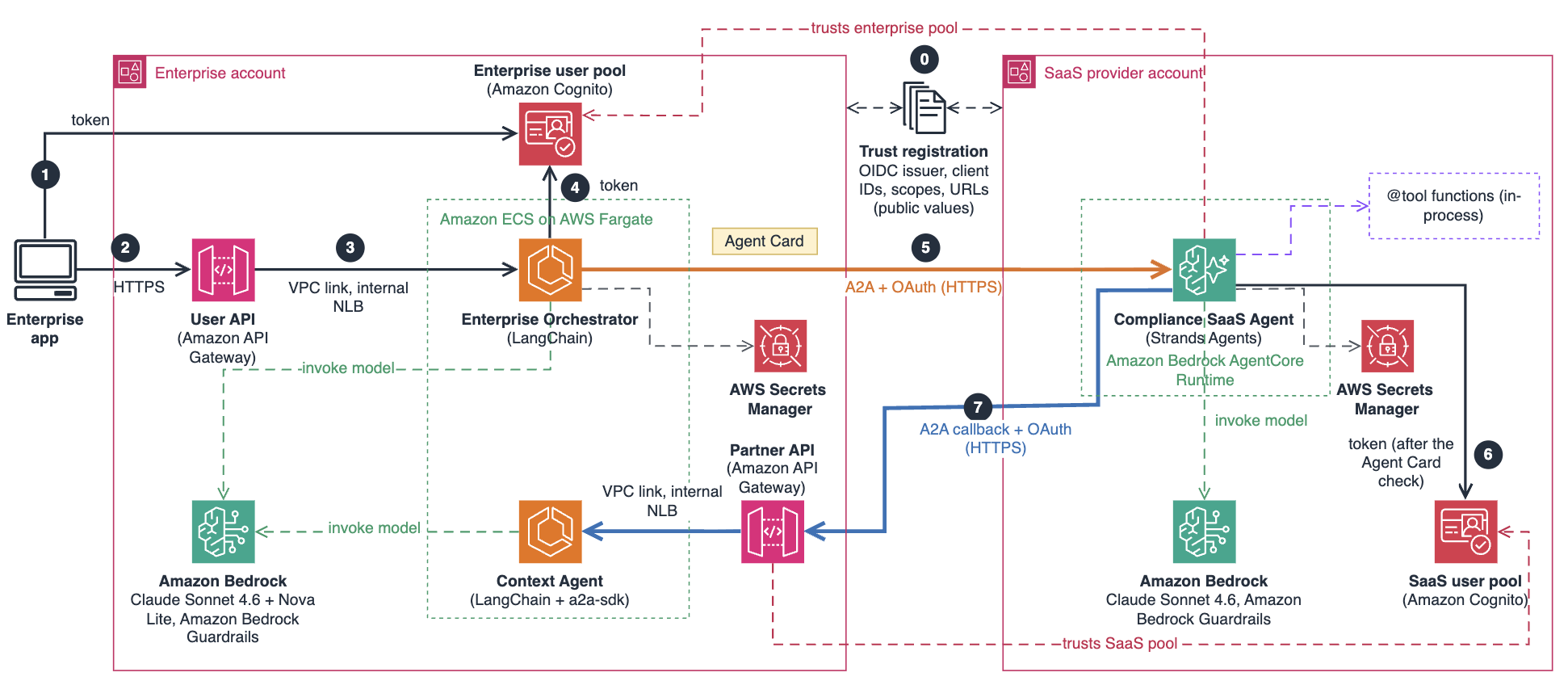
AWS published a reference architecture that connects agents built on different frameworks across separate AWS accounts using the Agent-to-Agent (A2A) protocol, with OAuth authentication flowing in both directions. The setup runs in two accounts: one for an enterprise and one for a software-as-a-service provider. Three agents participate, and the enterprise's orchestrator is written with LangChain while the provider's compliance agent is written with the Strands Agents SDK, so neither side depends on the other's framework or SDK.
The scenario is a compliance scan. A user submits a question through an Amazon API Gateway HTTPS endpoint that only accepts tokens from the enterprise's own Amazon Cognito user pool. API Gateway forwards the request privately through a VPC link and an internal Network Load Balancer to the Enterprise Orchestrator, a LangChain agent running on Amazon ECS with AWS Fargate. If the model decides a compliance scan is needed, the orchestrator obtains its own token from the enterprise pool using a client secret held in AWS Secrets Manager and sends an A2A request to the compliance agent on Amazon Bedrock AgentCore in the provider's account. That agent calls back to a second enterprise agent, the Enterprise Context Agent, for details such as which accounts are production, which internal policies apply, and who to escalate to, then completes the scan and returns the answer.
That callback is the unusual part. Most agent-to-agent demonstrations are one-way: a client calls a server and waits. Here the called agent needs information only the caller's organization holds, so the two act as peers rather than client and server. The callback goes only to the address the customer registered during onboarding, and the provider's agent verifies the customer's public context card there before requesting a token from its own Cognito pool.
During onboarding the two organizations exchange only public values: identity provider URLs, client IDs, scopes and endpoint URLs. Each side then trusts tokens issued by the other side's user pool. No secrets are shared, and each account keeps its own identity provider. On the enterprise side, both agents run in private subnets of an Amazon VPC with no public IP addresses. The provider reaches the context agent through an API Gateway partner API that accepts only the provider's callback token.
The orchestrator uses Anthropic Claude Sonnet 4.6 on Amazon Bedrock, while the context agent uses Amazon Nova Lite for metadata lookups. The compliance agent also uses Claude Sonnet 4.6. Bedrock exposes multiple foundation models through one API, so each agent can be matched to its workload; a reasoning-heavy orchestrator gets a larger model while a lookup agent gets a cheaper, faster one. Bedrock's Claude models typically require a first-time use form per account, and model availability varies by Region.
At startup the orchestrator fetches the provider's Agent Card from its well-known URL and creates a LangChain tool for each skill listed. The model then picks which tool to call based on the user's question, so no routing logic is hardcoded. The provider's card, generated automatically at /.well-known/agent-card.json when deployed to AgentCore, publishes one curated skill rather than its internal tool names. Behind that interface the agent exposes three compliance tools built with the Strands @tool decorator — listing accounts, running scans and retrieving remediation steps — plus a fourth for the enterprise callback. The card is a JSON document describing the agent's name, capabilities and skills, and it also declares how a caller obtains a token.
The enterprise's context agent is built on the official a2a-sdk, pinned to a2a-sdk[http-server]==1.2.2, and uses AgentCard, AgentExecutor and spec-conformant JSON-RPC routes. The orchestrator does not use that SDK at all; it sends raw httpx HTTP calls carrying A2A JSON-RPC payloads. That is the interoperability claim in concrete form: if the provider switched from Strands to another A2A-compatible framework, the orchestrator would keep working as long as the card and interface stay compatible.
A2A and the Model Context Protocol are complementary here. MCP connects an agent to its own tools and data sources in a client-server pattern; A2A connects agents to other agents as peers without exposing internals. In production, the provider's agent could use MCP internally for its scanning tools while presenting A2A externally. The demo uses synthetic compliance findings; real scanning tools would connect to services such as AWS Config, AWS Security Hub or Amazon GuardDuty.
A2A is now a Linux Foundation project, and AWS is among its supporters. The protocol relies on existing authentication standards such as OAuth 2.0 and OpenID Connect for cross-boundary security.
Deployment takes three notebooks run in order. Notebook 1 in the enterprise account takes about three minutes and creates the enterprise identity plus an onboarding request file. Notebook 2 in the provider account takes about five minutes, deploys the compliance agent and writes an onboarding response. Notebook 3 in the enterprise account takes about twenty minutes, deploys the enterprise agents and runs an end-to-end test. Only the two onboarding JSON files pass between the parties, and they contain public values.
Prerequisites are two AWS accounts in the same Region, limited to us-east-1, us-east-2 or us-west-3, meaning us-west-2, with Claude Sonnet 4.6 access in both and Nova Lite in the enterprise account. Users need Python 3.10 or later and either local JupyterLab with AWS CLI version 2 and IAM Identity Center profiles per account, or a SageMaker AI notebook instance such as ml.t3.medium in each account. Docker is not needed because AWS CodeBuild builds the container images. An IAM role in each account must be able to create CloudFormation stacks and their resources. Cost is a real consideration: always-on enterprise resources include a NAT gateway, two Fargate tasks, the internal Network Load Balancer and two interface VPC endpoints, while Bedrock and AgentCore bill per use. Cleanup runs notebook 3 first, then notebook 2.
The design choice that matters most is confining every cross-boundary call to A2A. The enterprise cannot see the provider's internal tools, system prompt or model choice, so the provider can rework its internals without touching customer integrations as long as the card and interface remain compatible. This suggests a practical split for vendors: publish a stable, curated skill surface and treat everything behind it as private, much as a REST API hides its database. A likely trade-off is that a curated card limits what a caller's model can discover and route around, so a single coarse skill pushes more interpretation onto the remote agent and can make failures harder to diagnose; the demo's approach of collapsing every callback failure into a single "Enterprise context unavailable" message, with details kept in the provider's logs, is evidence of that tension. Cross-account OAuth with separate identity providers also means onboarding becomes an operational step per customer, not just a configuration file.
Why it matters: teams building agents that cross company lines now have a worked pattern for framework-independent, secret-free integration, which is most relevant to ISVs whose customers already run different agent stacks. Developers should note that the A2A client here is plain HTTP and JSON-RPC, so adopting the protocol does not force a particular agent framework. My inference is that the biggest change for product teams is packaging — agents get published interfaces and onboarding documents rather than bespoke integration code per customer.
Based on reporting from the original publisher. Visit the source for full context and later updates.
Publisher excerpt
Build a composable, interoperable multi-agent system on AWS with the Agent-to-Agent (A2A) protocol. A LangChain orchestrator on Amazon ECS communicates with a Strands agent on Amazon Bedrock AgentCore across organizational boundaries, using bidirectional, OAuth-authenticated calls, with neither side depending on the other's framework or SDK.