Fostering community amid Kendall Square’s innovation
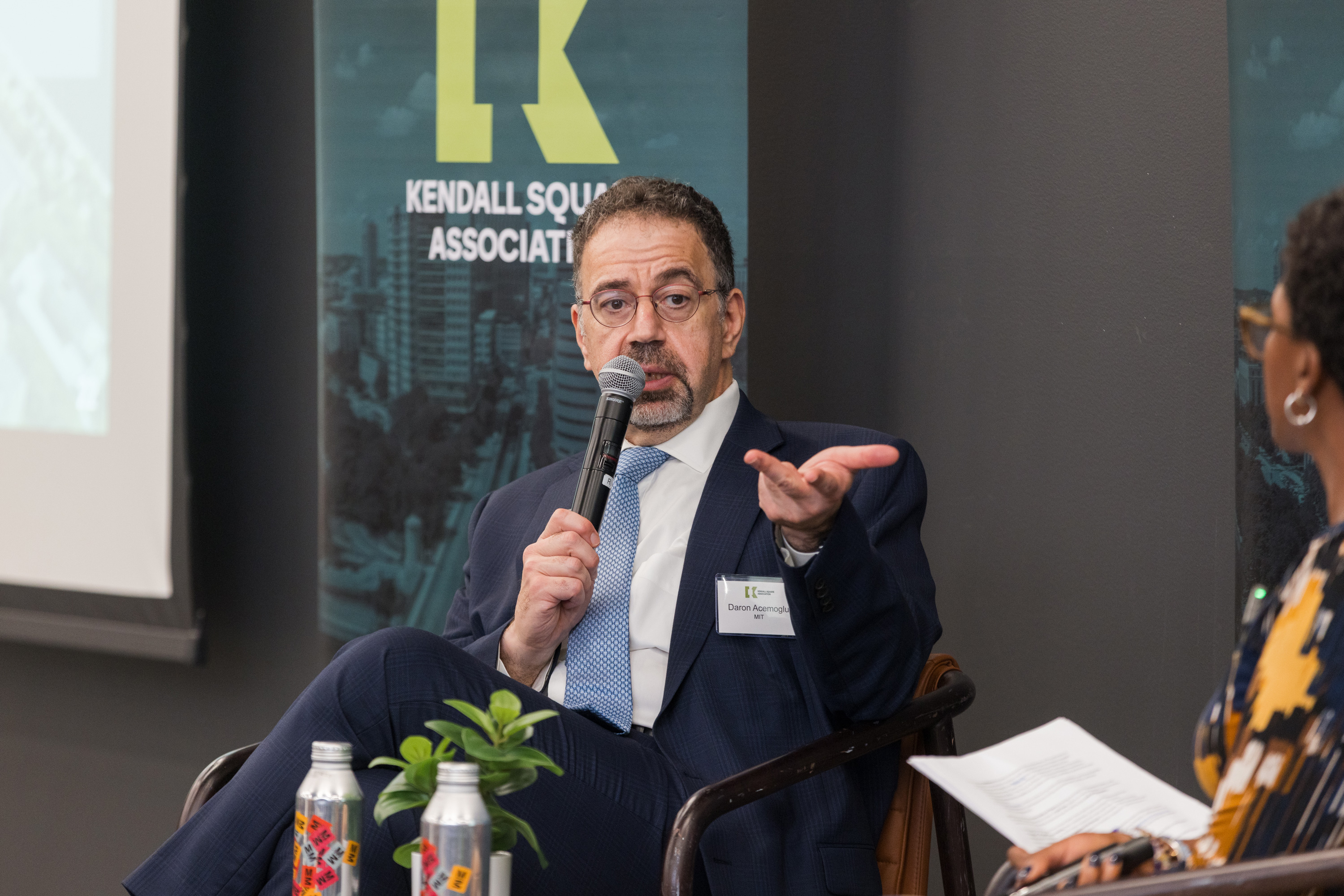
Kendall Square in Cambridge, Massachusetts, hosted the Kendall Square Association's 18th Annual Meeting on Thursday at The Engine, a nonprofit startup incubator. The gathering drew business leaders, elected officials, local residents and students from across the city for an evening of local food, music from the Kendall Square Orchestra, a vote on new KSA board members, and awards recognizing organizations that make a positive impact through innovation.
The keynote came from Daron Acemoglu, an MIT Institute Professor who shared the 2024 Nobel Prize in economics for studying how institutions affect prosperity. Acemoglu framed the central question of his talk around work and automation, asking how AI can become a tool that lets workers expand their capabilities and build new expertise rather than an adversary to their jobs. He said the world has reached a point that demands new innovations and adaptations to growing challenges.
Acemoglu was speaking in connection with his book, "What Happened to Liberal Democracy?" He argued that liberal democracy is under pressure as trust in liberal institutions declines, political polarization grows and people lose faith in elected officials. He acknowledged that the shared prosperity liberal democracy promised has not always been delivered, particularly over the past 50 years, but maintained it remains the best path forward and needs renewed backing. He described liberal democratic institutions and the norms supporting them as one of the greatest human achievements, pointing out that societies of hundreds of millions of people with diverse interests still find ways to participate politically, reach compromises and sustain institutions that deliver services and broaden prosperity.
Cambridge Mayor Sumbul Siddiqui also spoke. She recounted how Cambridge residents worked alongside biotech labs in the 1970s to create a pioneering policy on recombinant DNA research, a collaboration she credited with helping turn Kendall Square into today's life science hub. She said the episode captures what makes the area distinctive: a willingness to work together on big challenges, driven not only by universities and labs but by a culture of collaboration among nonprofits, government and residents.
Lee McGuire, chief communications officer at the Broad Institute, reviewed a 2009 report on what made Kendall Square a powerful driver of innovation, noting that factors such as talent density, education and a collective voice remain strong today. He said protecting and naming those qualities is the work of the association and the broader community, and that as long as a good idea exists, Kendall Square is a place positioned to move it forward and scale it.
Beth O'Neill Maloney, KSA's executive director, opened the evening by saying people come to Kendall Square to make the world better, to improve the human condition, to solve big problems and to innovate for good. The KSA is a nonprofit made up of more than 150 organizations across Kendall Square, spanning major companies, universities, research organizations and the independent shops and restaurants that give the district its character.
Taken together, the remarks illustrate a familiar tension in dense innovation clusters. The same proximity that speeds up research and company formation also drives up rents and displacement pressure, and the Cambridge recombinant DNA story is a reminder that early scientific breakthroughs in the area arrived alongside public debate about their risks. Acemoglu's question about AI and work carries particular weight in a square mile that is home to both artificial intelligence research and the policy thinkers studying its labor-market effects. This suggests the near-term agenda for clusters like Kendall Square will be less about any single technology and more about the institutional arrangements — training, governance, civic participation — that determine who captures the gains.
Why it matters: Developers and product teams building AI tools increasingly face questions about labor displacement and public trust, and the framing offered here — AI as capability expansion for workers rather than replacement — is one that shapes product positioning and policy conversations. For teams in or near research hubs, the emphasis on talent density, cross-sector collaboration and long-horizon civic support is a reminder that location and community relationships remain part of the infrastructure behind shipped technology, though how much that translates into concrete incentives is an inference rather than something stated at the event.
Based on reporting from the original publisher. Visit the source for full context and later updates.
Publisher excerpt
The 18th annual Kendall Square Association Annual Meeting explored how new technologies could be a force for shared prosperity in society.