Game over, man?
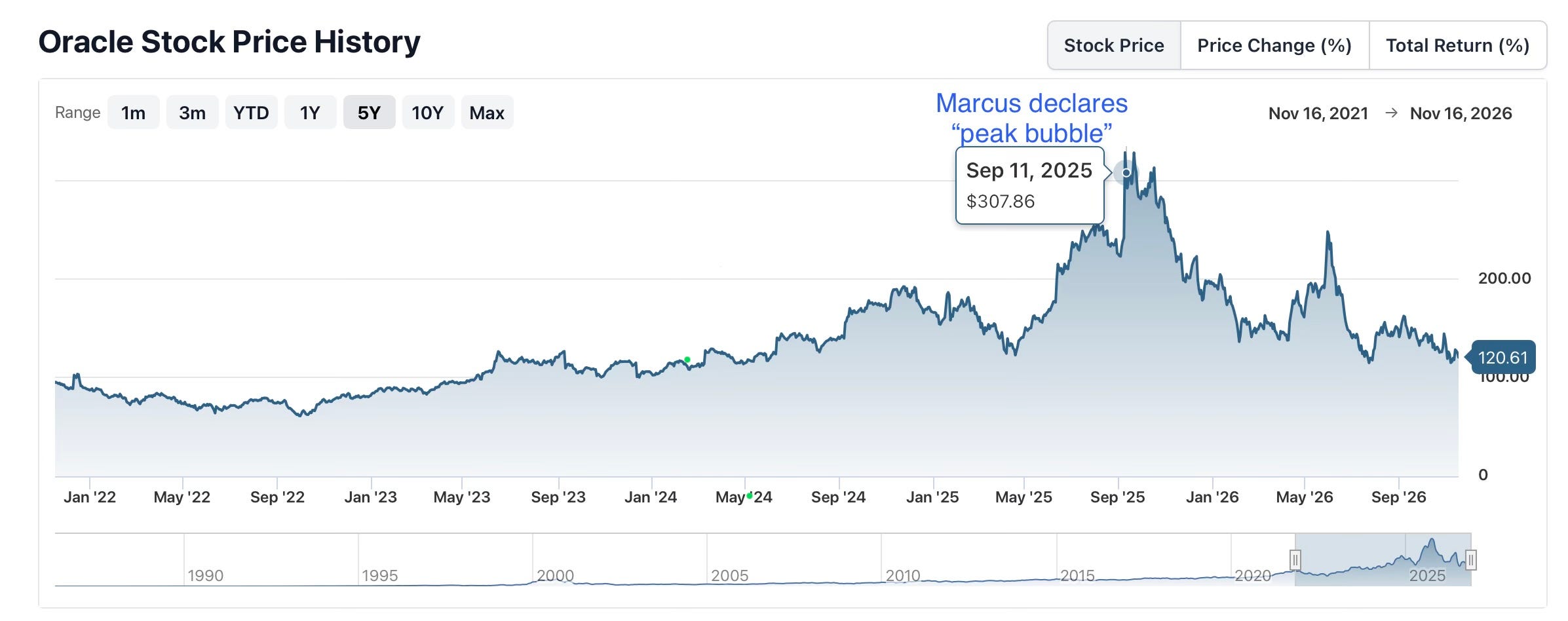
Tech stocks continued to fall sharply, extending a rout from the previous week, according to Gary Marcus's account. Oracle has dropped roughly 61% since Marcus declared the excitement around its OpenAI deal "peak bubble" last September. Ben Thompson of Stratechery published what Marcus describes as an "obituary" for the AI trade, writing that the demise of Jensen Huang ended many things, including Nvidia's long-term prospects, the AI bubble and the way the U.S. viewed itself in the world.
A central claim in the piece is that Nvidia, which had effectively acted as the bank financing much of the AI buildout, is unlikely to keep doing so. Marcus cites a Wall Street Journal article from the day before headlined to the effect that Nvidia's days as an open checkbook for the AI economy are numbered. According to that report, interim CEO Colette Kress is expected to rein in deals after a stretch in which Nvidia aggressively financed computing deals and startup investments. The piece also quotes Dave Troy criticizing Huang's management style as resembling an all-in trader with no risk mitigation, and says the opening phases of a collapse are sending shockwaves through the industry.
Marcus's longer-running argument is that large language model companies still lack a technical moat and are struggling to be profitable, a point he says he first made in 2023 and which he maintains still holds. His reasoning: Nvidia cannot sustain phenomenal growth indefinitely if the companies buying its chips are not making profits from them, and mostly they were not. He also cites hints in recent days of questionable activity in Asia that may have made conditions look better than they were, and notes that with circular financing it was always hard to tell what was really happening.
For developers and product teams, the practical read is about financing conditions rather than model capability. A likely trade-off is that if Nvidia restricts the deals and investments that helped capital-poor AI companies afford compute, access to capacity could become more tightly tied to a buyer's own balance sheet rather than to vendor financing. That is inference, not something the source states. Nvidia's compute has been the default substrate for most frontier training and inference, so any shift in how it is financed can ripple into cloud pricing and the pace at which smaller labs scale.
The piece also attributes part of the shift to politics, saying the midterms contributed and that the free pass AI companies enjoyed in the first half of the Trump era is over. That framing is Marcus's interpretation of the market mood rather than a measured result.
The open question he raises is whether any of this affects Thursday's planned IPO for Anthropic, or whether investors simply move to the next fad the way they moved from crypto to NFTs to generative AI. He argues the financial fundamentals do not justify the hoped-for valuation once liabilities are factored in, and that selling a deeply speculative IPO during what looks like an AI stock crash will not be easy. He says he cannot judge whether enough optimistic buyers exist.
Why it matters: If the selloff and Nvidia's expected pullback in dealmaking persist, teams building on frontier models may face tighter compute budgets and more selective vendors, and a marquee AI IPO becomes a live test of investor appetite. My inference is that the near-term signal to watch is Anthropic's offering and any change in Nvidia's investment posture, since both would shape how much capital flows to model builders.
Based on reporting from the original publisher. Visit the source for full context and later updates.
Publisher excerpt
Looks like the bubble has finally popped