Building agents that transact with Anchor Browser and AgentCore payments
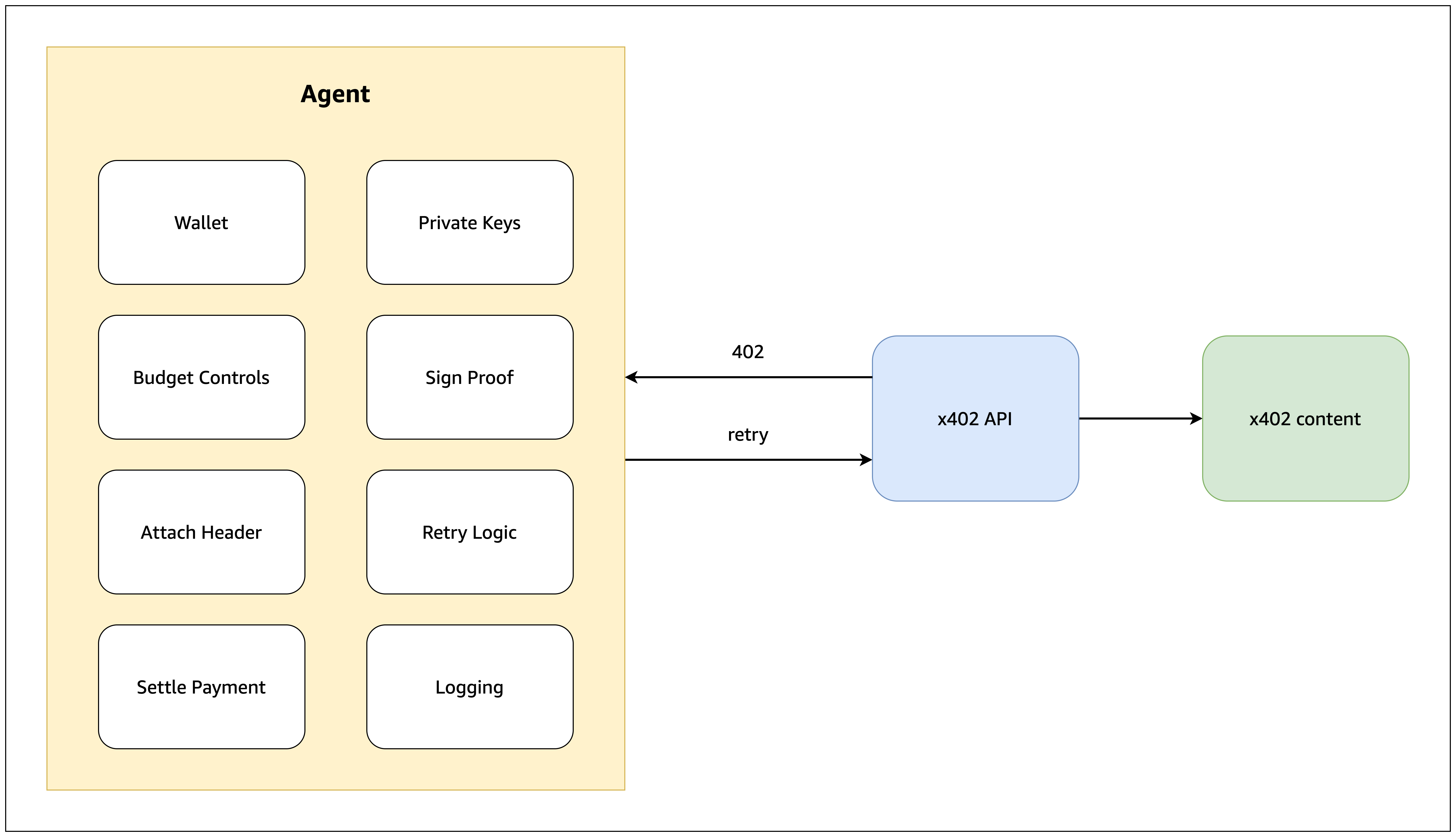
Anchor Browser has integrated its Agentic Payments capability with Amazon Bedrock AgentCore payments, giving AI agents a way to satisfy the HTTP 402 Payment Required responses that per-request web resources return. The integration was developed in collaboration with the AWS Generative AI Innovation Center Partner Agent Factory and is now listed on AWS Marketplace. The setup required from a developer is deliberately small: set the session property session.x402 to true when creating an Anchor Browser session, and the managed browser handles the rest. The property defaults to false.
Anchor Browser is a cloud-based browser automation service built for AI agents. Each session runs in a managed browser environment that keeps authentication state, handles navigation, captures network requests, and offers a live view of page interactions. AgentCore provides tooling to build, connect and optimize agents at scale, and its payments capability is a fully managed service that agents use to discover, access and pay for APIs, Model Context Protocol servers, and web content. Payment processing runs over x402, an open standard for HTTP-based machine-to-machine payments in which a server answers with 402 along with the amount owed, accepted payment methods, and a payment address.
The problem being solved is concrete. When an agent fetches a premium research report or calls a metered data enrichment API, the merchant returns 402. Without a payment mechanism the autonomous workflow stalls and a human has to step in. Anchor Browser and AWS frame the alternative as developers having to build the entire payment stack themselves, spanning four areas: parsing the 402 challenge and constructing a correctly formatted payment header across multiple schemes (exact, upto, and protocol variants) while staying compatible with merchant implementations that differ in challenge format, stablecoin support, and settlement timing; storing a private key securely in an environment that also handles untrusted web content, plus wallet lifecycle work such as key rotation and provider failover; resubmitting the original request with payment attached while preserving session state, cookies and context, with idempotency and per-session and per-transaction spend limits tracked across concurrent runs; and logging every attempt, approval, denial and settlement for compliance and reconciliation.
The security argument follows from that. Budget controls located in application code can be defeated by a bug, a retry loop, prompt injection or an accidental access, and an agent looping on a paid endpoint keeps authorizing payments until someone intervenes. Private keys living in the agent runtime share an environment with third-party tools and untrusted pages. If the signing infrastructure is reachable from that runtime, an attacker can attempt to reach the key or redirect payments. The stated mitigation is that the key should never enter the runtime. Browser agents add one more constraint: the payment has to happen inside the same browser session, or recorded sessions and the live view stop matching what actually executed.
AgentCore payments moves that stack into managed infrastructure. Its top-level resource is the Payment Manager, which coordinates payment operations for an AWS account and is created by specifying an authorizer type and an IAM role; AgentCore then provisions a workload identity in Amazon Bedrock AgentCore Identity. A PaymentConnector links the Payment Manager to an external wallet provider, either Coinbase Developer Platform or Stripe Privy. A PaymentCredentialProvider stores wallet provider credentials in AgentCore Identity, and a PaymentInstrument identifies the wallet address funds are drawn from. Anchor Browser sets up wallets through a supported provider without putting secrets or private keys in the agent runtime. For discovery, a curated Coinbase x402 Bazaar MCP server is available through Amazon Bedrock AgentCore Gateway so agents can find pay-per-use x402 endpoints programmatically. In the resulting architecture the agent holds only a budget session and an x402 tool; authentication, wallet secrets, payment limits, observability and proof signing sit in the managed layer.
The end-to-end flow runs as follows. When a session starts with x402 enabled, Anchor Browser provisions a dedicated AgentCore PaymentSession tied to a payment instrument and budget. The agent navigates or issues a fetch or XHR request, and the merchant replies with a 402 challenge. Anchor Browser reads the payload and matches the requested method against the linked instrument; AgentCore checks the amount against the session spending limit, signs with the configured wallet provider and returns a cryptographic proof, with no key material entering the browser or agent runtime. The browser attaches the proof as PAYMENT-SIGNATURE for x402 v2 or X-PAYMENT for x402 v1 and retries the original request exactly once. The merchant verifies, settles on-chain, and serves the resource, and the agent continues. Wallet credentials stay with AgentCore and the wallet provider throughout.
Failures degrade to standard HTTP behavior rather than silent errors. If the merchant response is malformed, no compatible network is offered, the budget is exhausted, or AgentCore rejects the payment, the browser returns the original 402 to the page unchanged so automation code can treat it as an ordinary HTTP error. Each payment-ready session operates within configured spending and time constraints, with specifics deferred to Anchor Browser's technical documentation. The x402 property covers third-party resources only; it does not replace Anchor credits or pay for the browser session itself.
Developer-facing surface area is minimal. A cURL call or JavaScript fetch creates a session with the x402 flag set, and automation connects over Chrome DevTools Protocol. Existing Playwright, Puppeteer and CDP workflows need no changes, and no wallet key or payment header appears in automation code. The same holds for paid APIs expecting POST or PUT: a built-in x402 tool handles signing and retry, and the response arrives as if the endpoint were free. The tool is not tied to a particular vendor, model or framework.
In practice, the design mirrors how managed identity and secret stores have taken credentials out of application code, applied to money rather than tokens. The most consequential claims to test are the budget enforcement boundary, the single-retry rule, and idempotency under concurrent sessions, since those determine whether a runaway agent can overspend. Buyers also inherit a dependency on the chosen wallet provider, today Coinbase CDP or Stripe Privy, so provider choice and failover behavior are worth examining before production use.
Anchor Browser says third-party x402 charges settle in credits on the same invoice as browser session time, avoiding separate crypto custody, USDC balance monitoring, and on-chain reconciliation for finance teams. Payment audit trails are exposed through AgentCore Observability in Amazon CloudWatch.
Why it matters: teams building browser agents that touch metered or paywalled resources can now let those agents complete paid steps without writing wallet, signing, retry and audit code, since payment becomes a session-level capability beneath existing Playwright, Puppeteer or CDP tooling. The trade-off is architectural: spending authority and key custody move to AWS-managed infrastructure and the chosen wallet provider, which simplifies compliance and key safety but ties agent budgets to that stack and its configured limits. For product teams, the practical near-term change is that per-request pricing stops being an automatic stopping point for automated workflows, provided budgets and settlement behavior are validated before scaling.
Based on reporting from the original publisher. Visit the source for full context and later updates.
Publisher excerpt
Learn how the AWS Generative AI Innovation Center Partner Agent Factory and Anchor Browser built AI agents that autonomously pay for x402-protected web resources and APIs. Amazon Bedrock AgentCore payments checks budgets, signs transactions, and retries requests without exposing wallet credentials to the agent runtime.