How Bayer Crop Science built an agentic decision engine on Amazon Bedrock AgentCore with AWS Unified Operations
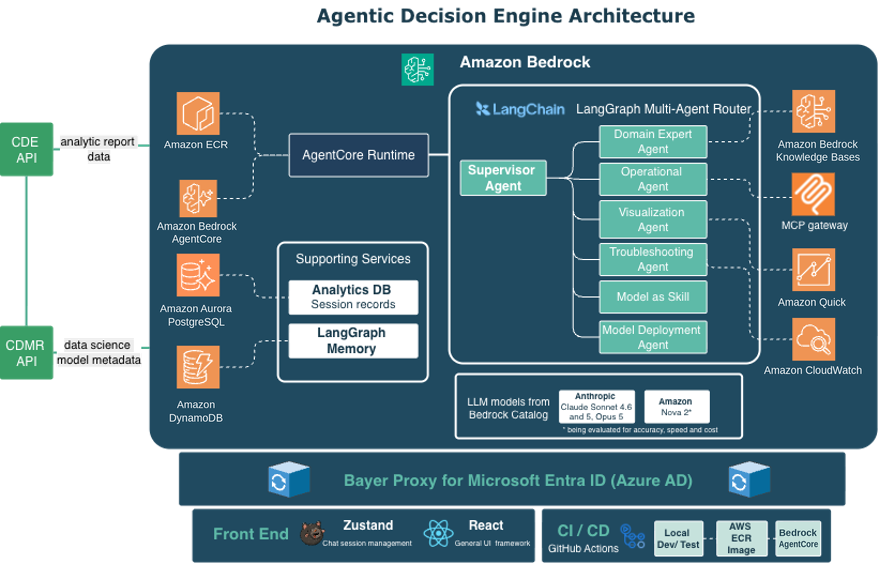
Bayer Crop Science has described how it built the Agentic Decision Engine (ADE), a multi-agent natural language interface layered on top of its existing Connected Decision Engine (CDE), and is running it in production on Amazon Bedrock AgentCore with support from AWS Unified Operations. CDE is the older system: it deploys, orchestrates, monitors and reuses machine learning workflows across genomics, field trials, imagery and environmental data, and holds more than 500 model configurations. As adoption grew, the article says the hard part stopped being running a workflow and became explaining one, since answers were scattered across APIs, documentation, metadata stores, dashboards and logs.
ADE addresses that by putting a supervisor agent in front of a set of specialists. The supervisor classifies a question, picks the right specialist, and merges results when a question crosses domains. In its first phase it resolves roughly 80 percent of user questions without an engineer in the loop. Fewer than two dozen specialist agents are in production — 22 — each scoped to one domain with its own tools and data sources. The Domain Expert Agent answers conceptual questions through retrieval-augmented generation; the Operational Agent pulls live workflow status and results from CDE; the Troubleshooting Agent reads operational telemetry; the Visualization Agent produces charts or hands back an existing dashboard. A named "Models as Skill" pattern turns a model's code and documentation into skill definitions in a central registry, so agents answer questions about a model from its actual implementation rather than general knowledge.
The benefit is easiest to see in a concrete flow. When a breeder asks why a phenotyping workflow failed the previous day, the supervisor routes to the Troubleshooting Agent, which reads the workflow's telemetry in CloudWatch and its status from the CDE API through AgentCore Gateway, locates the failure and returns a diagnosis. The article reports that a diagnosis which used to take over an hour of manual log-hunting plus waiting for engineering support now takes under ten minutes.
The architecture has four layers: a React front end behind an identity proxy for Microsoft Entra ID, the orchestration layer, the specialist agents, and the tools and data they call. GitHub Actions builds the agent images, pushes them to Amazon ECR and deploys to AgentCore runtime. Because the runtime is framework-agnostic, Bayer runs its own LangGraph orchestration on it — chosen for explicit graph-based control flow and checkpointing. State is split by responsibility: DynamoDB holds LangGraph checkpoints, Aurora PostgreSQL holds session records, feedback and analytics, ElastiCache caches responses with a TTL, S3-hosted domain content is embedded with Amazon Titan Text Embeddings V2 and indexed in OpenSearch Serverless for RAG, and CloudWatch captures telemetry.
Five design decisions stand out. First, the team treats the runtime session as execution context rather than durable storage, writing LangGraph checkpoints to DynamoDB so a graph can resume after scale-out, restarts or session boundaries. Second, identity is split across trust boundaries instead of one token being reused everywhere: Entra ID for user identity, IAM for service-to-service calls, AgentCore Gateway outbound authorization for downstream CDE services, and a request interceptor Lambda for custom validation and passing the attributes tools need. Third, model choice is treated as an interface contract; the team evaluated a newer model version with reasoning enabled, found its combination of tool use and structured output incompatible with how the agents were implemented, and kept the current model for the release. Fourth, the tool surface is controlled before it reaches the prompt: rather than a dedicated MCP server per API across CDE's 500-plus configurations, Bayer registers OpenAPI specifications with AgentCore Gateway, which exposes REST operations as MCP tools, turning an API change into a schema and gateway configuration change. Tools are scoped per specialist agent, and AgentCore Gateway's semantic tool search is available for larger catalogs. Fifth, capabilities graduate from tool to agent when they start owning state, retries or presentation logic — visualization began as a tool and became an agent that renders charts with matplotlib and Plotly in AgentCore Code Interpreter and exchanges data through S3, or returns an existing Amazon Quick or Power BI asset.
Production readiness focused on operability. Bayer found that exception handlers were catching agent errors and returning responses that monitoring counted as successes, so the team added custom CloudWatch metrics inside failure paths and alarms on tool call errors, throttling, model timeouts and structured output validation failures, with traces and invocation logs following requests across supervisor and specialists. For cost, the team combined Bedrock application inference profiles, request metadata with model invocation logging, and IAM principal attribution to estimate cost per interaction and find expensive agents. The Visualization and Operational agents, heavy on MCP tool calls, consumed the most tokens. The same telemetry revealed a workload with a large repeated input prefix and no prompt cache activity; caching the stable prefix cut input-token cost by 20 to 30 percent. IAM roles are scoped per agent, so the Troubleshooting Agent can read operational data but not modify workflows, and the Domain Expert Agent cannot call unrelated CDE APIs. Bayer plans to evaluate Amazon Bedrock Guardrails as an added layer over its existing controls.
Before launch, AWS Unified Operations ran a Critical Workload Review and a Well-Architected review with the Generative AI Lens. Findings included gaps in failure visibility, mutable container image tags, limited image traceability and missing vulnerability scanning; the response was stronger alarms, immutable versioned images, scan on push in ECR and lifecycle policies. Load testing validated quotas and exposed a networking failure mode that returned empty responses, fixed before launch, and 35 blockers were tracked to resolution. ADE launched to a gated group, and more than 100 users across Bayer Crop Science have used it. Alongside the 22 agents it exposes about 20 API tools and can host third-party agents. Exposing APIs through AgentCore Gateway rather than a server per API cut per-API integration overhead by more than 99 percent. Critical CloudWatch alarms are onboarded to AWS Incident Detection and Response, where engineers engage within 5 minutes, and AWS Security Incident Response supports security events. Bayer's next focus is hybrid cloud agent interoperability — letting agents in different environments discover and communicate without manual configuration.
This is a useful case study for teams building internal agent systems, because most of the reported effort sits outside prompts: durable state, identity hops, tool scoping, task-level observability and cost attribution. A likely trade-off in the supervisor pattern is latency and token cost, since one question fans out into several model and tool calls; Bayer's own token data points at the tool-heavy agents as the biggest consumers, and prompt caching as the main lever found. The identity guidance is worth noting for anyone wiring agents into enterprise SSO: the failure modes cluster where user, agent and tool identities meet, so each hop needs its own issuer, audience, scopes and credential lifetime rather than a borrowed token.
Why it matters: Teams building agents over existing internal platforms will recognize the second-order problem here — once workflows run reliably, the bottleneck becomes explaining them, and a supervisor-plus-specialists design with scoped tools is one answer that has survived contact with production. The operational lessons, especially distinguishing transport success from task success and attributing token spend per agent, are likely to apply well beyond Bayer, though the 80 percent resolution rate is a first-phase figure with an engineer still handling the remainder (inference). Product teams weighing a multi-agent build should also note that the reported gains came from groundwork — checkpointing, identity boundaries, gateway-mediated APIs — rather than from prompt engineering.
Based on reporting from the original publisher. Visit the source for full context and later updates.
Publisher excerpt
Bayer Crop Science built the Agentic Decision Engine (ADE), a multi-agent platform on Amazon Bedrock AgentCore that lets breeders, analysts, and researchers ask natural language questions about their analytics platform. This post covers the ADE architecture, five design decisions, and how the team prepared it for production with AWS Unified Operations.