Put Gemini to work for you
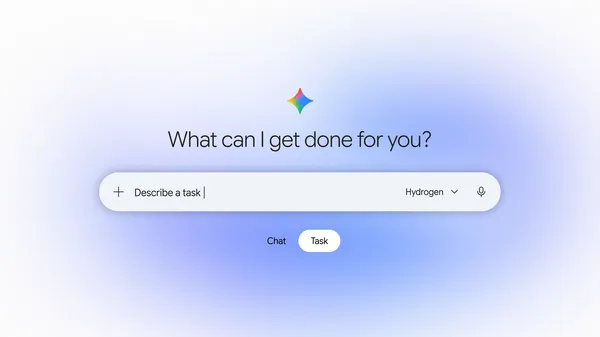
Google announced a shift in the Gemini app from answering questions to completing chores. In a post attributed to Josh Woodward, Vice President of Labs, Gemini app, and AI Studio, the company said users can now hand off tasks such as scheduling appointments, analyzing utility bills, managing grocery lists and buying items through integrated services. The rollout is free of charge for what Google describes as hundreds of millions of people in the U.S., Japan, Korea, Canada, Australia and India, and it runs on a new model the post calls Gemini 4 Hydrogen. A set of advanced features is rolling out starting in the U.S.
Access is through a toggle on the app's home screen that switches from Chat to Task. In the U.S., users can also text Gemini on Android or iOS after enabling it under Settings, then Channels, then "Set up" under Text with Gemini with phone-number verification, or forward emails to gemini@google.com. The assistant draws on the user's existing Google data, including email, calendar, passwords, photos, files and payment cards, so the information does not have to be sent to third parties.
The examples Google gives are concrete. In one, a user asks Gemini to call the two nearest dealerships and find an early Friday morning service appointment within about a month. Because it already knows the vehicle and home location through a feature called Personal Intelligence, it found nearby shops on Google Maps and called both at once, waited through hold music, booked a slot at a dealership that takes appointments, and placed it on the calendar in under five minutes. Gemini identifies itself as an AI on the call, businesses can opt out, and it withholds payment or private account details unless told otherwise.
A second example involves a $389 electricity bill. With permission granted through a new Google Password Manager integration, Gemini analyzed past statements in email and traced the spike to a heat pump running around 4 p.m., during peak pricing. A third covers shopping: asked for USB-C charger options, Gemini compared products using Google's Shopping Graph, asked follow-up questions on wattage and color, checked out through a new Google Pay integration, and found a discount code worth an extra $10. A fourth has a user texting Gemini over a new RCS integration to add items to an Instacart order, including a photo of an empty cereal box, with Gemini handing off to Instacart to finish checkout. Gemini connects with more than 60 apps today, and developers can apply to join a Connected Apps Platform.
Payments run on the Agent Payments Protocol (AP2). Google says it is working with American Express (coming soon), Mastercard and Visa on digital tokens for supported cards, and that users keep card points, cashback and purchase protections at checkout. A hard spending cap can be set in advance, with Gemini designed to stay within it, and receipts and tracking information land in Google Wallet, which is expanding to iOS. Google also plans to integrate the Universal Commerce Protocol (UCP) for faster shopping from discovery to checkout.
On security, tasks execute in a hardware-isolated virtual machine on Google Cloud's Agent Compute Engine, dedicated to a single account and never shared, with each machine sandboxed and regularly tested by security red teams. Google describes further layers including prompt-injection filters that scan search results and webpages, plus Safe Browsing to limit which links Gemini can open. Users can interject mid-task, and Gemini is designed to pause for confirmation or pre-approval before critical steps such as clicking "Buy," and to ask clarifying questions when instructions are ambiguous. Routine actions can be set to "Always allow." Task settings can be adjusted, Google and third-party apps disconnected, and chat history deleted. Google is also inviting researchers into its AI Vulnerability Reward Program for agentic systems.
Google acknowledges the system is imperfect. Tasks may fail or miss the mark, and users are asked to flag those with a thumbs-down. On some sites Gemini may complete most of a flow and then hand control back for the final click, a reflection of the web still adapting to assistants that browse on a user's behalf. Google says it is working with major websites and security providers on standards for agents, arguing that the old default of blocking bots needs a more nuanced approach for personal assistants.
This suggests the interesting variable is not raw model quality but how much authority users grant an agent over accounts, calendars and money. The design leans on spend caps, confirmation gates and account-isolated virtual machines to make delegation tolerable, and the opt-out for businesses plus self-identification on calls addresses the most visible friction points. A likely trade-off is that heavy confirmation prompts blunt the promised time savings, which is why granular "Always allow" settings matter as much as the underlying model. Coverage remains uneven: the free tier spans six countries, but advanced features start in the U.S., and site-by-site handoffs mean the experience will vary.
Why it matters: Developers building assistants or commerce flows now have a concrete reference for how Google is sequencing agent capabilities, payment tokens, app connections and sandboxed execution, and its Connected Apps Platform is an open door for integrations. Product teams that manage accounts, subscriptions or checkout pages should assume more agent traffic arriving with disclosed AI identity and expect to decide whether to support or block it. The spending-cap and confirmation model, if it holds up, sets an expectation users may carry to competing assistants.
Based on reporting from the original publisher. Visit the source for full context and later updates.
Publisher excerpt
A user interface displaying the prompt "What can I get done for you?" above an input box containing placeholder text "Describe a task". Tasks in Gemini is now free of charge in six countries, with new features starting in the U.S. and deeper Google Workspace integration to get things done on your behalf.