The five components of building a "company harness"
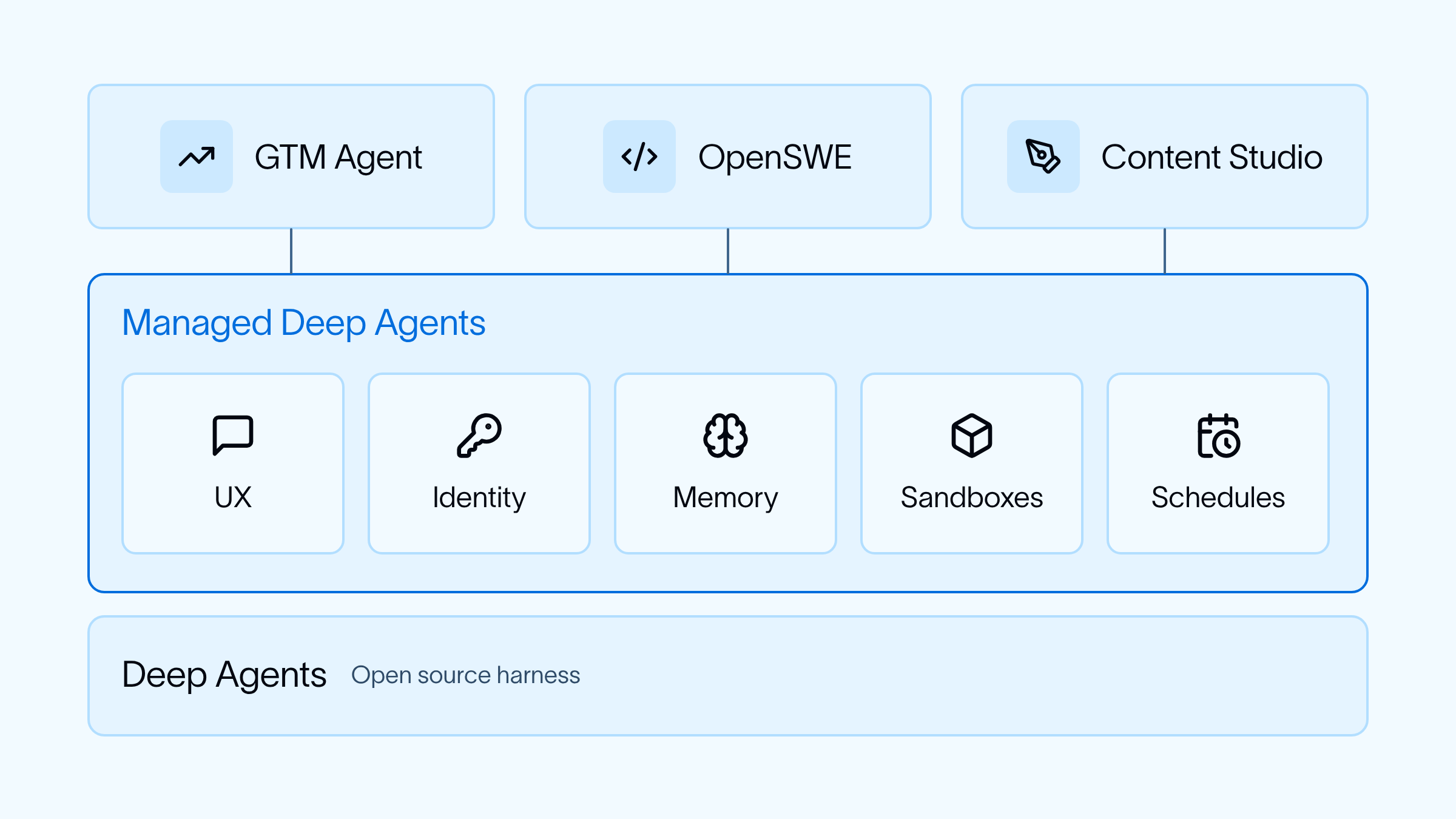
LangChain published an account of how it built internal agents for its marketing, sales and engineering teams, framed as a general recipe for what it calls a "company harness." The post says the company's three main agents — GTM Agent, OpenSWE and Content Studio — are all constructed the same way, and that all three run on Managed Deep Agents, a product layer built on top of the open source Deep Agents harness. Managed Deep Agents supplies infrastructure for channels, scheduled jobs, sandboxes, memory and identity; teams customize behavior on top. The write-up credits @caspar_br for help.
The three agents cover distinct jobs. GTM Agent is described as proactive and always on: it monitors and answers email, handles new qualified leads, sends daily briefs, answers questions about accounts and can run outbound motions. OpenSWE is the engineering agent, able to work on and draft pull requests and also to run code review across all PRs. Content Studio drafts marketing assets — blogs, images, PowerPoint decks and videos — in the company's style and with awareness of its positioning.
The first primitive is placement: agents live where people already work, which for LangChain means Slack. Each has its own Slack app and can be direct-messaged or tagged in a channel. Working in channels has a side benefit in that colleagues can watch how others use the agents. The team also built a "breakout" feature so that when a good human conversation is underway and someone wants the agent's input, the agent can move into its own thread in the channel instead of cluttering the discussion. Not everything belongs in Slack: reviewing a large backlog of emails the GTM Agent proposes to send was unpleasant to track through Slack messages, so the team built a custom UI for that workflow.
Identity is described as the thorniest problem: when an agent acts, whose authority does it use? The post lays out two common industry patterns — on-behalf-of, where the agent acts as the invoking user, and fixed credentials, where a single service account is used regardless of who asked. LangChain mixes them per tool. OpenSWE acts on behalf of the person who messages it, so PRs carry that person's GitHub handle, but acts under its own identity (a GitHub app) when running in the background as a reviewer. GTM Agent uses fixed credentials for tools like Salesforce so individuals need not log in, but uses on-behalf-of identity for email — and those email tools are available only in direct messages, not in shared channels. Content Studio acts on behalf of the invoker for tools like Notion, while some tools such as Twitter use fixed credentials for the company account, with a whitelist controlling who can do what; not everyone can post, though some may read or draft.
The second pillar, memory, has two tiers: global memory that applies to every user and user-level memory scoped to one person. The agents themselves choose which facts to store at which level. The post calls this the least explored area and says there is substantial work still planned. In practice, the split matters because a wrong default is costly in both directions: facts kept globally can leak one team's assumptions into another's answers, while facts kept only per user force repetition and make shared context invisible.
All three agents can write and execute code. They run outside the sandbox, connect to it and execute there, each with a slightly different base image and dependencies. OpenSWE, the most coding-oriented, selects a base image depending on the channel or user. They also use the secret proxy in LangSmith Sandboxes so an agent can reach services from inside the sandbox without handling raw credentials directly. A likely trade-off is that differentiated images and per-context selection add setup and maintenance overhead, but they keep each agent's tooling close to the task at hand.
The final primitive is scheduling: a large share of runs are started by schedules or background events rather than a person. Some schedules are configured by the agent's developer — OpenSWE listens for new PRs and reviews them on creation — while others are created by the agent at a user's request. The post gives the example of asking GTM Agent for a daily brief, after which it created its own cron job. Ambient behavior of this kind shifts agents from tools you call to services that act while you are away, which raises questions the post does not settle, such as how scheduled output is surfaced and how much autonomy background runs should have.
Why it matters: Teams building internal agents now have a concrete reference for the plumbing that usually gets discovered late — where the agent lives, whose identity it borrows per tool, how memory is scoped, how code runs safely, and how much work happens without a prompt. The most transferable lesson is per-tool identity: mixing on-behalf-of access with fixed service accounts, and restricting sensitive tools to direct messages, is a pattern product teams can copy as they connect agents to email, CRM and social accounts. Expect the memory tiering LangChain flags as immature to be the area where most teams, by inference, will need to build their own conventions before agents behave consistently across a company.
Based on reporting from the original publisher. Visit the source for full context and later updates.
Publisher excerpt
Learn how LangChain built internal agents across marketing, sales, and engineering, and how they have completely changed how those teams work.