How Rescale built an AI triage agent with Strands Agents and AI-DLC
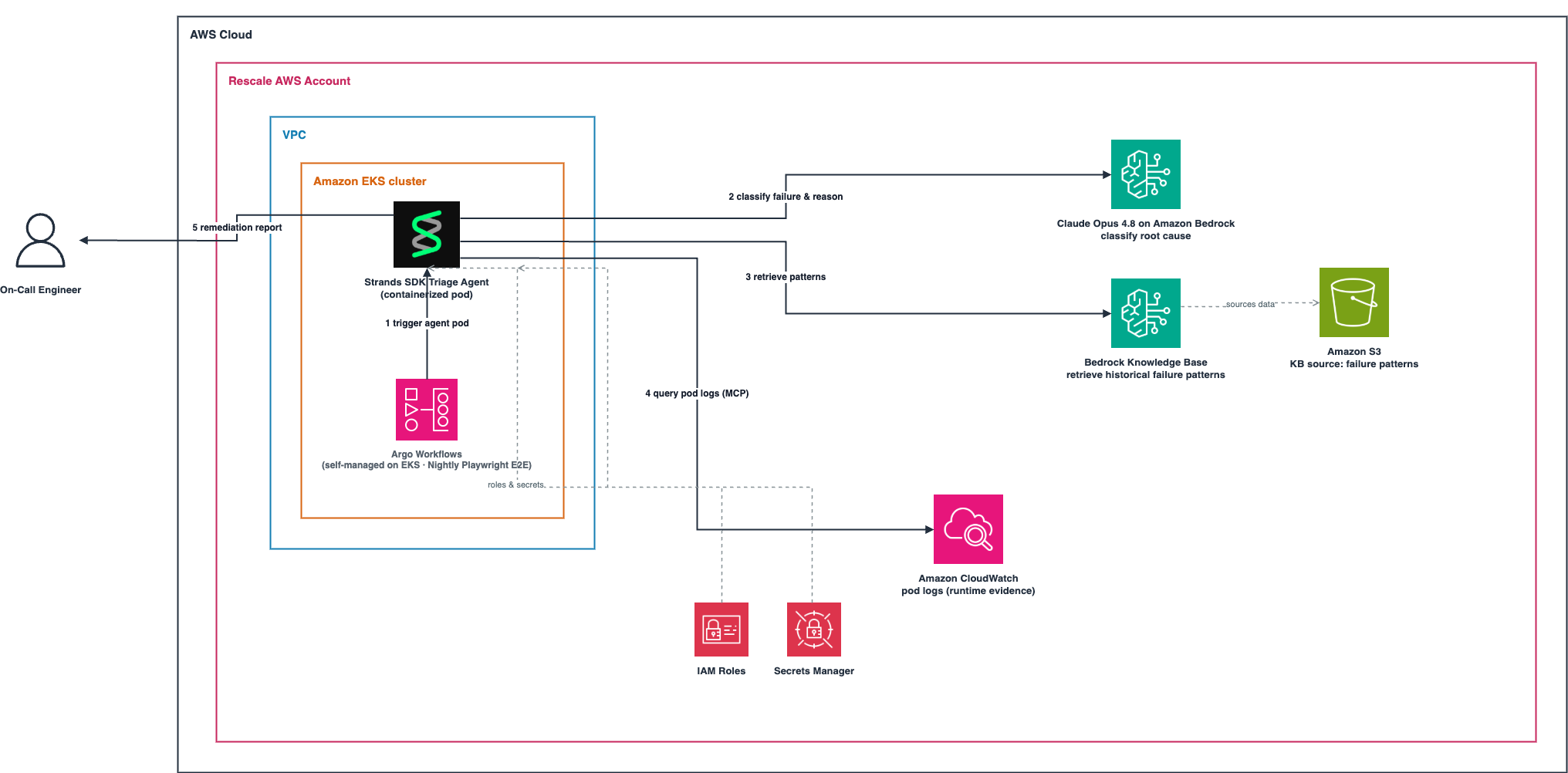
Rescale, which sells a digital engineering platform for HPC and simulation workloads, built an agent that classifies and routes failures from its nightly end-to-end test suite. The work was done with AWS architects in a five-day in-person workshop using the AI-Driven Development Lifecycle (AI-DLC), an open source, AI-centric development methodology. According to the AWS Machine Learning Blog post describing the build, the team reached a staging deployment by the end of day five and had the agent in production within weeks. The agent has been running in production since the workshop.
The problem it addresses is familiar on-call overhead. Rescale runs hundreds of Playwright test cases nightly, and because passing end-to-end tests gate weekly production releases, unresolved failures sit directly in the path of shipping. Each failure previously required an engineer to pull logs, gather evidence from several logging and monitoring systems and repositories, classify the root cause, and route it to an owning team. At the scale of distributed services across dozens of repositories, that first-pass triage consumed a meaningful share of the on-call rotation and could pull multiple teams into hours of coordination before a deployment could proceed.
The agent runs as a step in Rescale's existing Argo Workflows CI/CD pipeline on Amazon EKS, so no separate runtime was introduced. When the nightly suite produces failures, the pipeline triggers the triage agent pod, which invokes Claude Opus 4.8 on Amazon Bedrock to sort each failure into one of four categories: infrastructure issue, code bug, flaky test, or environment problem. It then pulls relevant historical failure patterns from a knowledge base, queries pod logs through the Model Context Protocol (MCP) for runtime evidence, and writes a structured remediation report naming specific files, functions and recommended fixes. Engineers review that report before anything happens. The workflow completes in seconds and feeds the team's existing reporting pipeline. The agent was built with the Strands SDK, supports concurrent failure analysis, and emits structured output as JSON and HTML.
MCP is worth a note for readers weighing a similar build: it is an open protocol for exposing tools and data sources to a model-driven agent in a uniform way, which is why the team could swap the log backend without reworking the agent. In the early build, log evidence came from a third-party logging service over MCP; the team later moved retrieval to Amazon CloudWatch, simplifying the dependency chain while keeping the same MCP interface. The second pivot was hosting: the agent was first planned for Amazon Bedrock AgentCore and moved to EKS to sit alongside the existing Argo pipeline, which gave a direct trigger path and avoided operating another runtime.
The workshop followed AI-DLC's structure of AI proposing and humans deciding, executed in group "mob" sessions rather than asynchronous handoffs. In the inception phase on days one and two, the team started from a single intent statement about AI-powered test triage and answered more than 20 clarification questions generated by the AI, producing a scoped requirements document that fixed Phase 1 boundaries and deferred Phase 2 items, including automated pull request generation. Five user stories were consolidated into four units of work: the historical failure knowledge base, the triage agent itself, Argo integration, and an evaluation harness.
Construction ran from day two to day four, with interface contracts, data schemas, and functional and non-functional design questions settled and signed off before building proceeded. Effort was matched to complexity rather than applied uniformly: the knowledge base had minimal design and deployed via Terraform in hours, the triage agent received an architecture review, 12 design questions and iterative code review, Argo integration centered on infrastructure contracts and IAM, and the evaluation harness was light on design but heavy on implementation.
Day five covered evaluation and handoff. The team built a PyTest-based evaluation framework with live and stubbed modes and established a classification-agreement baseline. The agent was demoed to Rescale's CTO and VP of Engineering, correctly classifying both an infrastructure failure and a real code bug with file-level fix recommendations. By the end of day five it was live in staging, processing real failures.
In production, classification agreement with human triage has climbed from 44% at initial deployment to 68%, which the team attributes to iterating on its golden dataset and prompt engineering. Time that test failures block production deployment has fallen 20% since the agent went live; because those tests gate weekly releases, the reduction shows up in how fast changes reach production. Engineers also spend less of the rotation on repetitive sorting. A 68% agreement rate is a useful figure for calibrating expectations: this is an assistive first pass whose output engineers still validate, not an autonomous router, and the remaining gap is where human judgment still enters. A likely trade-off of keeping the agent inside the existing EKS cluster is tighter coupling to that infrastructure, though it avoids a new operational surface.
Rescale is extending the method beyond this agent. It is evaluating an internal AI-DLC Center of Excellence to codify practices and help other teams adopt the methodology, and is folding AI-DLC into the standard lifecycle for new engineering simulation products. The approach is also in use for HPC simulation application catalog management, container vulnerability tracking and remediation for government compliance, and workflow-based cloud coding agents. The broader argument in the post is that the durable output was the reviewed specification — clarifying questions, scoped requirements, acceptance criteria — which gave coding agents a narrower problem to solve.
Why it matters: Teams with flaky, high-volume integration suites and weekly release gates are the clearest audience, since the pattern shows a first-pass triage agent can be scoped, built and put in staging inside a week on existing CI infrastructure. The reported 44%-to-68% agreement curve suggests the practical value depends heavily on a curated evaluation set and ongoing prompt tuning, so product and platform teams should budget for that loop rather than treating deployment as the finish line. It also illustrates a lighter-weight path to agent adoption: reuse the cluster and pipeline you already operate, and keep a human in the approval step rather than automating the fix.
Based on reporting from the original publisher. Visit the source for full context and later updates.
Publisher excerpt
Rescale used the AI-Driven Development Lifecycle (AI-DLC) framework on AWS, with Strands Agents and Amazon Bedrock, to build an intelligent test-triage agent in weeks. Learn how AI-DLC structures AI-assisted development and how Rescale is scaling the practice across its engineering organization.